
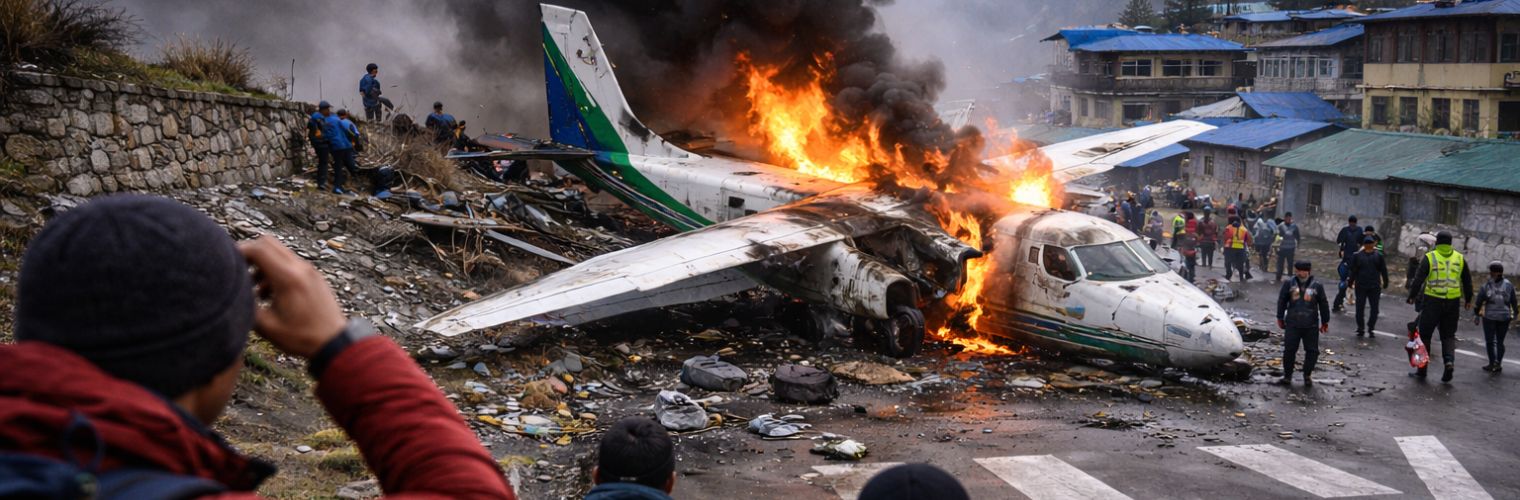
Lukla Airport Crash: What Happened And What Changed
If you trek in the Everest region long enough, someone will eventually ask this question at dinner. “Has there ever been a Lukla airport crash?”
The short answer is yes. But the longer answer matters far more.
Because what most people imagine when they hear about the Lukla airport crash is not how aviation accidents really happen here. There is no chaos, no reckless flying, no thrill seeking. Historically, it happens because Lukla airport is in a tight mountain environment where weather, visibility, timing, and human decisions sometimes line up the wrong way.
And every time that has happened, the system has changed.
Quick Summary
- Crashes at Lukla Airport are rare but well documented and carefully investigated.
- Most past incidents involved weather conditions, limited visibility, and narrow operational margins.
- Each major crash resulted in stricter regulations, improved pilot training, and more conservative decision-making.
- Lukla Airport now operates far more cautiously than it did in its early years.
- Understanding this history helps trekkers see delays and cancellations as safety measures rather than failures.
Have There Been Crashes at Lukla Airport?
Yes. There have been both fatal and non-fatal incidents at Lukla Airport over the decades.
But here is the important framing.
Lukla is not a “dangerous because people ignore rules” airport. It is a high-consequence airport, meaning when conditions deteriorate, the margin for error becomes very small.
That distinction is everything. Most incidents at Lukla share common themes:
- deteriorating visibility
- weather is changing faster than expected
- decisions made close to the limits of what was safe at the time
Understanding those patterns is what actually reduces fear.
Timeline of Notable Lukla Airport Incidents (What Actually Happened)
Instead of throwing dates at you, let’s walk through the major incidents the way we recognize, one by one.
1. 2008: Yeti Airlines Flight 101 (DHC-6 Twin Otter)
This is the accident that shaped Lukla’s global reputation.
What happened
On October 8, 2008, Yeti Airlines Flight 101 attempted to land at Lukla during deteriorating weather. Visibility dropped rapidly near the runway environment. The aircraft impacted terrain during the landing phase.
According to the Aviation Safety Network, 18 of the 19 people on board lost their lives, and only one crew member survived.
Why it happened
The investigation summary and subsequent reporting consistently point to weather and visibility as the dominant factors.
Lukla operates under Visual Flight Rules. That means pilots must be able to see the runway environment clearly. In this case, fog and cloud reduced visual references at a critical moment.
This was not reckless flying. It was a judgment call under rapidly changing conditions, and the margin disappeared.
What changed afterward
After this crash, operational discipline around poor-weather approaches tightened significantly. The event became a reference point for more conservative decision-making at Lukla.
It is because of this accident that cancellations became more common after this period. That is how aviation learns.
2. 2017: Summit Air L-410 (Flight 409, 9N-AKY)
This incident matters because it is one of the most thoroughly documented Lukla accidents.
What happened
On May 27, 2017, a Summit Air L-410 crashed while attempting to land at Lukla. There were fatalities and injuries, documented in the official investigation report.
Why it happened
This is where the record becomes very clear.
The official accident investigation revealed that very low visibility and the inability to visually acquire the runway environment were key contributing factors. In plain language, the pilots could not see what they needed to see, when they needed to see it.
The weather had deteriorated, and the approach became unsafe.
What changed afterward
After this incident, the airport issued formal safety recommendations, which are how aviation improvements are enforced.
Those recommendations fed directly into:
- stricter visibility decision thresholds
- reinforced approach to discipline
- stronger alignment between pilots, operators, and air traffic services
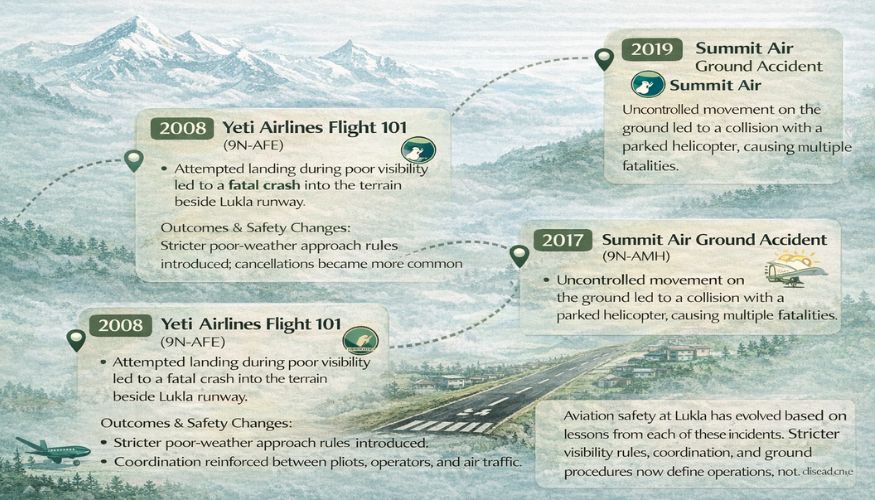
3. 2019: Summit Air L-410 (Ground Incident, 9N-AMH)
This incident surprised many trekkers because it happened on the ground, not in the air.
What happened
In 2019, a Summit Air L-410 was involved in a runway accident at Lukla that resulted in fatalities and injuries, including people on the ground.
Why it matters
Mountain airports do not only carry risk during flight. They also have limited apron space, tight movement areas, and high traffic concentration during peak hours.
This incident reinforced the importance of ground coordination and movement control, especially during busy trekking seasons.
Common Factors Behind Lukla Airport Crashes
When you step back from individual years, a clear pattern appears and they are:
Weather and visibility
Every major Lukla accident record references visibility in some form. Fog, cloud, or rapidly changing weather reduces visual cues in a place where visual references are essential.
This is why Lukla delays flights so often. The system prefers waiting over pushing limits.
Terrain and approach constraints
Lukla sits in steep terrain. Once an approach begins under marginal conditions, options become limited quickly. That is why the approach to decisions here is conservative.
This is also why pilots treat Lukla as a specialized field, not a routine airport.
Human decision-making under pressure
Aviation investigations do not blame individuals. They analyze systems under stress.
At Lukla, pressure can come from:
- weather windows closing
- high traffic volume
- expectations to complete flights
Modern procedures exist specifically to reduce that pressure.
What Safety Changes Were Introduced After These Incidents?
This is where fear usually dissolves. Because Lukla today is not Lukla twenty years ago, and here are the changes that were introduced later on:
Stronger weather decision rules
After repeated visibility-related accidents, poor-weather tolerance narrowed. Flights that might once have been attempted are now routinely cancelled.
Trekkers feel the delay. They do not see the accident that didn’t happen.
More formalized investigation and reporting
Nepal’s aviation safety reporting framework expanded after major incidents. Accident findings now feed directly into procedural updates, not just press coverage.
Conservative operational culture
Today, Lukla’s flying culture is stop-first, go-later. Pilots are not rewarded for “making it through.” They are supported for turning back early.
How Safe Is Lukla Airport Today?
Here is the honest answer we give our trekkers.
Lukla is still serious. But it is not chaotic. It operates under strict visibility rules. Flights are cancelled frequently. Decisions frequently change to apply some caution. And every major accident has led to tighter controls.
That combination does not eliminate risk. It manages it.
Should Trekkers Be Worried?
No. But trekkers should be realistic.
If you expect Lukla to behave like a city airport, you will be stressed. However, if you understand that the weather decides the schedule, you will be calm.
At Eco Nepal Trekkers, we plan itineraries of Everest Base Camp with buffer days for exactly this reason. Not because Lukla is reckless, but because waiting is part of flying safely in the Himalaya.
How Airlines and Pilots Reduce Risk Today
From a trekker’s point of view, this is what safety looks like now:
- Flights only operate when visibility meets requirements.
- Weather deterioration leads to immediate delays or cancellations.
- Accident investigations directly influence operational rules.
- Conservative decisions are normalized, not questioned.
FAQs
When was the very first recorded accident at Lukla Airport?
Early minor incidents date back to the airport’s initial decades, but detailed public records became consistent only later.
Are Lukla airport crashes more common than at other mountain airports?
No confirmed data shows Lukla has a higher accident rate per flight compared to similar mountain airfields.
Do crash investigations involve international aviation authorities?
In serious cases, investigations may involve international standards and external technical advisors.
Were any crashes linked to mechanical failure rather than weather?
Most documented Lukla incidents emphasize visibility and operational context, not engine or structural failure.
Have runway conditions ever caused an accident directly?
Runway length and slope shape risk, but reports usually cite weather and visibility as primary triggers.
Did any Lukla crashes involve foreign airlines?
Commercial operations at Lukla are primarily Nepali domestic airlines, so incidents involve local carriers.
Are accident sites near Lukla accessible to trekkers today?
Some locations are visible from trails, but they are not marked or promoted for visitors.
Has Lukla Airport ever been closed permanently after a crash?
No. Temporary closures occurred, but the airport always reopened after safety reviews.
Do crashes at Lukla affect trekking permits or park access?
No. Aviation incidents do not change trekking permit rules in the Everest region.
Is safety data about Lukla publicly updated every year?
There is no single annual public summary, but incidents are logged through aviation safety databases.