
Manaslu Circuit Trek Permit
The Manaslu Circuit Trek permit is not a single document. It is a set of mandatory permits required to legally enter Nepal’s Manaslu region, which is classified as a restricted and conservation-protected trekking area.
Unlike Everest or Annapurna, Manaslu trekking is regulated through immigration law, conservation policy, and local government authority. This means trekkers must follow fixed rules, including minimum group size, licensed guide requirement, and route-specific permits. Missing even one permit can stop your trek at the first checkpoint.
This guide explains exactly which permits are required, how much they cost, who issues them, and why they exist, using only official rules and ground-level enforcement reality.
Quick Summary
| Item | Status |
| Total permits required (standard circuit) | 4 |
| Total permits with Tsum Valley | 5 |
| A restricted area permit is required | Yes |
| Solo trekking allowed | No |
| Minimum trekkers required | 2 foreign trekkers |
| Licensed guide mandatory | Yes |
| Main issuing authority | Department of Immigration |
| Conservation permit authority | NTNC / ACAP |
| Local permit authority | Chumnubri Rural Municipality |
These permits are mandatory for all trekkers, regardless of experience or fitness level.
Why the Manaslu Circuit Trek Requires Special Permits
The Manaslu Circuit passes through an area officially designated as a restricted trekking region under Nepal’s immigration regulations. This classification is not based on difficulty, but on location and sensitivity.
The upper Manaslu region lies close to the Tibet border, particularly around Samdo. Because of this proximity, the government restricts free movement and monitors all foreign trekkers through a permit and guide-based system. Every trekker is registered, routed, and checked multiple times.
At the same time, Manaslu is a conservation landscape with fragile alpine ecosystems and culturally distinct Nubri and Tsum communities. Controlled tourism helps limit environmental damage and cultural disruption while funding local infrastructure and conservation work.
Why Manaslu is regulated
- Border-sensitive location near Tibet
- Restricted area under immigration law
- Protected conservation landscape
- Cultural protection of Nubri & Tsum communities
- Low-volume, high-control tourism model
How Many Permits Are Required for the Manaslu Circuit Trek?
The number of permits depends on your exact route, not your experience level. For the standard Manaslu Circuit trek, four permits are required in real trekking conditions.
If you add the Tsum Valley side trip, one additional restricted permit is required. Each permit serves a different legal authority, which is why none of them replace each other.
Permit count by route
| Trek Route | Total Permits |
| Standard Manaslu Circuit | 4 permits |
| Manaslu + Tsum Valley | 5 permits |
Detailed Breakdown Of All The Permits Required For Manaslu Circuit Trek
1. Manaslu Restricted Area Permit (MRAP)
The Manaslu Restricted Area Permit is the most important permit for this trek. It is issued under immigration law and controls access to the restricted zone of the Manaslu region.
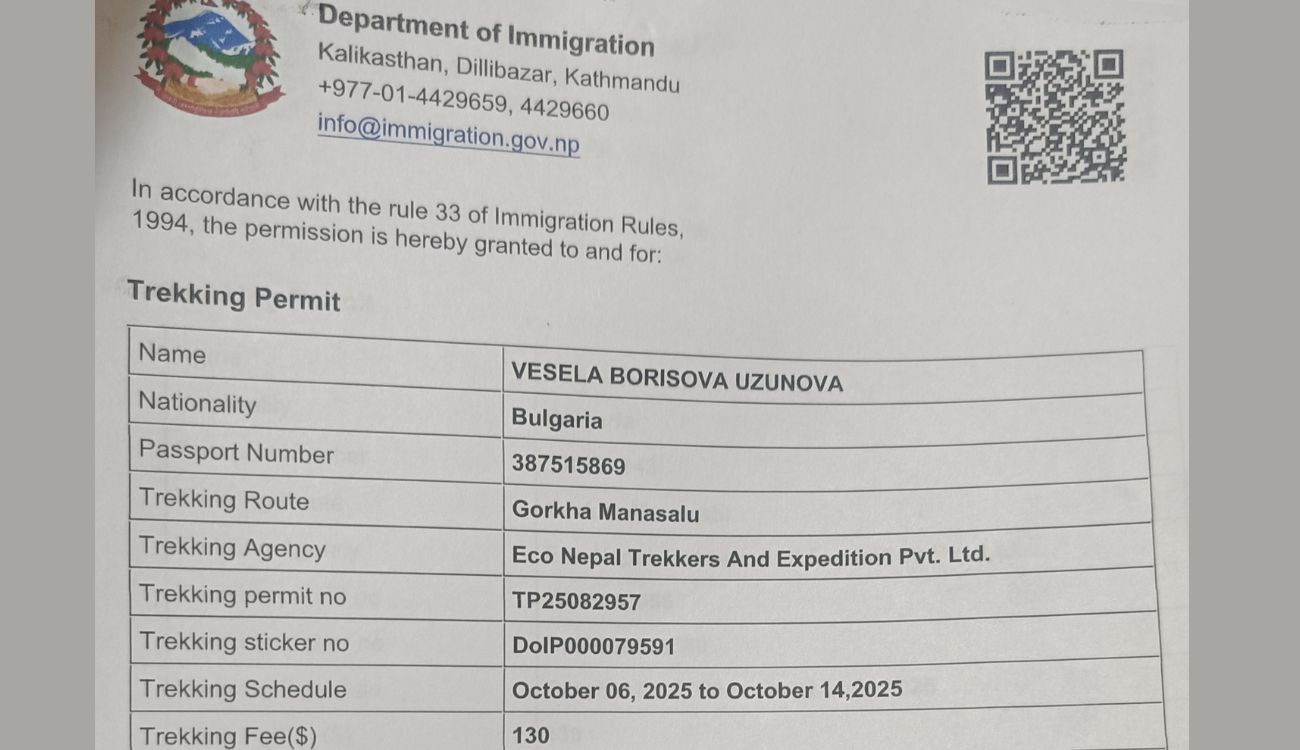
This permit exists because the trekking route passes through a border-sensitive area and cannot be accessed freely. It is date-locked, route-specific, and issued only through registered trekking agencies.
Area covered by MRAP
| Section | Details |
| Entry point | Jagat |
| Exit point | Dharapani |
| Villages covered | Jagat, Deng, Namrung, Lho, Samagaun, Samdo |
| Administrative area | Chumnubri Rural Municipality (Wards 1–4) |
Cost of Manaslu Restricted Area Permit
| Season | Cost (First 7 Days) | Extra Day Cost |
| Sep – Nov | USD 100 | USD 15 / day |
| Dec – Aug | USD 75 | USD 10 / day |
Key rules for MRAP
- Minimum two foreign trekkers
- Solo trekking is not allowed
- Licensed guide mandatory
- Issued only through registered trekking agencies
- Dates and route cannot be changed after issuance
2. Manaslu Conservation Area Permit (MCAP)
The Manaslu Conservation Area Permit is a conservation entry permit, not a restricted permit. It allows access to the Manaslu Conservation Area and supports environmental protection and local development.
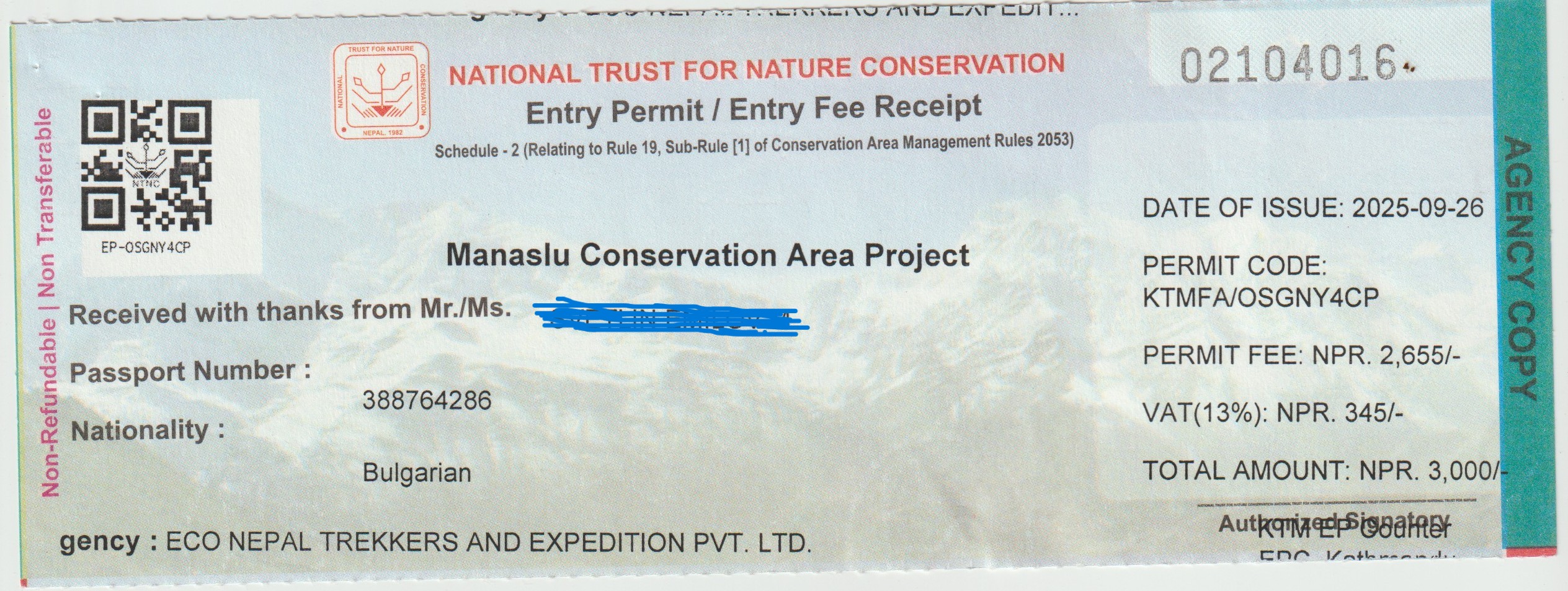
Unlike MRAP, MCAP has no group size rule and no seasonal pricing.
MCAP cost and validity
| Category | Cost | Validity |
| Foreigners | NPR 3,000 | 1 year |
| SAARC nationals | NPR 1,000 | 1 year |
| Nepali citizens | NPR 100 | 1 year |
What MCAP funds
- Trail maintenance
- Wildlife protection
- Waste management
- Community development
- Conservation programs
3. Chumnubri Rural Municipality Permit
This is a local government permit that many trekkers overlook. It is enforced on the ground and collected separately from national permits.
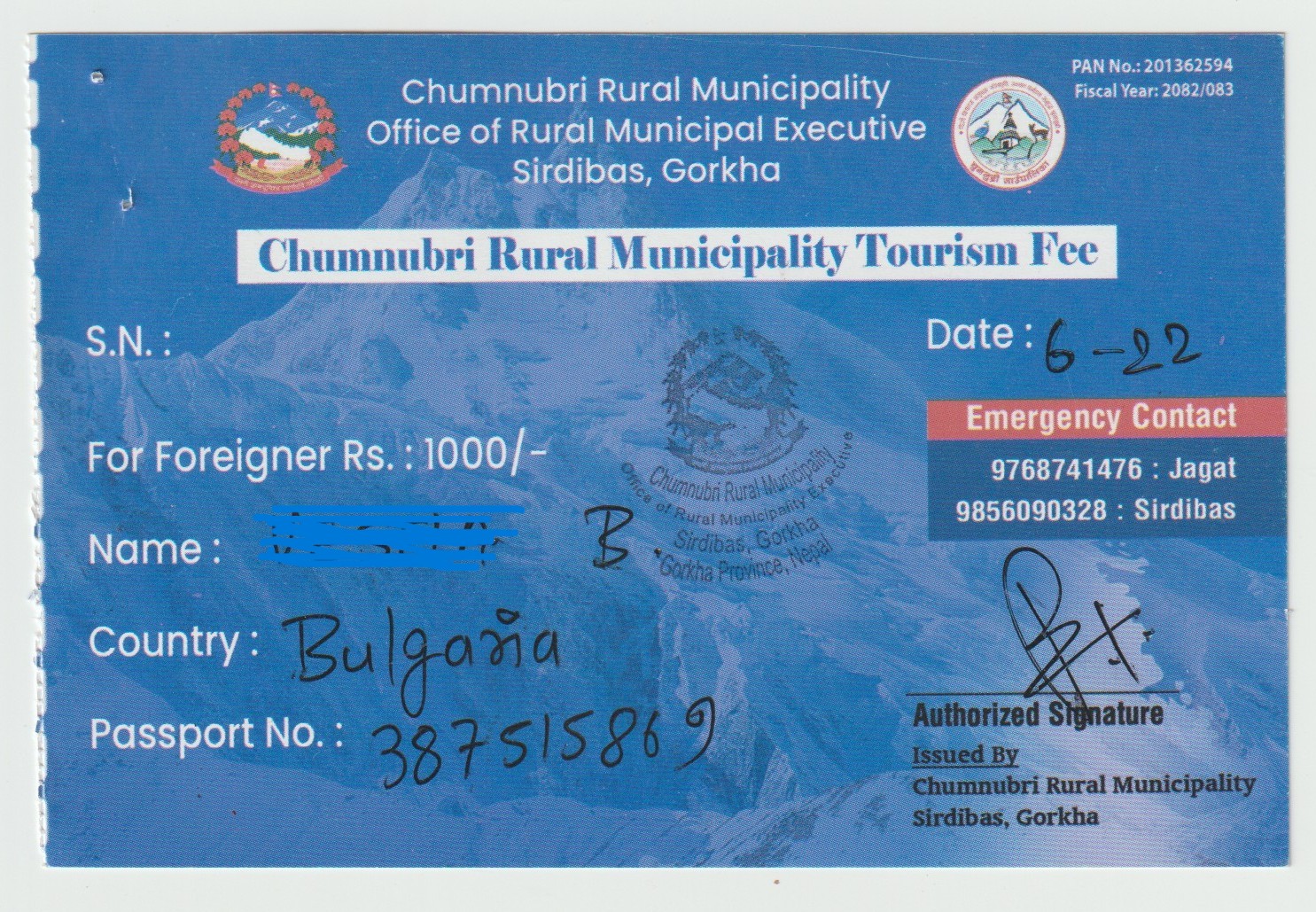
After Nepal’s federal restructuring, local governments gained the authority to collect tourism fees. Chumnubri Rural Municipality applies this permit to trekkers passing through its wards.
Area covered by the Chumnubri permit
| Villages | Included |
| Jagat | Yes |
| Deng | Yes |
| Namrung | Yes |
| Lho | Yes |
| Samagaun | Yes |
| Samdo | Yes |
Chumnubri permit cost
| Season | Total Cost |
| Sep – Nov | USD 10 |
| Dec – Aug | USD 10 |
This permit is usually collected at Jagat and handled by your trekking guide or agency.
4. Tsum Valley Restricted Area Permit (Optional)
This permit is required only if your itinerary includes Manaslu Tsum Valley. It is not included in the standard Manaslu Circuit trek.
Tsum Valley is a separate restricted zone and requires its own permit before the trek starts.
Tsum Valley permit cost
| Season | First 7 Days | Extra Day |
| Sep – Nov | USD 40 | USD 7 / day |
| Dec – Aug | USD 30 | USD 7 / day |
When this permit is required
- Manaslu + Tsum Valley itinerary
- If you have plans of visiting Lokpa, Chumling, Chhekampar, Nile, Mu Gompa
5. Annapurna Conservation Area Permit (ACAP)
ACAP is required when you exit the Manaslu Circuit via Dharapani and continue toward Besisahar, which is the standard completion route.
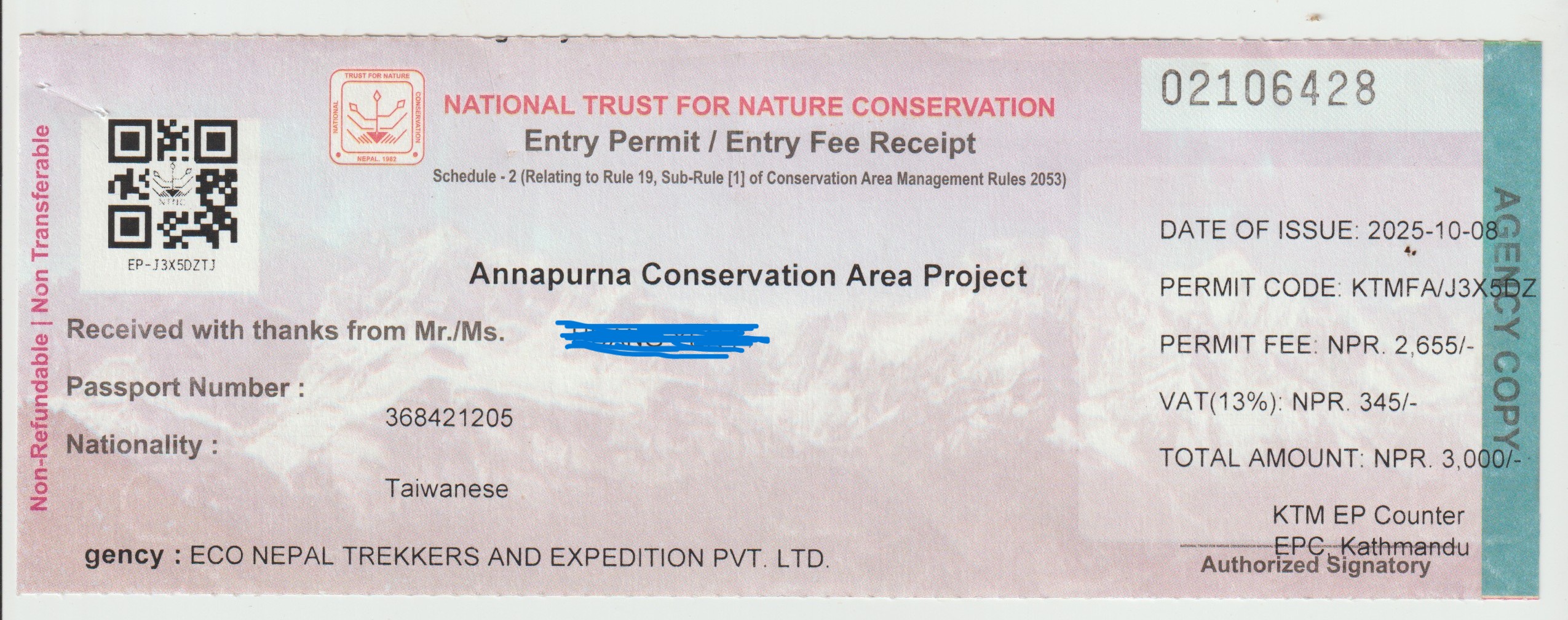
Most trekkers need this permit even though the trek starts in Manaslu.
ACAP cost
| Category | Cost | Validity |
| Foreigners | NPR 3,000 | 1 year |
| SAARC nationals | NPR 1,000 | 1 year |
| Nepali citizens | NPR 100 | 1 year |
Manaslu Circuit Trek Permit Cost Breakdown (All Permits Combined)
Standard Manaslu Circuit (14 days)
| Permit | Peak Season | Off-Season |
| MRAP | USD 205 | USD 145 |
| MCAP | USD 22 | USD 22 |
| Chumnubri RM | USD 10 | USD 10 |
| ACAP | USD 40 | USD 30 |
| Total | USD 472 | USD 352 |
Can You Trek Manaslu Without a Guide?
No, Manaslu is a restricted trekking region, which means immigration rules require:
- Minimum two foreign trekkers
- Licensed guide registered with an agency
- Agency-handled permits only
Attempting to trek without permits or a guide can result in fines, termination of the trek, or a forced return at checkpoints.
Documents Required for Manaslu Circuit Trek Permits
These permits are document-driven. If one detail doesn’t match (name spelling, passport number, dates), you can get stopped at checkpoints, especially inside the restricted zone.
1) Passport requirements
Your passport is the “base ID” for every permit. The name and passport number must match across MRAP, MCAP, ACAP, and the permit logs at checkpoints.
- Validity: Ideally, 6+ months beyond your trek end date (most agencies follow this standard).
- Copies: Carry 1–2 photocopies (agency uses copies; checkpoints want originals + permits).
- Exact spelling: If your passport has middle names, your permit should too—no shortcuts.
Checklist
- Original passport
- 2 photocopies (main page)
- Digital backup (only for your safety, not accepted at checkpoints)
2) Visa requirements
You need a valid Nepal tourist visa that covers your trek dates. If your visa expires mid-trek, your permit application can be delayed or rejected by agencies.
- Your visa must remain valid until after your trek finishes.
- If you’re trekking longer (Tsum + Manaslu), agencies often ask you to extend your visa first before issuing restricted permits.
Checklist
- Visa page copy (or arrival stamp proof)
- Confirm the visa expiry date is after the trek end date
3) Photos (passport-size)
Permits still depend on physical photos, especially for conservation permits and paperwork bundles.
- Bring at least 4 passport-size photos (safe buffer).
- Standard size usually accepted: 2×2 inch style.
- Keep extras—photos also help if something needs re-issuance.
Tip: Put photos in a small envelope so they don’t get damaged.
4) Trek itinerary (route + dates)
For Manaslu, this is not just “planning.” It becomes part of your restricted permit logic.
Your itinerary should clearly mention:
- Entry date into the restricted zone (usually Jagat)
- Exit point (usually Dharapani)
- If Tsum Valley is included (Lokpa, Chumling, Chhekampar, Nile/Mu Gompa)
- Total days inside restricted area (affects MRAP cost)
Why it matters
- MRAP/Tsum RAP are issued for specific dates
- If you start a day earlier/later than the permit dates, you can be denied at checkpoints
5) Guide & agency details
This is the strict part. Restricted permits are agency-only, and the guide must be legitimate.
Agencies need:
- Trekking agency registration details (NTB/TAAN-linked)
- Guide’s license number and assigned guide identity
- Group list (minimum two foreign trekkers)
Note: If you only want the service of permits and guides, we can arrange that as well.
What you should confirm
- Your guide is licensed
- Your agency is registered
- Your name is correctly listed (spelling + passport number)
Processing Time for Manaslu Circuit Trek Permits
Processing depends on the permit type. Conservation permits are fast. Restricted permits are slower because they go through Immigration.
Average processing time
| Permit | Typical time | Where it happens |
| MRAP | 1 business day (often next day) | Kathmandu (Immigration) |
| MCAP | Same day (within office hours) | Kathmandu / Pokhara / checkpoints |
| ACAP | Same day (within office hours) | Kathmandu / Pokhara / checkpoints |
| Chumnubri RM | On the trek (same day) | Jagat/Sirdibas area |
Same-day vs next-day issuance
- Same-day is common for MCAP/ACAP (conservation permits).
- MRAP is usually next-day, because Immigration processes and verifies restricted permits.
- Chumnubri permit is typically collected on-trail at the local checkpoint.
Peak season delays
In peak months, Immigration gets crowded.
- Peak season (Sep–Nov / Mar–May): MRAP can take 2–3 business days
- Best practice: submit details 5–7 days before departure, especially in October and April
Common Permit Mistakes Trekkers Make
These are the mistakes that cause delays, fines, or being stopped at checkpoints.
1) Missing permits
Many trekkers assume “one permit covers Manaslu.” It doesn’t.
- Standard circuit usually needs MRAP + MCAP + Chumnubri + ACAP
- Missing one can stop you at Jagat or Dharapani.
Fix: Use a checklist and physically confirm every permit paper before leaving Kathmandu.
2) Wrong dates on the restricted permit
MRAP and Tsum RAP are date-sensitive. If your trek starts later or earlier, officers can treat it as invalid.
Fix
- Confirm final dates before submission
- Don’t change plans casually after permits are issued
3) Assuming ACAP is optional
This becomes a problem at Dharapani, because most trekkers continue into the Annapurna region to exit via Besisahar.
Fix: If you exit via Dharapani to Besisahar, treat ACAP as mandatory.
4) Confusing Tsum Valley inclusion
Tsum Valley is not included in standard Manaslu permits.
Fix: Decide on Tsum Valley before the permit application. Don’t assume you can “add it later” mid-trek.
5) Attempting solo permits
Manaslu restricted trekking requires a minimum of 2 foreign trekkers and a licensed guide through an agency.
Fix: If traveling solo, ask an agency to pair you with another trekker/group. Avoid any “fake second trekker” approach.
FAQS
How many permits are required for the Manaslu Circuit Trek?
Four permits are typically required for the standard Manaslu Circuit: MRAP, MCAP, Chumnubri Rural Municipality permit, and ACAP. If you add Tsum Valley, you need one more permit: the Tsum Valley Restricted Area Permit.
What documents do I need to apply for Manaslu permits?
You need a passport, a valid Nepal visa, passport photos, a trek itinerary, and guide/agency details. Restricted permits also require a group list (minimum 2 foreign trekkers).
Can I get Manaslu permits in Pokhara?
You can usually get MCAP and ACAP in Pokhara, but MRAP must be processed in Kathmandu through the Department of Immigration via a registered trekking agency.
How long does MRAP processing take?
MRAP typically takes one business day, but in peak season, it can take 2–3 business days, so it’s safer to apply at least 5–7 days before departure.
Is a guide mandatory for the Manaslu Circuit Trek?
Yes. Manaslu is a restricted area trek, so a licensed guide and registered agency are required. Solo trekking is not allowed.
Is ACAP always required for the Manaslu Circuit Trek?
ACAP is required if you exit the circuit through Dharapani and continue toward Besisahar, which is the most common completion route.
Do I need the Tsum Valley permit for the standard Manaslu Circuit?
No. The Tsum Valley permit is only required if your itinerary includes Tsum Valley villages like Lokpa, Chumling, and Mu Gompa.
What happens if I trek without permits?
You can be stopped at checkpoints, fined, and forced to end the trek. Enforcement is strict in the restricted zone.