
Why Is Lukla Airport So Dangerous?
Lukla Airport is often labelled as “one of the most dangerous airports in the world,” but that phrase needs context before it creates fear.
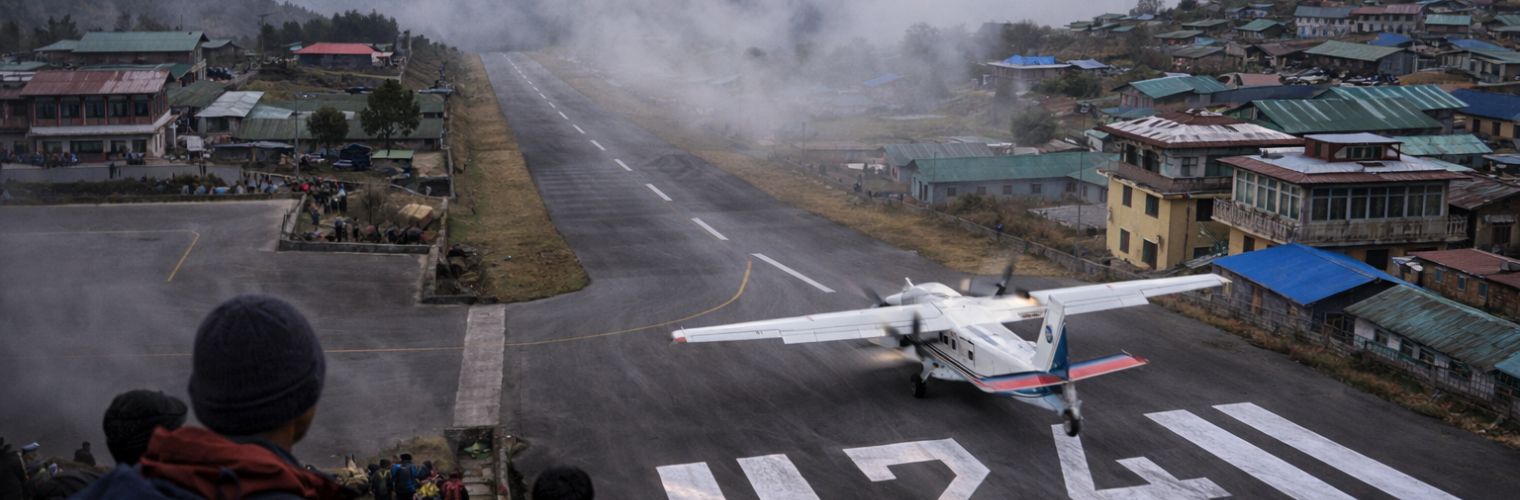
Lukla, officially called Tenzing-Hillary Airport, is a small mountain airport in Nepal that operates under visual flight rules and serves as the main gateway to the Everest region. Its runway is short, steeply sloped, and surrounded by mountainous terrain, which leaves little room for error. These factors make operations highly specialised and conservative.
The risk at Lukla does not come from thrill-seeking or recklessness. It comes from a high-consequence, low-margin operating environment where weather, visibility, terrain, and altitude must all align before a flight is allowed to operate.
Understanding this difference between perception and reality is the key to understanding Lukla Airport.
Quick Summary
- Lukla Airport feels dangerous because operational margins are small, not because safety is ignored.
- A short runway, surrounding terrain, weather variability, and high altitude shape every flight decision.
- Visual Flight Rules and conservative cancellations function as safety controls rather than weaknesses.
- Most risks at Lukla come from the natural environment, not from reckless flying or poor regulation.
- Understanding how Lukla Airport operates reduces fear and sets realistic expectations for travelers.
Geographic Factor That Makes Lukla Airport Dangerous
Lukla Airport sits in a narrow mountain valley, often described as a natural bowl formed by surrounding ridgelines. This geography is not accidental. The airport was built where terrain allowed a runway to exist at all in the lower Khumbu region.
From a traveller’s perspective, the mountains appear close, dramatic, and enclosing. From an operational perspective, those same mountains define airflow patterns, approach paths, and visibility limits. There is no wide, flat landscape beyond the runway where an aircraft can simply roll to a stop or circle indefinitely. That visual reality is what fuels many “dangerous airport” lists.
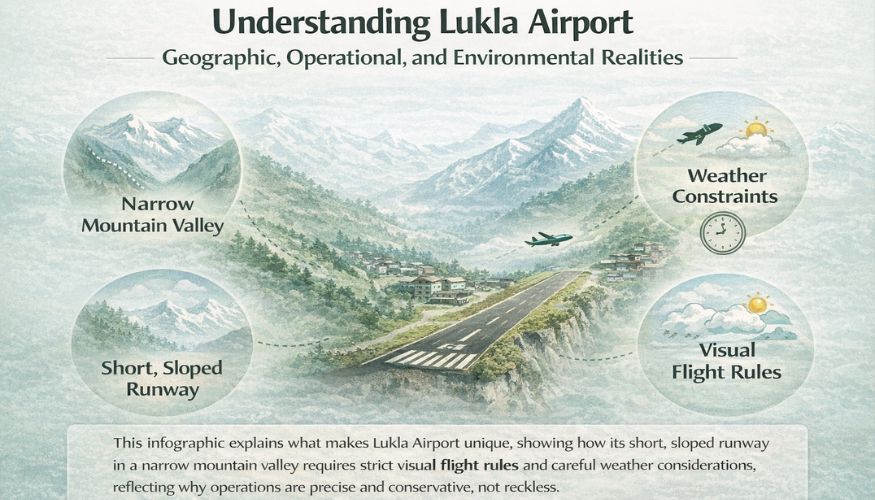
Another important geographic factor is the absence of traditional runway overrun space. Large international airports often have long, flat areas beyond the runway ends. Lukla does not. Instead, the terrain rises steeply at one end and drops away at the other. This does not make the airport unsafe by default, but it does mean that precision matters, and margins are intentionally kept tight.
Airports in similar geographic situations exist elsewhere. Short alpine airfields in Europe and specialized mountain strips in parts of Asia operate under comparable constraints. Lukla stands out not because it is unique in concept, but because it is the most visible example due to Everest’s global profile.
Short and Sloped Runway Increases The Danger Factor
The Lukla runway is often described without explanation, which is where fear creeps in.
The runway is 527 meters long and 20 meters wide, surfaced with asphalt concrete. By mainstream commercial aviation standards, this is short. By STOL airport standards, it is purpose-built.
What makes the runway unusual is its upslope, documented in Nepal’s Aeronautical Information Publication as approximately 11.7 per cent. This slope plays a critical role in how the runway functions.
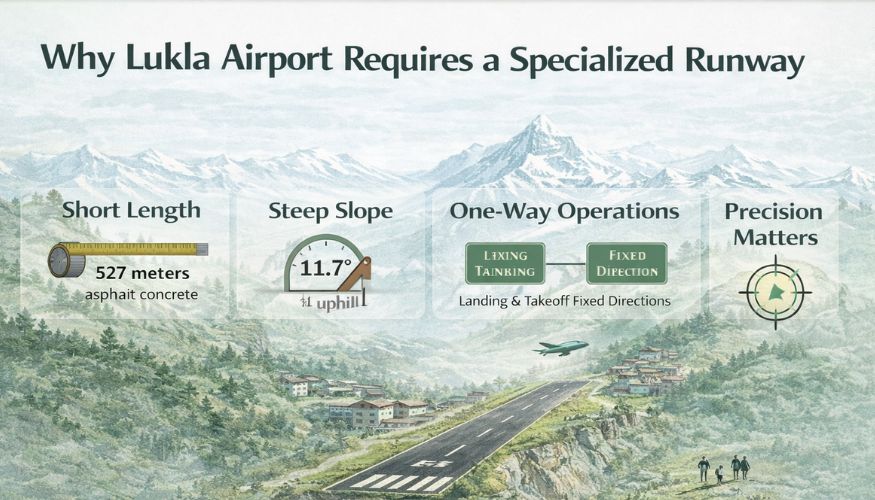
On landing, an uphill runway helps an aircraft slow more effectively. Gravity assists braking rather than fighting it. On departure, the aircraft accelerates downhill in the opposite direction. This is why Lukla is officially designated as a one-way operational runway, with takeoff and landing directions fixed by terrain and design.
This is not a sign of danger. It is a sign of specialization.
There is also an important misconception worth addressing clearly: the presence of a short, sloped runway does not mean Lukla has a constant crash history. Accidents at Lukla are documented and investigated, but the airport does not experience frequent incidents relative to its traffic volume. The runway design itself is not a flaw. It is a solution adapted to an extreme landscape.
Lukla Weather and Visibility Challenges
Weather is the single most important factor in how Lukla operates, and it is also the most misunderstood.
Lukla Airport operates under visual flight rules, meaning pilots must maintain visual reference with terrain and runway. When cloud cover lowers, fog moves into the valley, or visibility drops, flights do not operate. This is not hesitation. It is the system working exactly as designed.
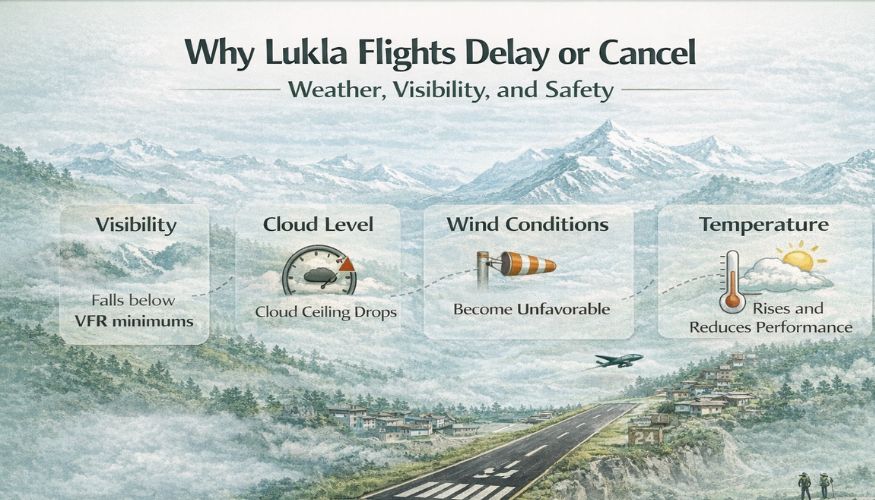
Mountain weather behaves differently from lowland weather. Clouds can form quickly as warm air rises, winds can funnel through valleys, and visibility can change within minutes. Lukla’s geography amplifies these effects, which is why morning flight windows are often preferred. Early hours typically offer clearer skies and calmer air before cloud buildup begins.
Several official accident investigations and air traffic control accounts highlight very low visibility as a recurring operational challenge. This does not mean flights operate in unsafe weather. It means flights are stopped when weather deteriorates, even if that leads to delays.
For travellers, this is often frustrating. For safety, it is essential.
High Altitude and Aircraft Performance
Another reason Lukla feels intimidating is its altitude.
At 2,846 meters, Lukla sits high enough that air density is significantly lower than at sea level. Aviation authorities such as the FAA explain this using the concept of density altitude, which accounts for altitude and temperature together. As density altitude increases, aircraft performance decreases.
In simple terms, thinner air means:
- Engines produce less effective power
- Wings generate less lift at the same speed
- Takeoff distances increase
- climb performance is reduced
This is not unique to Lukla. High-altitude airports around the world face the same physics. What makes Lukla different is that altitude, terrain, runway length, and weather all interact in the same place.
Because of this, airlines operating into Lukla apply strict weight limits, prefer cooler morning temperatures, and cancel flights when performance margins shrink. These are risk controls, not signs of danger.
Why Flights Are Often Delayed or Cancelled
From a traveller’s point of view, flight delays at Lukla can feel alarming. In reality, they are a safety outcome, not a failure.
Lukla flights are delayed or cancelled primarily because:
- visibility falls below VFR limits
- cloud ceiling lowers
- wind conditions become unfavourable
- performance margins are reduced by weather or temperature
Unlike major airports, Lukla does not have instrument approaches that allow operations in poor visibility. That limitation is intentional. It forces conservative decision-making.
In mountain aviation, a cancelled flight is often the safest decision available. Normalizing this idea is one of the most important mindset shifts for trekkers. Delays are not warning signs. They are evidence that safety thresholds are being respected.
Is Lukla Airport Actually Unsafe?
No, Lukla Airport isn’t actually unsafe. In fact, due to its strictness, it might actually be one of the safest yet thrilling flying experiences in Nepal.
Lukla is often ranked on “most dangerous airport” lists because it looks dramatic. Short runway, mountain drop, steep slope, and viral videos make for compelling content. What those lists rarely include is context.
They do not show:
- How many flights operate safely each year
- How conservative are the operating rules are
- How often are flights cancelled before conditions become unsafe
- How strictly pilot experience and aircraft type are controlled
Lukla operates under AFIS service, uses one-way runway procedures, and restricts operations to visual conditions. These are risk-reducing measures, not vulnerabilities.
A more accurate description would be that Lukla is a high-consequence environment, not an unsafe one. When margins are smaller, decisions must be stricter. That is exactly what happens here.
In a way, you can say that it will be your first test before you start trekking in the Everest region.
What Happens If Conditions Are Not Safe?
When conditions at Lukla are not suitable, there is no improvisation.
Flights may:
- be delayed until visibility improves
- be diverted back to origin
- be cancelled for the day
These outcomes are not dramatic. They are routine.
Airlines, air traffic services, and pilots all operate under the same priority: do not push the margins. If conditions do not meet the required standards, operations stop.
For trekkers, this often means waiting in Kathmandu, Ramechhap, or Lukla itself. While inconvenient, this system prevents risk from escalating.
Lukla Airport vs Other Mountain Airports
Lukla feels extreme because it is famous, not because it is alone.
Mountain airports in Europe, Japan, South Korea, and parts of North America operate under similar constraints:
- short runways
- terrain-limited approaches
- weather-dependent operations
- specialized aircraft and pilot experience
What sets Lukla apart is its visibility in global media and its association with Everest. The underlying principles of safe mountain aviation apply everywhere.
So, Is Lukla Airport Dangerous?
Yes, Lukla Airport is dangerous if you judge danger by how small the margins are and how strictly conditions must align. No, Lukla Airport is not dangerous if you judge danger by how recklessly it operates, because it does not.
Lukla works in a high-consequence environment: short runway, steep terrain, changing mountain weather, and high altitude. Because of that, flights are conservative, cancellations are common, and pilots do not push limits. Those restrictions are not flaws. They are the reason the airport functions safely at all.
The real risk at Lukla does not come from flying itself. It comes from misunderstanding how mountain aviation works and expecting it to behave like a lowland airport. Once you accept that visibility matters, delays are normal, and safety decisions come first, Lukla stops feeling scary and starts feeling serious.
From our experience as a trekking organization, Lukla is best understood this way:
it is demanding, not reckless; disciplined, not casual; and cautious by design.
FAQs
Do pilots choose to fly into Lukla, or are they assigned randomly?
Pilots are assigned based on experience and clearance for mountain and STOL operations, not rotation.
Is Lukla Airport used by international jets or large aircraft?
No. Only small, specialized turboprop aircraft designed for short runways operate here.
Does Lukla Airport have modern navigation technology, such as ILS?
No. Lukla operates under visual flight rules, relying on pilot visibility rather than instrument landings.
Why are Lukla flights scheduled mostly in the morning?
Morning hours usually offer more stable weather and better visibility in the mountains.
Has Lukla Airport been upgraded or changed over time?
Yes. Runway surfacing, procedures, and operational controls have evolved over decades, even if the terrain cannot.
Do helicopters face the same risks as aeroplanes at Lukla?
Helicopters operate differently and are not bound by the runway, but they are still limited by weather and visibility. However, helicopters do fly upto Everest base camp.
Is Lukla more dangerous than mountain airports in Europe or North America?
Not necessarily. Some airports in Alaska, the Alps, and the Andes face similar or greater weather and terrain challenges.
Why do some travelers feel more scared landing than taking off from Lukla?
Landing visually emphasizes the short runway and terrain, which triggers fear even when procedures are controlled.
Does altitude affect passengers physically during landing?
Not directly during the flight, but altitude affects aircraft performance and operational planning.
Can Lukla Airport ever become completely “safe” by normal airport standards?
No. Geography cannot be changed. Safety comes from strict limits and conservative decisions, not expansion.