
Is Everest Base Camp Dangerous?
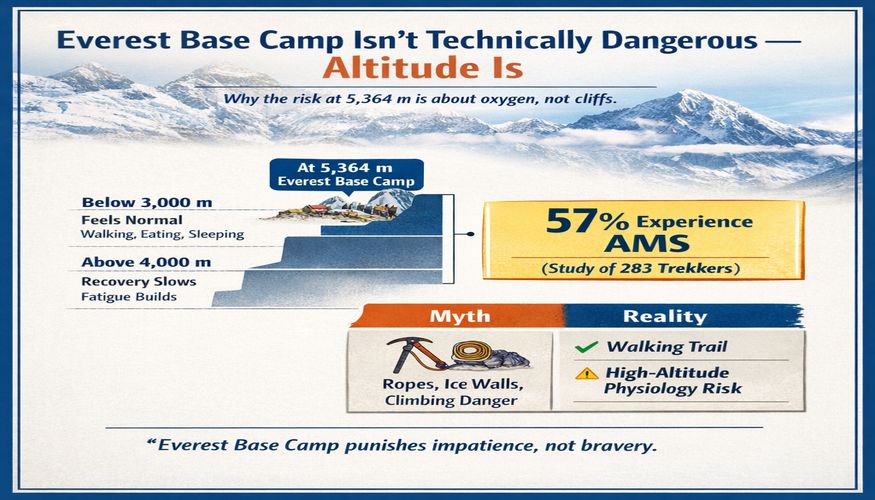
Everest looks close in photos, but in real life, Everest Base Camp sits at 5,364 m, and that altitude quietly changes how the human body behaves. Below 3,000 m, walking, eating, and sleeping still feel familiar. Above 4,000 m, recovery slows. Above 5,000 m, the same pace can feel twice as hard.
That shift is where most confusion about danger at Everest Base Camp begins.
The Everest Base Camp trek is a non-technical trek. There is no rope climbing, no ice walls, and no exposure like on Everest’s upper slopes.
Yet people keep asking the same question in different ways: is Everest Base Camp dangerous, how dangerous is Everest Base Camp, is trekking to Everest Base Camp dangerous, or is it dangerous to hike to Everest Base Camp?
All of those questions point to the same concern. Not terrain. Physiology.
Quick Summary
- The Everest Base Camp trek is not technically dangerous, but altitude exposure makes it a serious undertaking.
- At 5,364 m, oxygen availability drops significantly and physical recovery slows for most trekkers.
- In a study of 283 trekkers, 57% experienced symptoms of Acute Mountain Sickness.
- Altitude risk begins above 2,500 m and increases notably after Namche Bazaar at 3,440 m.
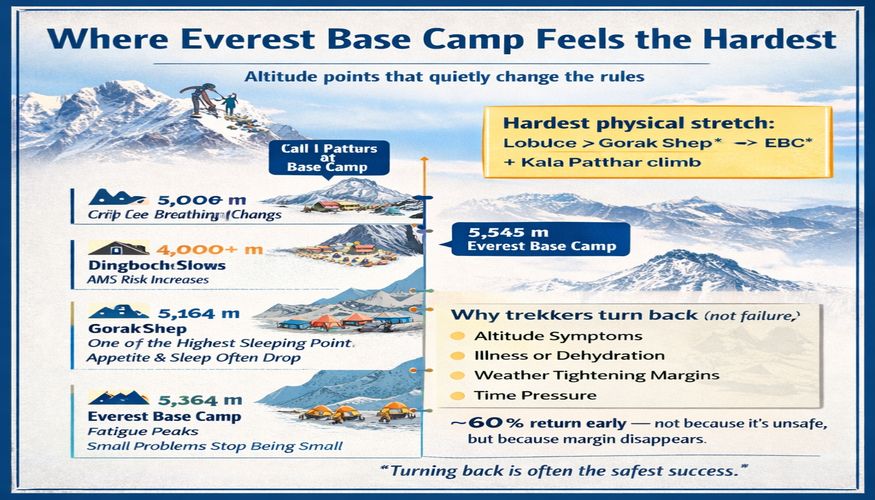
- The most physically demanding sections are Lobuche to Gorak Shep to Everest Base Camp, and the Kala Patthar climb at 5,545 m.
At Eco Nepal Trekkers, we also analyse what actually happens on the trail.
Based on our internal trekking data and guide reports, we see that around 60% trekkers return early, not because the trek is unsafe, but because altitude, illness, weather, and time pressure reduce margin later in the journey.
Why do people think Everest Base Camp is dangerous
Most people do not fear the trail itself. They fear three things that sound vague until you put numbers on them.
First, people confuse trekking to Everest Base Camp with climbing Mount Everest. And we all know Mount Everest infamously carries images of the Death Zone, ropes, and rescue stories.
So when someone asks if climbing to Everest Base Camp is dangerous, the confusion is already built into the phrasing. You do not climb Everest to reach Base Camp. You walk.
Second, the altitude number looks unreal. 5,364 m is higher than anything most trekkers have ever slept at. Even experienced hikers know that altitude changes the rules, and they are right to pause.
Third, the Lukla flight gets talked about more than the trek itself. Lukla’s runway is 527 m long, short and steep, which means consequences are higher if the weather turns bad. For many trekkers, their highest-risk moment happens before they even start walking.
And last but not least, in a group EBC trek, only 60% of them are able to complete the trek, which makes people wonder if it really is that dangerous.
Once you separate these fears, the picture becomes clearer.
How dangerous is Everest Base Camp?
Now, after knowing why many trekkers feel it is dangerous, let us tell you the reality. The EBC trek becomes “dangerous” mainly because of altitude, not because of technical difficulty.
A field study that followed 283 trekkers on the Everest Base Camp route found that 57% developed Acute Mountain Sickness (AMS) at some point. That number surprises people because the trail feels manageable. But AMS does not care how strong your legs are.
Medical guidance explains why. For many travellers, altitude illness risk begins above roughly 2,500 m, and the response varies widely from person to person. Some feel symptoms early. Others later. Some not at all. Fitness does not provide immunity.
On the other hand, the trail in itself is quite manageable if you are physically healthy.
Once you understand that, questions like Is Base Camp Everest dangerous or Is Mount Everest base camp dangerous stop being emotional questions and start becoming planning questions.
Altitude Points That Change The Risk
Everest Base Camp risk increases in steps, not all at once. Certain elevations matter more than others.
| Altitude | Why it matters |
| 3,440 m | Namche Bazaar, where many trekkers first notice breathing and sleep changes |
| 4,000+ m | Recovery slows, and AMS risk rises more noticeably |
| 5,164 m | Gorak Shep, one of the highest sleeping points on the trek |
| 5,364 m | Everest Base Camp altitude |
| 5,545 m | Kala Patthar, the highest point most trekkers reach |
From Dingboche and above, the trek becomes higher-consequence. Sleep altitude is high, appetite often drops, and small issues like dehydration or a mild headache stop being “minor.”
Where the Everest Base Camp trek feels hardest
EBC is rarely dangerous because of cliffs or exposure. It becomes risky when fatigue meets thin air.
Most trekkers report the same pattern. Early days feel long but manageable. Above Dingboche, effort increases even when pace stays the same. The longest and most tiring push is usually Lobuche to Gorak Shep to Everest Base Camp, followed by the steep, cold climb of Kala Patthar, often done early in the morning when oxygen availability is lowest.
This is where slips, poor pacing, and ignored symptoms are most likely, and also the reason why trekkers wonder about whether hiking to Everest Base Camp is dangerous, as they are really asking whether their body will still cooperate on the hardest days.
Where altitude sickness shows up most often
Altitude sickness in the Everest base camp trek does not belong to one village, but patterns are consistent.
Symptoms often begin after Namche Bazaar and become more frequent above 4,000 m, especially as trekkers move toward Lobuche and Gorak Shep. Risk increases when ascent is rushed or rest days are skipped.
The key point is variability. AMS can appear earlier or later depending on the person. That unpredictability is what makes Everest Base Camp feel serious even though the trail itself is straightforward.
How EBC compares to hard treks in other countries
Many people from the USA, UK, Australia, or Germany ask whether EBC is “harder” than what they have done at home.
Some treks match the effort. Some match the weather exposure. Very few match sleeping at 4,000 to 5,000+ m for multiple nights.
| Trek | What feels similar |
| Mount Whitney (USA) | Big altitude effort in a single day |
| Grand Canyon Rim-to-Rim (USA) | Severe fatigue if hydration and pacing fail |
| Ben Nevis via CMD Arete (UK) | Long, tiring mountain day with weather swings |
| Overland Track (Australia) | Multi-day endurance and cold logistics |
| Zugspitze via Höllental (Germany) | Consequence terrain and sustained fatigue |
The difference is simple. Most Western treks let you sleep low. Everest Base Camp does not.
So, is it dangerous to go to Everest Base Camp?
Now the answer becomes honest and calm.
Is Everest Base Camp dangerous? It can be, mainly because of altitude and cold.
Is it dangerous to trek to Everest Base Camp? Only if pace, acclimatization, and symptoms are ignored.
Is it dangerous to hike to Everest Base Camp? The trail is not technical, but fatigue in thin air increases mistakes.
Is climbing to Everest Base Camp dangerous? It is not a climb, but the altitude still demands respect.
Everest Base Camp does not punish bravery. It punishes impatience.
At 5,364 m, the mountain does not need drama. Physics does the work quietly. When trekkers let altitude set the schedule, EBC usually becomes steady and controlled. When they try to outpace it, small problems stop staying small.
And lastly, we would like to tell you that even if you suffer from AMS, a helicopter evacuation is possible from the Everest base camp, which means even in the worst case scenario, we would still be able to descend safely.
FAQs
Is Everest Base Camp actually dangerous?
Everest Base Camp is not technically dangerous, but the altitude makes it serious. Most risk comes from low oxygen, not the trail itself.
Is the Everest Base Camp trek safe for beginners?
Yes, if the itinerary is slow and acclimatization is respected. Fitness helps, but it does not prevent altitude sickness.
What is the biggest danger on the Everest Base Camp trek?
Altitude sickness is the biggest risk, not falls or terrain. Medical studies show it affects many trekkers at some point.
Is climbing required to reach Everest Base Camp?
No. Reaching Everest Base Camp is trekking, not climbing. No ropes, ice axes, or mountaineering skills are needed.
At what altitude do problems usually start?
Many trekkers notice changes after Namche at 3,440 m. Risk increases significantly above 4,000 m.
Is the Lukla flight dangerous?
The Lukla flight has higher consequences due to a short runway. Delays and cancellations are common; accidents are rare.
Can fit people still get altitude sickness?
Yes. Altitude sickness is unpredictable. Being fit does not guarantee protection.
Is Everest Base Camp more dangerous than other famous treks?
It is riskier mainly because trekkers spend days above 4,000–5,000 m. Most Western treks do not involve sustained high sleeping altitudes.
What should I do if I feel unwell?
Stop ascending and inform your guide immediately. Descending early prevents serious complications.
Does everyone reach Everest Base Camp?
No. Many capable trekkers turn back responsibly. Turning back is normal and often the safest decision.