
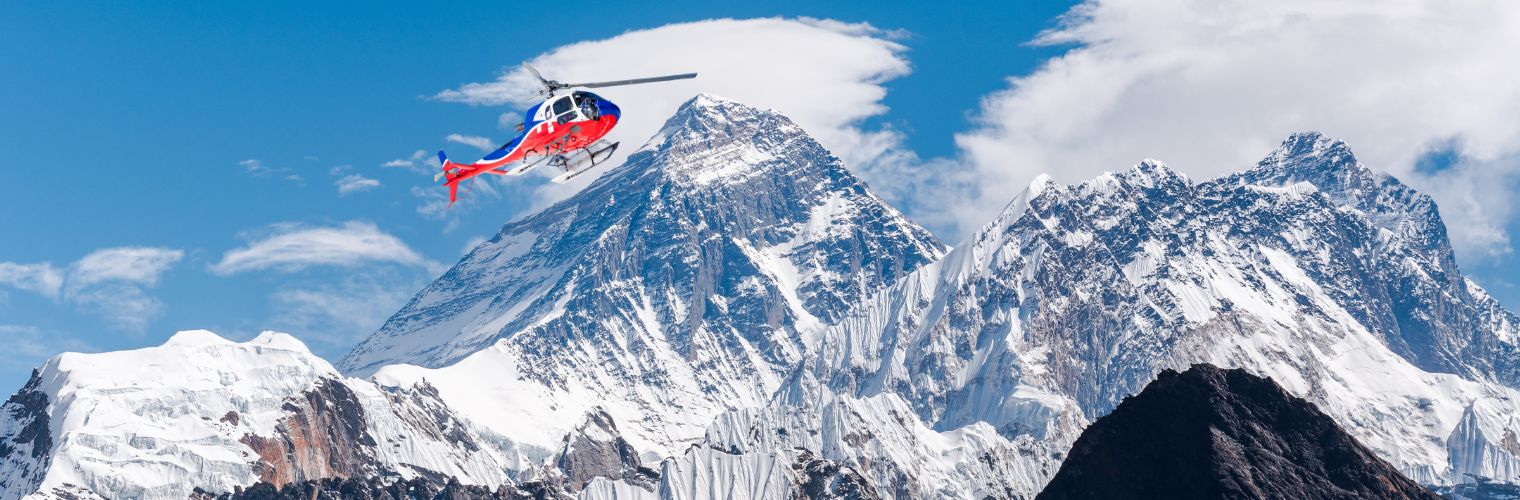
Can a Helicopter Fly To Everest?
Everest looks close in photos, but in real life, it sits at 8,848.86 m and changes the rules for everything that flies. In the Khumbu, helicopters feel normal at 2,840 m (Lukla), but they start to feel “limited” once you pass 5,364 m (Everest Base Camp). Honestly, that contrast is where most of the confusion about Everest helicopters begins.
In fact, helicopters do fly in the Everest region every season, but they don’t fly “anywhere,” and they don’t land “anytime.” Most repeatable operations stay around 5,364–6,400 m, and the hardest rescues push toward 7,000–7,800 m in short windows of 3–8 minutes. And once you understand those numbers, Everest suddenly makes sense.
| Key Everest number | What it means |
| 8,848.86 m | Everest summit altitude |
| 5,364 m | Everest Base Camp altitude |
| 6,400 m | Camp 2, the main rescue zone |
| 7,000 m | Common certified limit for AS350 B3 |
| 7,800 m | Highest rescue record zone |
Guidance: Treat helicopters as a safety tool below 7,000 m, not a summit solution.
Quick summary
- Helicopters fly reliably up to 6,400 m, especially around Camp 2.
- The summit landing at 8,848.86 m happened once, in 2005.
- Most practical rescue work stays below 7,000 m (23,000 ft).
- Above 7,800 m, rescue chances drop toward <1%.
- Morning flights 6:00–10:00 AM are the safest window.
Can helicopters fly at Mount Everest
No, helicopters don’t fly at the top of the Mount Everest because of extremely thin air that reduces the rotor lift and engine power. However, rescue camp from altitude of 6,400 m is possible.
The complete scenario totally depends on what you mean by “Everest.” Helicopters can fly and work in the Everest region around 5,364 m (Base Camp) and 6,400 m (Camp 2), and that’s why you see them often in spring (March–May) and autumn (September–October).
But a helicopter cannot routinely land at 8,848.86 m or run “normal” missions in the Death Zone above 8,000 m.
In fact, the Everest helicopter story has 3 layers: routine flying (up to about 6,400 m), extreme rescue attempts (7,000–7,800 m), and one experimental summit landing (2005) done with zero payload. Once you separate these layers, the answer becomes simple and honest.
| Everest helicopter use | Typical altitude | Reality |
| Routine operations | 5,364–6,400 m | Regular and repeatable |
| Extreme rescues | 7,000–7,800 m | Rare, specialist-only |
| Summit landing | 8,848.86 m | One-off experiment |
How high can helicopters fly in Everest
High altitude flying has three ceilings, and Everest sits near the harshest edge of all 3. Most commercial helicopters feel comfortable at 3,000–4,500 m (10,000–15,000 ft), and high-altitude machines are operated at 6,000–7,000 m (19,685–22,966 ft).
The “absolute ceiling” can reach 7,600 m, but that does not mean safe hovering with a patient, a crew, and fuel.
Here’s the truth: at 20,000 ft, air density drops to about 33% of sea level, and at the Everest summit (29,031 ft) it sits around 29–31%. That loss hits lift and engine power at the same time, so the numbers look possible on paper, but the margin disappears in real weather.
| Ceiling type | Typical range | What it means |
| Service ceiling | 3,000–4,500 m | Practical climb and control |
| Operational ceiling (high-altitude) | 6,000–7,000 m | Reliable missions with margin |
| Absolute ceiling | 7,600– 8,000m | Theoretical reach, not rescue-ready |
Guidance: For Everest planning, trust the operational ceiling, not the “record” numbers.
Highest helicopter landing ever in Everest
The highest landing ever on Everest is real, but it’s not a normal Everest tool. On May 14, 2005, test pilot Didier Delsalle landed an Eurocopter AS350 B3 on the summit at 8,848.86 m (29,035 ft) for 3 min 50 sec, and flew the next day again to prove it wasn’t luck. It was a controlled experiment, not a rescue method.
In fact, the helicopter was stripped by about 120 kg (265 lb), carried zero payload, and relied on near-perfect conditions, including strong lift in the air. That’s why you don’t see “summit helicopter rescues” in real Everest operations.
| Record | Aircraft | Altitude | Date | Time |
| Summit landing | AS350 B3 | 8,848.86 m | 2005-05-14 | 3:50 |
Why helicopters struggle at altitude
Up high, Everest doesn’t fight helicopters with drama; it fights them with physics. At 10,000 ft, air density is about 65%; at 20,000 ft, it drops to 33%; and near the summit, it sits around 29–31%. That means the rotor has fewer molecules to push, while the engine also loses oxygen for combustion, creating a power “crossover” where demand becomes higher than supply.
Furthermore, rotors can’t simply spin faster forever because blade tips approach the speed of sound around 25,000–30,000 ft, where control problems and stall risks rise fast. Add summit winds that can exceed 200 km/h (124 mph), and the aircraft starts fighting a retreating-blade stall, turbulence, and narrow terrain. Even temperature is mixed: -30°C to -40°C gives denser air, but it also stiffens materials and slows systems.
| Altitude | Air density | What happens |
| Sea level | 100% | Normal power and lift |
| 3,000 m | 66% | Still manageable |
| 6,000 m | 50% | Hover margin shrinks |
| 8,000 m | 30–33% | Hover becomes unreliable |
Helicopter rescue on Everest
Helicopter rescue on Everest is real, and it has saved many lives, mostly between 5,364 m (Base Camp) and 6,400 m (Camp 2). Below 6,000 m, helicopters can land, hover longer, and carry proper medical support, which is why evacuations from places like Dingboche (4,400 m) or Gorakshep (5,140 m) are common in season. But above 7,000 m, even elite pilots treat the mission as extreme.
In fact, the highest rescue record sits around 7,800 m (2013), and only about 2–3 pilots are known for long-line work above 7,000 m.
| Rescue reality | Typical number |
| Main rescue zone | 5,364–6,400 m |
| Certified max (AS350 B3) | 7,000 m (23,000 ft) |
| Highest rescue record | 7,800 m |
| Hover time (high zone) | 3–8 min |
| Specialist pilots (very high) | 2–3 |
Rescue limits table + explanation
Everest rescue limits are not policy first—they are physics first. Once you cross 7,000 m, the AS350 B3 is at or beyond its certified range (23,000 ft), and the air is near 30% density. That’s why rescues are common below 6,400 m, difficult at 6,400–7,000 m, and almost never successful above 7,800 m.
| Altitude range | Feasibility | Typical method | Typical success trend |
| Below 6,000 m | Possible | Direct landing | 95% |
| 6,000–6,400 m | Possible | Landing/hover | 90% |
| 6,400–7,000 m | Difficult | Long-line hover | 60–70% |
| 7,000–7,800 m | Extreme | Long-line only | 20–30% |
| Above 7,800 m | Not practical | Not reliable | Less than 1% |
Where do helicopters commonly fly
Most Everest helicopter routes stay inside a practical corridor from Kathmandu (1,400 m) to Lukla (2,840 m) and then up toward 4,400–5,364 m for evacuation and logistics. During stable seasons like March–May and September–October, flights are usually safest in the morning window of 6:00–10:00 AM, when winds are lower, and clouds haven’t built yet. But even then, delays happen often.
In fact, weather cancels around 30–40% of scheduled flights, especially when visibility drops below 1 km or wind gusts climb beyond safe limits. That’s why the Everest sky feels “busy” some days and completely silent on others.
| Common corridor | Approx altitude |
| Kathmandu to Lukla | 1,400 m to 2,840 m |
| Namche / Tengboche zone | 3,400–3,880 m |
| Dingboche / Pheriche zone | 4,400 m |
| Gorakshep / Base Camp zone | 5,140–5,364 m |
Guidance: Keep 1–2 buffer days in your plan, because flight delays are normal here.
Helicopters vs climbing reality
A helicopter can shorten the distance, but it cannot shorten adaptation. Everest acclimatization takes 3–4 weeks, because your body needs time to build red blood cells and adjust to thin air, not just minutes in a cabin. And above 8,000 m, the Death Zone remains the Death Zone, oxygen availability is only 30–33%, and atmospheric pressure is around 34 kPa compared to 101 kPa at sea level.
Here’s the best part: when people respect the timeline, Everest becomes safer and calmer. But when people try to “skip the mountain” with speed, the risk of altitude sickness can rise by 2–3×, and that’s when small mistakes become big ones.
| Climbing reality | Key number |
| Base Camp altitude | 5,364 m |
| Death Zone starts | 8,000 m |
| Oxygen at 8,848 m | 30–33% |
| Acclimatization time | 3–4 weeks |
Can helicopters reach Base Camp
Yes, helicopters can reach Everest Base Camp, and they have done it many times at 5,364 m. A flight from Lukla (2,840 m) to Base Camp can take about 10–20 minutes, and return flights can save 3–4 days of trekking time. This is also why some trekkers plan a walk-up and a helicopter-return itinerary like Everest Base Camp Trek With Helicopter Return.
| Base Camp flight fact | Number |
| Lukla altitude | 2,840 m |
| Base Camp altitude | 5,364 m |
| Typical flight time | 10–20 min |
| Trek time saved (down) | 3–4 days |
Why helicopters matter for safety
In the Khumbu, minutes can matter more than comfort. A fast descent from 5,364–6,400 m to a lower altitude can change the outcome of HAPE or HACE, especially when symptoms build over 6–12 hours. That’s why Everest rescue helicopters focus on the zone where they can actually land, hover, and carry real medical support.
In fact, a typical evacuation can cost around USD 6,000–10,000, and it is still weather-dependent, with a cancellation risk of 30–40% on bad cycles. So helicopters matter, but they are not magic—they are a limited safety bridge when conditions allow.
| Safety value | Number |
| Main safe rescue hub | 5,364–6,400 m |
| Symptom buildup window | 6–12 hours |
| Typical evac cost | $6,000–10,000 |
| Weather cancellations | 30–40% |
Myths Vs Reality
Everest helicopter myths sound confident, but the numbers quietly disagree. Myth 1 says “helicopters can take anyone to the summit,” yet the only summit landing was in 2005, at 8,848.86 m, with zero payload and a stripped aircraft by 120 kg.
Myth 2 says “rescue is available anywhere,” but practical rescues drop sharply above 7,000 m and become near-impossible above 7,800 m, with success trending toward <1% in the Death Zone.
Myth 3 says “helicopters make Everest safe,” but most deaths happen above 8,000 m, where lift, payload, and hover time simply fail. Honestly, helicopters can reduce risk below 6,400 m, but they cannot replace judgment above 8,000 m.
| Myth | Reality number |
| “Summit transport” | 1 landing (2005), zero payload |
| “Rescue anywhere” | 7,000–7,800 m max, <1% above |
| “Everest is safe now.” | 8,000+ m is still critical |
Final reality check
Everest helicopters can fly high, but Everest still decides the limit. Most reliable work happens around 5,364–6,400 m, rare rescues push 7,000–7,800 m, and the Death Zone above 8,000 m stays mostly out of reach. In the end, Everest is not just a mountain of height—it’s a mountain of margins.
At Eco Nepal Trekkers, we treat helicopters as a safety layer, not a shortcut, because the best rescue at 6,400 m is the one you never need.