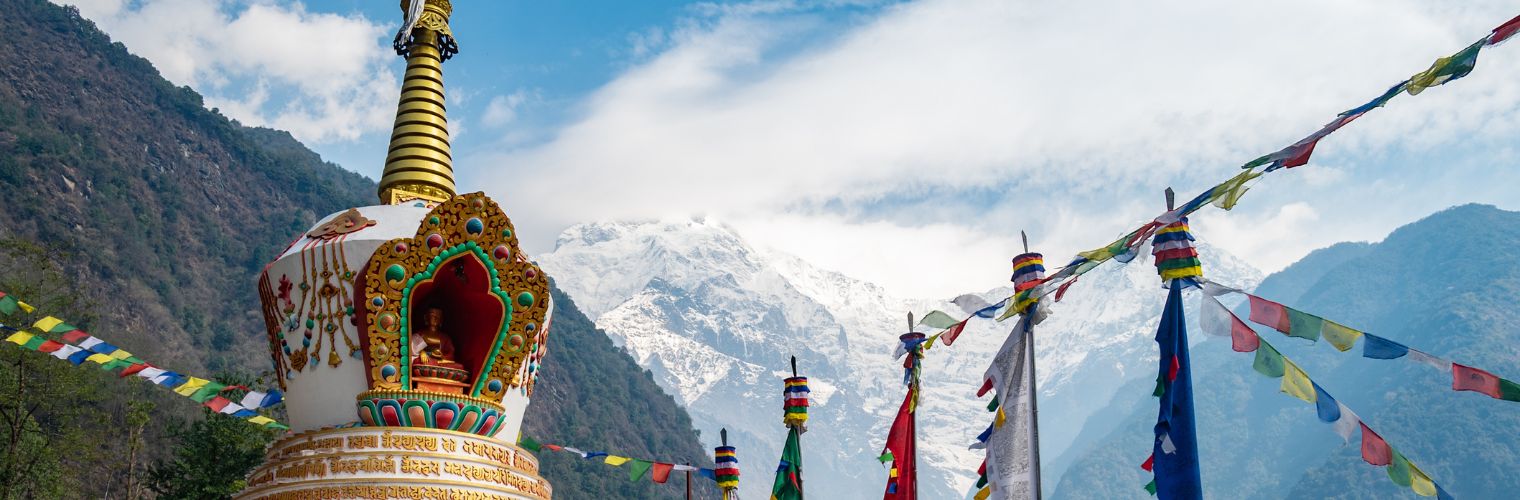
Chhomrong Village
Chhomrong is a mountain Village situated near the Annapurna range in Nepal at an elevation of approx 2,170 meters above sea level. It is popular as the main entry point to the Annapurna Base Camp.
Nearly every trekker on their way to the Annapurna Sanctuary passes through this quaint Gurung Village. It is rich in culture, inhabited by a majority of the Gurung people, and offers magnificent views of Annapurna South, Himchuli and Machhapuchhre.
The ideal seasons to explore Chhomrong are spring and autumn, when the weather is enjoyable, and the mountain views are perfect.
Quick Summary
- Chhomrong Village is located in central Nepal inside the Annapurna Conservation Area
- Chhomrong Elevation is approximately 2,170 meters (7,120 feet) above sea level.
- It is the main entry point to ABC Trek and the last major settlement before the ascent to the Annapurna Sanctuary.
- The village is primarily home to the Gurung communities.
- The best seasons to visit Chhomrong are spring and autumn.
- It functions as a key accommodation and logistical hub on the Annapurna Base Camp route.
Where is Chhomrong Village Located?
Chhomrong Village is located in the Kaski District of Gandaki Province, central Nepal. Within the Annapurna Conservation Area, Known as one of the best trekking regions in Nepal.
Nearly every trekker bound for the Annapurna Sanctuary will pass through Chhomrong Village, so it’s a popular overnight stop before entering higher alpine terrain. The village is a junction point for major trekking routes originating from Ghandruk Village, Jhinu Danda, and Landruk.
Chhomrong Village on Map
Chhomrong is one of the main settlements along the trek to ABC. A lot of steps lead you up into Chhomrong. It sits high above the Modi Khola Valley and serves as a sort of doorway before ascending further.
While trekking to Chhomrong, trekkers will visit the lower villages, including Nayapul, Syauli Bazar, Jhinu Danda, Ghandruk, and Landruk. From Chhomrong, the stone staircase trail descends to the river and ascends through more forest to Sinuwa, another gateway to the Annapurna Sanctuary.
However, because it lies in the shadow of Annapurna’s massive south face, Chhomrong serves equally well as a checkpoint and an unmistakable turning point from lower hillside settlements to the higher bunches of alpine villages.
It is easy to find for trekkers on digital maps, using ‘Chhomrong Village ’ to plan the route and keep track of their elevation.
Chhomrong Village Altitude and Geography
Chhomrong Village is a large village stacked up the hillside at Hinchuli on the western side of Modi Khola.
At this altitude, the transition from low hills to mid-mountain is evident. The air feels a bit thinner during long climbs, it gets cool at night, and altitude awareness begins to take on some meaning, not yet critical but there nonetheless.
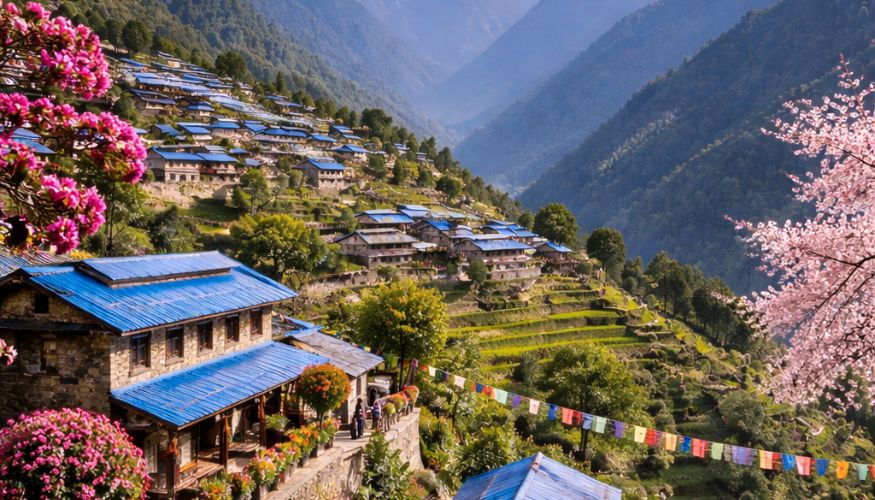
The village is directly integrated into the terraced agricultural slope. Streets in Chhomrong are not like flat pathways but connected by high stone staircases, which lead to the other side of the village where homes and lodges keep their presence almost vertical.
Below is the deep gorge of the Modi Khola River. A steep descent to the river, then another ascent to Sinuwa, it’s this back and forth in elevation that characterises this stretch of the Annapurna Base Camp route.
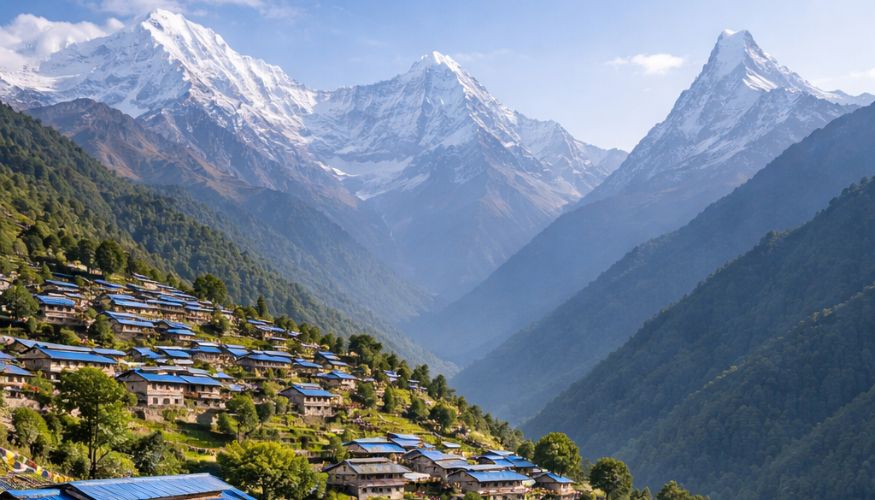
The surrounding woods have rhododendron, oak and bamboo at lower levels.
Chhomrong is on your right, not along the mountainside. It is shaped by it.
Mountains Visible from Chhomrong
Chhomrong Village Offers to see trekkers with clear views of the following mountains:
- Annapurna South
- Machhapuchhre
- Hiunchuli
The great mass of Annapurna South fills the western view and towers above the Chhomrong village. At the first light of dawn, sunshine often hits its upper part first, thus rendering a dramatic scene of a dark valley below and a brightly lit summit above. It is one of the most spectacular frontal mountain views on the Annapurna Base Camp trail.
Machhapuchhre rises sharply, its unique fishtail shape contrasted against the skyline, while Hiunchuli’s profile extends more subtly along the ridge.
It’s because of this relatively open positioning that many trekkers choose to spend an extra night in Chhomrong, not for altitude, but for the view from on high. It provides one of the final wide mountain passages as the trail begins to animate into forest and thins out on the approach to Annapurna Sanctuary.
Why Chhomrong Is Called the Gateway to ABC
Chhomrong is known as the gateway to Annapurna Base Camp, and indeed it’s the final large, permanent village before trekking trails enter into the heart of Annapurna Sanctuary.
It provides solid shelters, food and a reasonable rendezvous spot for trekkers and guides. Above Chhomrong, villages are fewer and more seasonal.
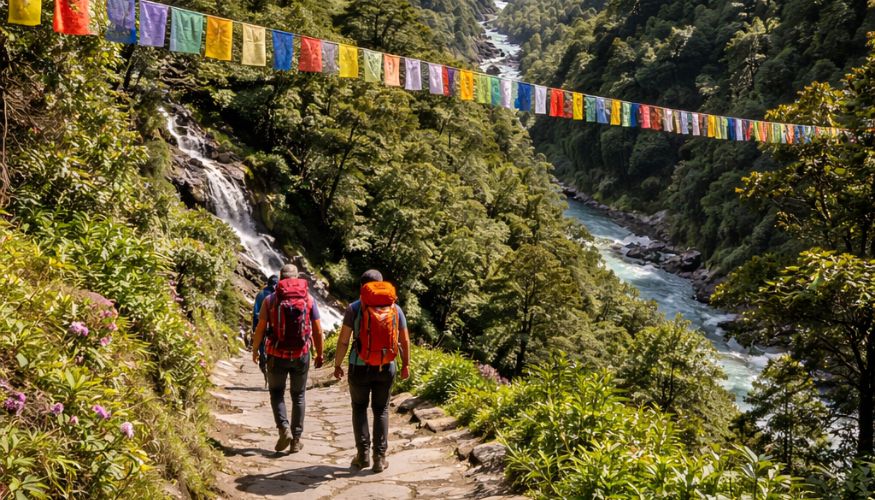
Laden with a heavy supply of the above-mentioned food, we left the village and hiked down the trail to the Modi Khola River, where we crossed a suspension bridge, then climbed into the forest on the other side towards Sinuwa. From there, the road narrows, and the distances are greater.
The area of Chhomrong is where the village gives way to the sanctuary interior.
Chhomrong to Annapurna Base Camp Route Breakdown
From Chhomrong, the trail immediately descends toward the Modi Khola River and then climbs again in a long staircase ascent to Sinuwa. Beyond here, the path slowly transitions from village landscape into forest and then into open alpine terrain.
The vast majority of trekkers will take 2 to 3 days, with their pace on each day dictating if it’s two or three from Chhomrong to Annapurna Base Camp.
Pokhara to Chhomrong Short Trek itinerary
| Day | Route | Duration | Elevation | Difficulty |
| Day 1 | Drive from Pokhara to Jhinu Danda, then Trek to Chhomrong | 4-6 Hrs | 2170m | Moderate |
| Day 2 | Trek from Chhomrong to Jhinu Danda and Drive to Pokhara | 4-6 Hrs | 827m | Easy |
Chhomrong to Annapurna Base Camp Trek Itinerary
| Day | Route | Duration | Elevation | Difficulty |
| Day 1 | Trek from Chhomrong to Dovan | 5-6 Hrs | 2,300m | Moderate |
| Day 2 | Trek from Dovan to Deurali | 5-6 Hrs | 3,230m | Moderate |
| Day 3 | Trek from Deurali to Annapurna Base Camp | 3-4 Hrs | 4,130m | Moderate |
| Day 4 | Back from ABC to Bamboo | 5-6 Hrs | 2,310m | Easy |
| Day 5 | Trek from Bambo to Jhinu, then drive to Pokhara | 5-6 Hrs | 827m | Easy |
This Itinerary allows gradual elevation gain while maintaining manageable daily Trekking distances.
Trek Difficulty and Fitness Level Required in Chhomrong
The stretch around Chhomrong is demanding, though not technically.
It is characterized by long, stone staircases, repetitive elevation gain and loss and extended periods of going uphill. The terrain itself takes persistence, not advanced climbing skill.
This by itself does not make the route extreme. It makes it consistent.
If you’re moderately fit and pace yourself, you can do this section. Endurance is more important than speed, and drinking plenty of water during a slow ascent helps ease the strain.
Best Time to Visit Chhomrong Village
Chhomrong conforms to the wider seasonal rhythms of the Annapurna region, and timing is a key part of that experience.
Spring Season:
In the Spring season, flowering rhododendron forests are usually clear mornings. The hillsides around the village become increasingly colourful, and mountain views tend to be crisp during the early hours before clouds start building later in the day.
Autumn Season
The skies are usually clear, and with little rainfall, visibility is generally constant toward the Annapurna range. This is the time of year when trekking traffic is at its highest because conditions can be predicted.
Winter Season
Cooler mornings and quieter trails. Beyond Chhomrong, snow might accumulate at higher elevations, but you can usually still reach the village itself. The air is cool, and visibility can be excellent during clear days.
Monsoon Season
During the monsoon, the trails become very slippery with heavy rainfall. Forest sections become muddy and slippery, and mountain views are often obscured by clouds.
In Chhomrong, Chamest mountain visibility is generally achieved in the early morning, regardless of season.
Accommodation in Chhomrong Village
Chhomrong Village is a well-established trekking point along the Annapurna Base Camp route.
The village has several teahouses and lodges lining its hillside terraces. Most offer private twin-sharing rooms with basic beds and shared bathroom facilities. Dining halls are the meeting places where trekkers eat and take rest, as well as warm up in the evenings.
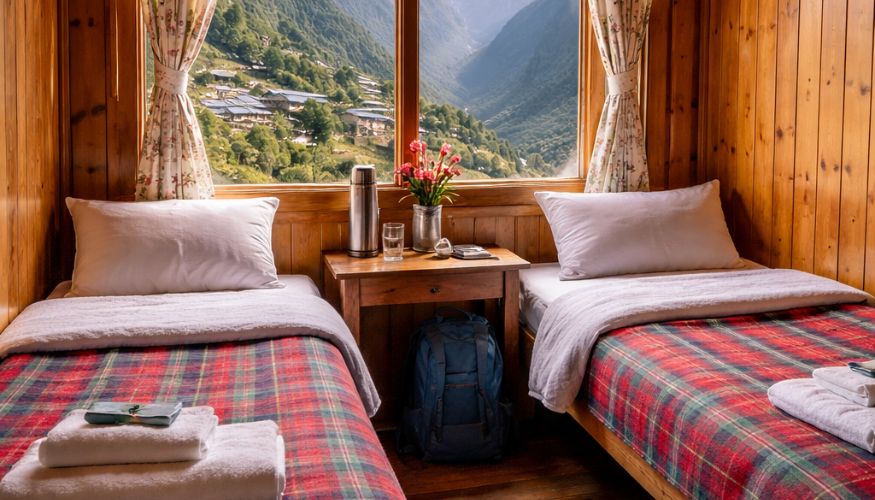
Facilities are basic but comfortable. Electricity is generally available, usually supported by solar systems, and WiFi is provided at many lodges for a supplemental charge.
Accommodation in Chhomrong is more developed and reliable than at smaller settlements higher up the trail, making it a practical and comfy overnight point ahead of entering the deeper Annapurna Sanctuary.
Typical Teahouse Experience in Chhomrong Village
Staying in Chhomrong Village follows the traditional teahouses and lodges model.
The meals are simple, filling, and made fresh daily. Dal Bhat rice, accompanied by lentils and seasonal vegetables, is the staple food and most popular choice for dinner. Menus also feature noodle soups, fried rice, potatoes, eggs, pancakes and tea. The food is meant to fuel, not diversify.
The rooms are simple but mostly clean, with twin beds, a blanket and little else. Bathrooms tend to be shared, and hot showers are often solar-heated, so availability can depend on sunlight and the season.
Comfort in Chhomrong has slowly improved over the years, though a sense of simplicity remains the name of the trekking game. The emphasis is on rest, warmth and readiness for the next day’s trek.
Culture and Lifestyle in Chhomrong
Chhomrong is largely inhabited by the Gurung people, one of Nepal’s most recognized indigenous communities.
The village is surrounded by terraced fields, a reflection of age-old traditions of agriculture and livestock practices among the Gurung community. Many families also have historical ties to military service and mountaineering work, reflecting a broader tradition of resilience and mobility.
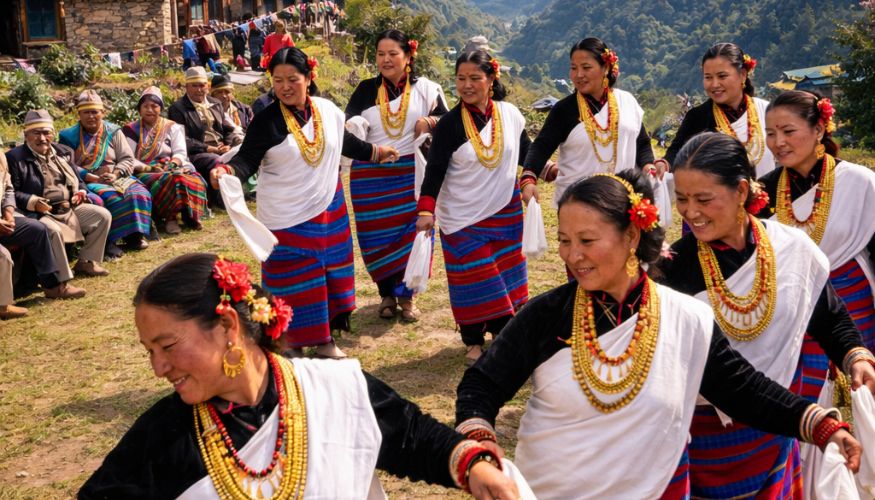
The hillside is lined with stone-built houses, and farming co-exists alongside tourism. There are seasonal festivals and Buddhist influences, but social life is largely practical and centered on daily labour
working fields, managing lodges or supporting trekking operations.
Things to Do in Chhomrong Village
While Chhomrong is most commonly seen as a stop on the road to Annapurna Base Camp, it has more than just transit value.
On early mornings, unobstructed views of Annapurna South soaring above the village.
Brief strolls through the terraced hills offer glimpses of everyday village life and the layered configuration of the settlement. Stone houses, farmland and snowcapped mountains make for pretty photography opportunities throughout the day.
Chhomrong is also a good place to rest before entering the deeper Annapurna Sanctuary. Spending time here helps to regulate the pacing of our climb and further acclimatizes body and mind for the long, sustained effort to come.
Staying put in Chhomrong frequently smoothens the general cadence of the trek.
How to Reach Chhomrong from Pokhara
There are two usual ways to reach Chhomrong from Pokhara.
First, take a jeep ride to Jhinu. The reduction of the lower walking section means trekkers can gain altitude more quickly near Chhomrong. The trail climbs up gradually from Jhinu Danda for about 3 to 4 hours above the village. Depending on the season and recent rainfall, road conditions can vary, and travel time can change.
Another option is to take the classic trek from Nayapul. This classic route is a steady progression through numerous villages over several days before you reach Chhomrong. It provides a gradual approach to the Annapurna landscape and longer days of walking.
No matter what route you take, vehicle access only mitigates part of the journey. Walking will never cease, and the last climb into Chhomrong is still always done on foot.
Permits Required for Chhomrong Village Trek
To trek to Chhomrong and onwards, towards the Annapurna Base Camp, you need two official permits.
The first one is the Annapurna Conservation Area Permit (ACAP). Chhomrong is inside the protected area of the Annapurna Conservation Area, and this permit goes towards conservation management, trail maintenance and local community development.
The latter is the TIMS card (Trekkers’ Information Management System). The card is used to register trekkers, for safety tracking and monitoring the routes within Nepal’s trekking areas.
Both passes are required and checked at designated control points along the trail. Bags trekkers have to carry all the way.
Estimated Budget Cost For Chhomrong Village Trek
Daily expenses in the Chhomrong route differ by season and personal spending habits. Costs generally increase gradually at higher elevations due to transport and supply logistics.
| Category | Estimated Cost (USD) |
| Transport (Pokhara-Jhinu Danda-Pokhara) | $20 to $30 by bus and sharing jeep, / $120 for a private jeep |
| Accommodation | $5 – $30 per Night depend on the hotel or lodge |
| Food | $30 – $45 per day |
| Permits | $60 ACAP and TIMS Card |
| Trekking Guide | $25 Per Day |
| Estimated Total Cost | $250 – $450 depends on travel style. |
Packing List for Chhomrong Village Trek
Given the fact that Chhomrong village is 2,170 meters above sea level, it is necessary to pack accordingly, without overdoing it. Lets see the packing list below in detail.
Clothing:
- Light down jacket or fleece
- Trekking pants
- T-shirts and thermal wear (winter)
- Rain protection
- Warm insulating layer
Trekking Equipment:
- Trekking shoes
- Day backpack
- Water bottle
- Sunglasses and sunscreen
Documents:
- Passport
- Permit documents (ACAP & TIMS)
- Basic first-aid supplies
- Travel insurance
Important Travel Tips and Safety Advice for Chhomrong Visitors
The descent from Chhomrong to the Modi Khola River is steep, and it can be physically taxing to climb back up, so pace should be careful. In reality, hydration is vital at this intermediate altitude.
We advise you to take enough cash, because there are no Bank ATM facilities available in Chhomrong village. We need to respect local homes and farmland, because the trail runs through residential and agricultural areas along its trail.
And as for starting your day every morning, this gives you a clear view of the mountains and better walking conditions. and , Altitude risk at 2,170 meters is relatively low for most trekkers, but one trail becomes increasingly colourful as you climb out past Sinuwa.
FAQs
What is the elevation of Chhomrong Village?
Chhomrong lies at around 2,170 meters (7,120 feet) above sea level.
How far is from Chhomrong to Annapurna Base Camp?
The standard duration for the trek to Annapurna Base Camp is 2 to 3 days from Chhomrong.
Is the Chhomrong trek difficult?
It is a route of long stone staircases and repeated changes in elevation. It is physically challenging, but feasible for the moderately fit.
Can I go to Chhomrong directly?
No. There is no permanent road access to the village itself. Only low lying trailheads are reachable by jeep like Jhinu Danda.
Is Chhomrong suitable for beginners?
Yes, this is suitable and perfect for beginners and kids with steady pacing, and a structured itinerary.
Are there any permits required for Chhomrong?
Yes. You need to obtion Annapurna Conservation Area Permit (ACAP) and TIMS card, and they will be checked along the trail.