
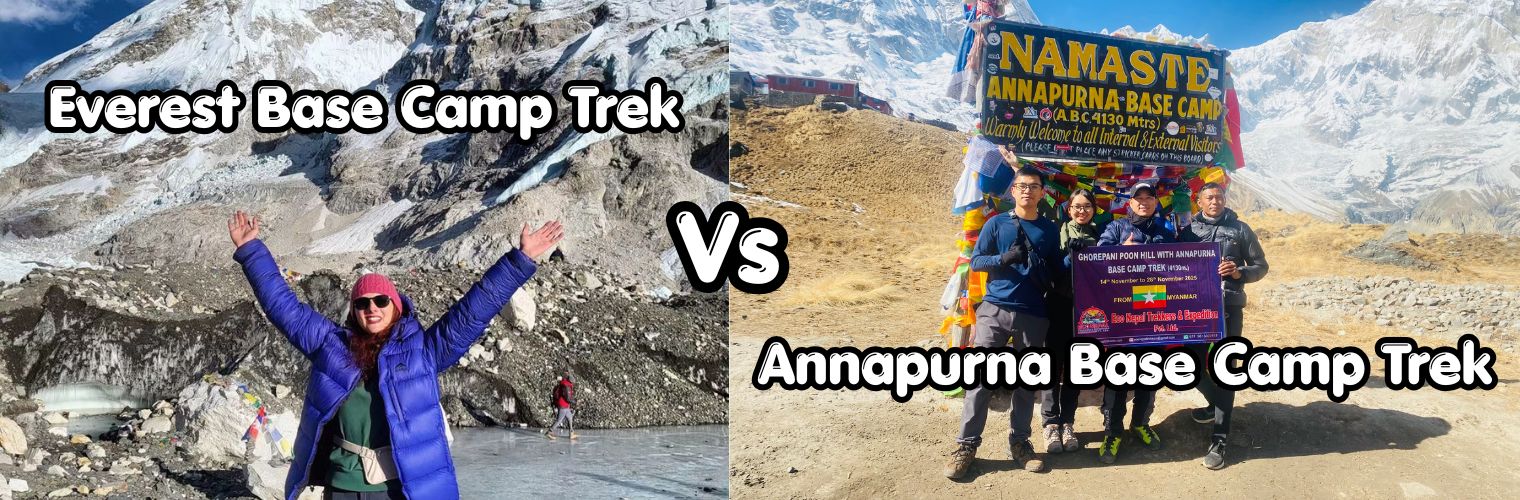
EBC Trek vs ABC Trek
When you are preparing for a trekking adventure in Nepal, you have probably heard and read about the two great routes, the Everest Base Camp Trek and Annapurna Base Camp Trek.
Both of these treks offer Himalayan landscapes, local culture, and trekking wonders, yet they provide a vastly different experience.
Firstly, the Everest Base Camp Trek is for trekkers who have always wanted to stand at the base of the world’s highest peak and experience Sherpa culture in the mythical Khumbu region.
However, the Annapurna Base Camp Trek offers a lower-altitude alternative, leading you deep into the Annapurna Sanctuary, through varied topography with impressive Gurung villages, rich forests, and beautiful mountain views.
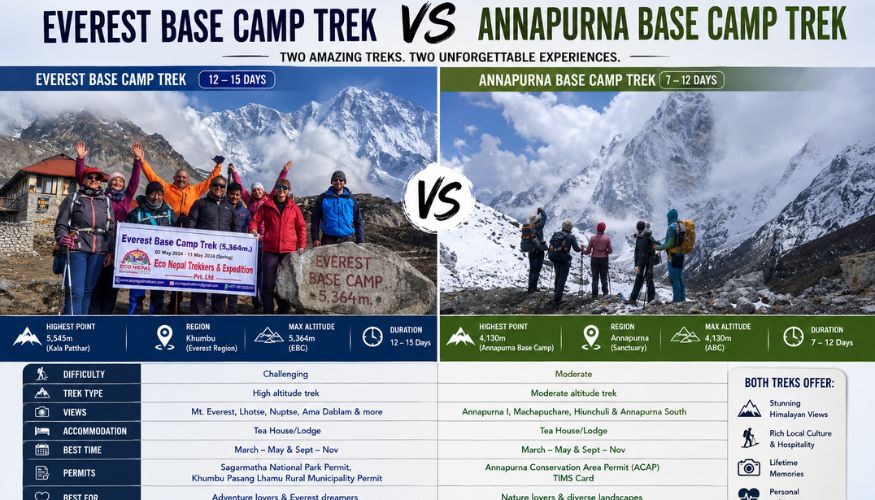
The selection of a trek again depends on your fitness level, travel time, budget, trekking experience, and the style of adventure you are looking for. Annapurna is at a similar altitude, offers easier access than Everest-based treks, and provides a more varied natural landscape at a much lower cost.
Welcome to the Ultimate Comparison between Everest Base Camp Trek and Annapurna Base Camp Trek, covering everything from itinerary, distance, difficulty, and altitude to cost, scenery, accommodation, permits, best time of the year for each trek, and which one is worth your penny.
Everest Base Camp vs Annapurna Base Camp at a Glance
Both the EBC Trek and the ABC Trek are two famous trekking adventures from Nepal, but they offer entirely different experiences.
Everest Base Camp is best for trekkers demanding the fundamentals of high-altitude trekking, dramatic Himalayan scenery, and Sherpa culture; Annapurna Base Camp is better for shorter itineraries at lower elevations with a mix of landscapes to soak up along your budget-friendly trek.
Here is a comparison with the most important differences to help you choose the trek that matches your physical condition, travel time, budget, and trekking goals.
| Feature | Everest Base Camp Trek | Annapurna Base Camp Trek |
| Location | Khumbu Region, Sagarmatha National Park | Annapurna Region, Annapurna Conservation Area |
| Maximum Altitude | 5,545 m (Kala Patthar) 5,364 m (Everest Base Camp) | 4,130 m (Annapurna Base Camp) |
| Trek Duration | 12 to 15 Days | 7 to 12 Days |
| Total Trek Distance | 130 km (Round Trip) | 70 to 115 km (Depending on Route) |
| Difficulty | Moderate to Challenging | Moderate |
| Best Season | Spring (March to May) & Autumn (September to November) | Spring (March to May) & Autumn (September to November) |
| Average Cost | $1,200 to $3,500 | $600 to $2,000 |
| Accommodation | Teahouses and Mountain Lodges | Teahouses and Mountain Lodges |
| Trekking Style | High-altitude Himalayan trek with Sherpa culture | Scenic mountain trek through forests, villages, and alpine landscapes |
| Suitable for Beginners | Yes, with proper preparation and acclimatization | Yes, more beginner-friendly than EBC |
| Mountain Views | Mount Everest, Lhotse, Nuptse, Ama Dablam, Pumori | Annapurna I, Machhapuchhre, Hiunchuli, Annapurna South |
| Cultural Experience | Sherpa villages, Buddhist monasteries, Everest culture | Gurung and Magar villages, traditional mountain lifestyle |
Trek Overview Of EBC Trek Vs ABC Trek
Both treks, Everest Base Camp Trek and Annapurna Base Camp Trek, will definitely offer you different experiences in the Himalayas!!
The EBC Trek takes you to the world’s highest mountain base camp via the famous region of Khumbu, whereas the Annapurna Base Camp Trek will take you into the heart of Annapurna Sanctuary, where you are encircled by some of Nepal’s highest peaks.
Both treks offer incredible mountain views and rich cultural experiences, but they differ in altitude, daily distance, route difficulty, and trekking style.
Everest Base Camp Trek Overview
Everest Base Camp is one of the most well-known high-altitude treks in the world. In the Khumbu region, it takes a well-trodden pathway past Sherpa villages, Buddhist monasteries, suspension bridges, and Sagarmatha National Park onto Everest Base Camp (5,364 m).
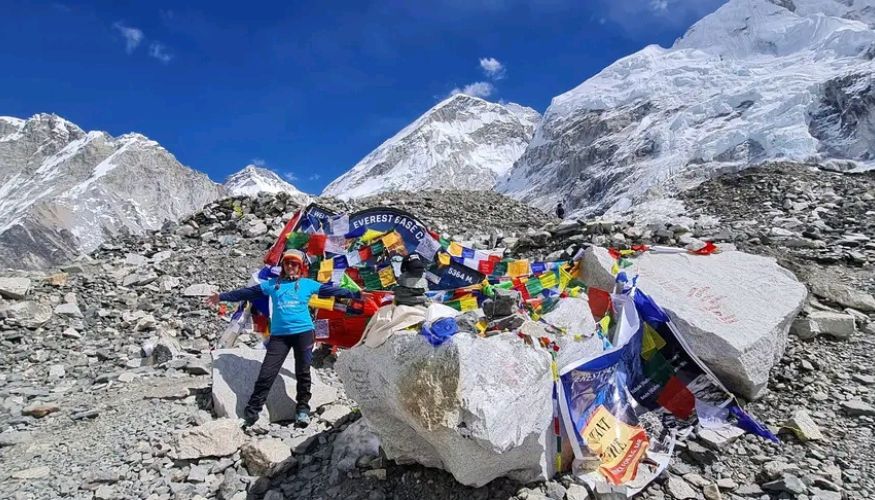
Many itineraries will also take you on a hike to Kala Patthar (5,545 m), the ultimate viewpoint of Mount Everest.
Annapurna Base Camp Trek Overview
Annapurna Base Camp is one of the most scenic trekking routes in Nepal that leads you through the traditional Gurung and Magar settlements, terraced farmlands, rhododendron forests, and waterfalls till Annapurna Base Camp (4,130 m) lies above.
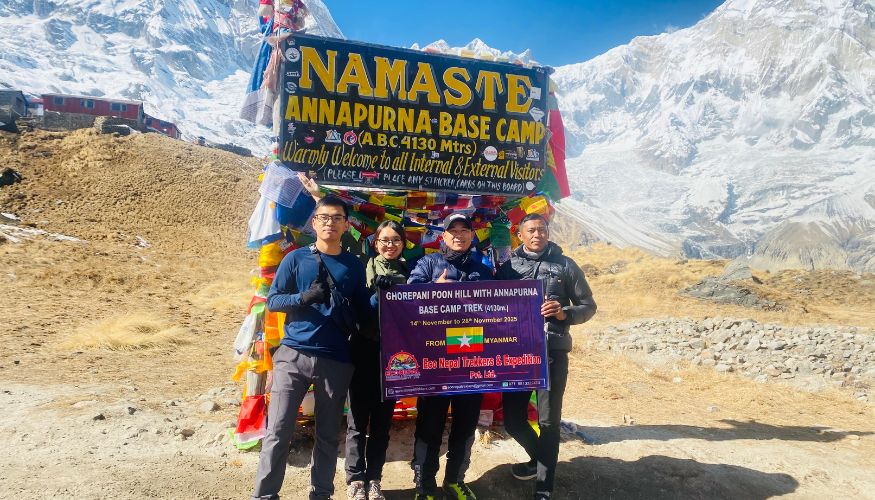
It is a closer view of Annapurna I, Machhapuchhre, Hiunchuli, and Annapurna South from the natural amphitheatre of the Annapurna Sanctuary.
Which Trek Is More Popular?
The Everest Base Camp Trek is a very famous trek route in Nepal because it offers you the chance to stand at the base of the highest mountain on earth.
The second most popular ongoing expedition after the EBC trek is the Annapurna Base Camp short trek, which lures trekkers searching for diverse scenic views, low altitude, a shorter period in Nepal, and an affordable Balmy Himalaya travelling experience.
Route and Landscape Comparison
Both treks offer incredible Himalayan beauty, but the mountain landscapes are entirely unique from each other.
The Everest Base Camp Trek traverses high alpine valleys, swaying suspension bridges, tumbling glacial rivers, lopsided rock moraines, and, of course, the Khumbu Glacier itself before arriving at Everest Base Camp. It is forest; the forests fade as you ascend into the hills, giving way to alpine tussock and finally crudely raw mountain peaks surrounding snow-capped summits.
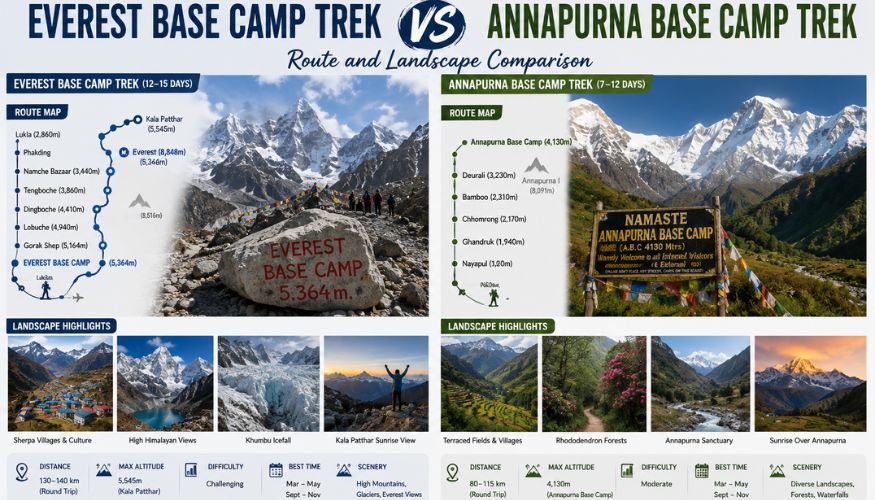
Annapurna Base Camp Trek navigates through terraced farmland, bamboo woods, rhododendron forests, waterfalls, rivers, and traditional mountain villages like Ghandruk and Chhomrong all at once, leading into the magnificent Annapurna Sanctuary.
Although Everest delivers dramatic high-mountain vistas and glaciers, Annapurna offers more varied scenery along the way, making it one of Nepal’s most scenic treks.
Mountain Views Comparison
Either of the two treks provides world-class scenery in the Himalayan mountains; however, each is a unique touring route.
The Everest Base Camp Trek offers almost intimate views of Mount Everest (8,848.86 m), Lhotse, Nuptse, Ama Dablam, Pumori, and Thamserku, as well as a number of other iconic peaks, with the best panoramic vistas being seen from Kala Patthar.
The Annapurna Base Camp Trek displays Annapurna I (8,091 m), Machhapuchhre (Fishtail), and surrounding peaks that fully encircle the Annapurna Sanctuary. Other ranges are located to the north of the Himalayas, where Annapurna is.
Everest Base Camp is the dream of touching the highest mountain. Annapurna Base Camp gives you one of the best mountain amphitheatres in the world if you enjoy a 360-degree spectacle of a Himalayan panorama encircled by enormous snow-covered summits.
Difficulty Comparison
Both treks are moderate to tough Himalayan adventures, but the Everest Base Camp trek is normally a more demanding route than the Annapurna Base Camp trek because of higher altitude, longer trekking route, and less oxygen in each cubic cm of air.
The Annapurna Base Camp Trek offers a shorter route at a lower elevation than the Everest Base Camp trek, so many first-time trekkers will find the Annapurna trek more suitably challenging.
Both routes have steep, long ascents and descents, but Everest still needs work on endurance & proper acclimatization with a more extended timeframe for day hikes.
| Feature | Everest Base Camp Trek | Annapurna Base Camp Trek |
| Trek Duration | 12 to 15 Days | 7 to 12 Days |
| Daily Walking Hours | 5 to 8 Hours | 4 to 7 Hours |
| Trail Conditions | Rocky trails, glaciers, moraines | Stone steps, forests, villages, mountain trails |
| Steep Climbs & Descents | Moderate | Moderate to High (Many Stone Staircases) |
| Overall Difficulty | Moderate to Challenging | Moderate |
Read More about the difficulty: Everest Base Camp Trek Difficulty, Annapurna Base Camp Trek Difficulty
Altitude and Acclimatization
One of the strict differences between these two treks is altitude. You will experience high elevation as the Everest Base Camp Trek has a maximum altitude of 5,545m at Kala Patthar, and Annapurna Base Camp is only 4,130m above sea level. Everest has an extra risk of altitude sickness due to the greater elevation.
Therefore, it includes two acclimatization days at Namche Bazaar and Dingboche. Annapurna Base Camp is significantly lower in altitude and therefore not recommended to acclimatize with the third-day trek, which makes it inherently safer for beginners and first-time high-altitude trekkers.
Cost Comparison
The Everest Base Camp Trek is usually more costly as it too includes a domestic flight to Lukla and has higher operating costs per day in the Everest region. The Annapurna Base Camp Trek has become relatively cheap due to road access from Pokhara and lower accommodation and food prices.
Both have excellent Return on Investment, but Annapurna wins hands down for the frugal traveller.
| Feature | Everest Base Camp Trek | Annapurna Base Camp Trek |
| Average Cost | $1,200 to $2,500 | $700 to $1,800 |
| Transportation | Lukla Flight / Road Transport | Lukla Flight / Road Transport |
| Transportation Cost | Higher | Lower |
| Better Value for Budget | Annapurna Base Camp |
Accommodation and Food
The accommodation during the trek comes in the form of simple but comfortable teahouses with food cooked fresh at every stop throughout your journey.
The Everest Base Camp Trek has a developed teahouse system, especially in Namche Bazaar, and the Annapurna Base Camp Trek has a better food variety because supplies can be more easily transported.
Both routes have facilities like Wi-Fi, battery charging, hot showers, and private rooms, though these are more basic and cost extra at higher altitudes.
Trekking Experience
Both versions are once-in-a-lifetime Himalayan experiences but are slightly different experiences.
The Everest Base Camp Trek also combines spectacular views of Earth’s highest mountain with a diverse and fascinating Sherpa culture, centuries-old Buddhist monasteries, glaciers, and suspension bridges.
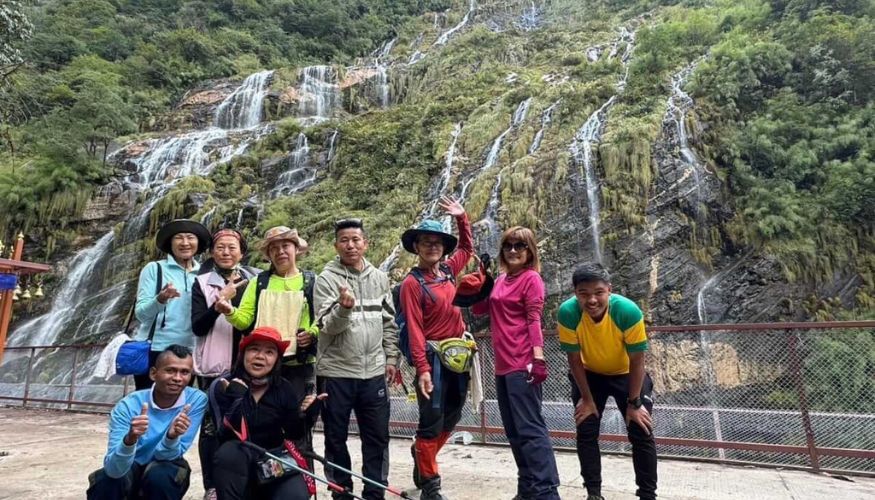
Annapurna Base Camp Trek has the most diverse landscape, characterized by terraced farmland, rhododendron forests, waterfalls, bamboo forests, and Gurung & Magar villages before finally arriving at Annapurna Sanctuary.
Everest provides a true high-altitude trek, while Annapurna is more diverse in scenery and culture.
Accessibility
The Annapurna Base Camp Trek is much more accessible than the Everest Base Camp Trek. So, your first step on Everest is to fly into Lukla, where flights can be delayed or even cancelled due to unavoidable bad weather. On the other end, the Annapurna Base Camp Trek starts off with a vehicle ride from Pokhara.
Therefore, transportation here is more convenient and inexpensive. Annapurna Base Camp ultimately has more manageable logistics and less risk of travel disruptions for trekkers.
Best Time to Trek
You can do both the Everest Base Camp Trek and Annapurna Base Camp Trek any time of the year, as both of them have low-altitude routes, but the spring trek (March to May) or autumn (September to November) is usually the best time for trekking.
It was during these seasons that the weather remained stable, mountain views stayed clear, and temperatures were lower. Winter is for experienced walkers willing to brave cold temperatures; monsoon season brings rain, soggy terrain, and cloud cover, rendering the lower reaches of either trail an adventure in limited visibility.
| Season | Everest Base Camp Trek | Annapurna Base Camp Trek |
| Spring | Excellent weather, blooming rhododendrons, clear Everest views | Excellent weather, colourful forests, ideal mountain visibility |
| Autumn | Best season with dry trails and crystal-clear skies | Best season with stable weather and spectacular mountain scenery |
| Winter | Cold temperatures and snowfall at higher elevations | Cold but easier than Everest due to lower altitude |
| Monsoon | Rain, cloudy skies, possible Lukla flight delays | Heavy rainfall, leeches, slippery trails, poor visibility |
If you want to know in detail about the best time for EBC Trek and ABC Trek, you can read our blogs here: Best Time For Everest Base Camp Trek, Best Time for Annapurna Base Camp Trek
Trekking with a Guide
For both treks, I would highly recommend travelling with a licensed trekking guide who can provide navigation, indigenous knowledge, altitude support, and emergency assistance.
You can hire porter services at both trailheads, which helps lighten your load along the trek. Although independent trekking is allowed on some routes, depending on recent regulations published in October 2023 by the Ministry of Tourism, it remains largely campylobacter-unrestricted when conducted as a guided trek organized by a guide-outfitter.
Read More: Hire Guide and Porter For Everest Base Camp Trek, Guide and Porter Hire for Annapurna Base Camp Trek
Which Trek Is Better for Different Types of Travellers?
Deciding whether to trek Everest Base Camp or Annapurna Base Camp ultimately comes down to your experience, fitness level, budget, and aspirations.
Everest is for travellers who want to go as high as it gets and experience one of the most famous trekking areas in the world, while Annapurna is more for people seeking variety from mountain scenery at lower altitudes and with easier access.
| Traveler Type | Best Choice | Reason |
| Beginners | Annapurna Base Camp | Lower altitude and shorter itinerary |
| Families | Annapurna Base Camp | Easier trails and more comfortable trekking pace |
| Solo Travelers | Everest Base Camp | Popular route with many trekkers and teahouses |
| Budget Travelers | Annapurna Base Camp | Lower transportation and overall trekking costs |
| Experienced Trekkers | Everest Base Camp | Higher altitude and greater physical challenge |
| Photographers | Everest Base Camp | Iconic Everest sunrise and dramatic Himalayan scenery |
| Adventure Seekers | Everest Base Camp | High-altitude trekking and legendary Everest experience |
Pros and Cons
Overall, both trekking experiences offer some of the best hiking in the Himalayas but have their respective benefits and limitations.
Only the Best for Trekkers Who Want the World’s Highest Mountain, a high-altitude challenge, and the Unique Sherpa Culture of the Khumbu Everest Base Camp Trek. But in comparison, it needs to be scheduled for a longer itinerary with higher costs and sufficient acclimatization due to its higher altitude.
Because the Annapurna Base Camp trek is shorter, cheaper, and easier to get to, it is great for beginners, families, and anyone on a budget! Though it lacks the height and iconic elements of the Everest region trekking, it still offers plenty of diverse landscapes, reasonable trekking conditions, and stunning mountain scenery.
The best trek for you could differ based on your fitness level, time, and budget, as well as the kind of experience in the Himalayas you are looking for.
Everest Base Camp vs Annapurna Base Camp Comparison Table
| Feature | Everest Base Camp Trek | Annapurna Base Camp Trek |
| Difficulty | Moderate to Challenging | Moderate |
| Average Cost | $1,200–2,500 | $700–1,800 |
| Trek Duration | 12–15 Days | 7–12 Days |
| Highest Elevation | 5,545 m (Kala Patthar) | 4,130 m (ABC) |
| Accommodation | Well-developed teahouses and lodges | Comfortable teahouses and lodges |
| Crowds | Higher during peak seasons | Moderate to High |
| Accessibility | Flight to Lukla | Road access from Pokhara |
| Scenic Diversity | Glaciers, alpine valleys, high mountains | Forests, waterfalls, villages, alpine landscapes |
| Mountain Views | Everest, Lhotse, Nuptse, Ama Dablam | Annapurna I, Machhapuchhre, Hiunchuli, Annapurna South |
| Cultural Experience | Sherpa culture and Buddhist monasteries | Gurung and Magar culture |
| Best For | High-altitude adventure and Everest experience | Scenic, affordable, and beginner-friendly trekking |
Which Trek Should You Choose?
Your choice is entirely dependent on what you enjoy, how experienced a trekker you are, your fitness level, and how much time you have to spend.
For those with dreams of gazing up at the world’s tallest peak and walking one of the most famous trekking trails on earth, the Everest Base Camp Trek is an easy selection.
If you opt for a shorter, lower-altitude trek with varied landscapes, lush scenery, and easier accessibility, the Annapurna Base Camp Trek would be a better option. Expressing the magnificence of the Nepalese Himalayas with a lifetime mountain adventure is what both treks have to offer.
If you have enough time, doing both treks on separate occasions is an opportunity to experience a fresh flavour of the Himalayan regions, cultures, and landscapes in completely different parts of Nepal, and to see why they are the country’s most popular trekking adventures.
FAQs
Which trek is harder, Everest Base Camp or Annapurna Base Camp?
The EBC Trek is more challenging than the Annapurna Circuit; it goes to a higher altitude, has two full days spent resting and acclimatizing in place of one, and longer days of trekking. The Annapurna Base Camp Trek is less demanding and has a lower maximum altitude, which makes it easier for most trekkers.
Which trek is better for beginners?
With a lower altitude, shorter itinerary, less technical and more accessible treks, as well as a decreased risk factor from altitude sickness, the Annapurna Base Camp Trek is tailored for beginner trekkers.
Which trek is more expensive?
The Everest Base Camp Trek is expensive due to domestic flights to Lukla, higher accommodation and food prices, and overall trekking logistics. The Annapurna Base Camp Trek is generally more budget-friendly.
Which trek has better mountain views?
Both treks offer spectacular Himalayan scenery. The Everest Base Camp Trek provides iconic views of Mount Everest, Lhotse, Nuptse, and Ama Dablam, while the ABC Trek offers beautiful panoramic views of Annapurna I, Machhapuchhre, Hiunchuli, and Annapurna South.
Which trek has a higher risk of altitude sickness?
The Everest Base Camp Trek has a higher risk of altitude sickness because it reaches 5,545 meters at Kala Patthar. The Annapurna Base Camp Trek reaches 4,130 meters, resulting in a lower altitude risk.
Which trek is more crowded?
Generally, Everest Base Camp Trek is more crowded during the spring and autumn trekking seasons. Annapurna Base Camp is also popular but usually experiences fewer trekkers.
Which trek offers the best value for money?
The Annapurna Base Camp Trek offers excellent value for money with lower overall costs, easier transportation, shorter duration, and outstanding mountain scenery. The Everest Base Camp Trek offers unmatched value for trekkers whose goal is to experience the world’s highest mountain.
Can I complete both treks in one trip?
Yes. If you have enough time, you can complete both treks in a single visit to Nepal. However, most trekkers choose to complete them on separate trips to fully enjoy each region and allow adequate time for rest and travel.
Conclusion
The Everest Base Camp Trek and Annapurna Base Camp Trek are two of the best trekking destinations in Nepal, but deciding between them depends on your travel motivation.
Everest Base Camp Trek is Ideal for high-altitude trekkers who want iconic views of Mount Everest and to experience the Sherpa culture of the Khumbu region. If you are looking for a shorter, cheaper trek with varied terrain at lower elevations while still experiencing spectacular mountain scenery.
then the Annapurna Base Camp Trek is for you. Depending on your budget, fitness level, time at hand, trekking experience, and the kind of adventure you prefer. Whichever trek you choose, both these treks promise to deliver lifelong Himalayan memories and highlight why Nepal continues to reign as the best trekking destination in the world.