
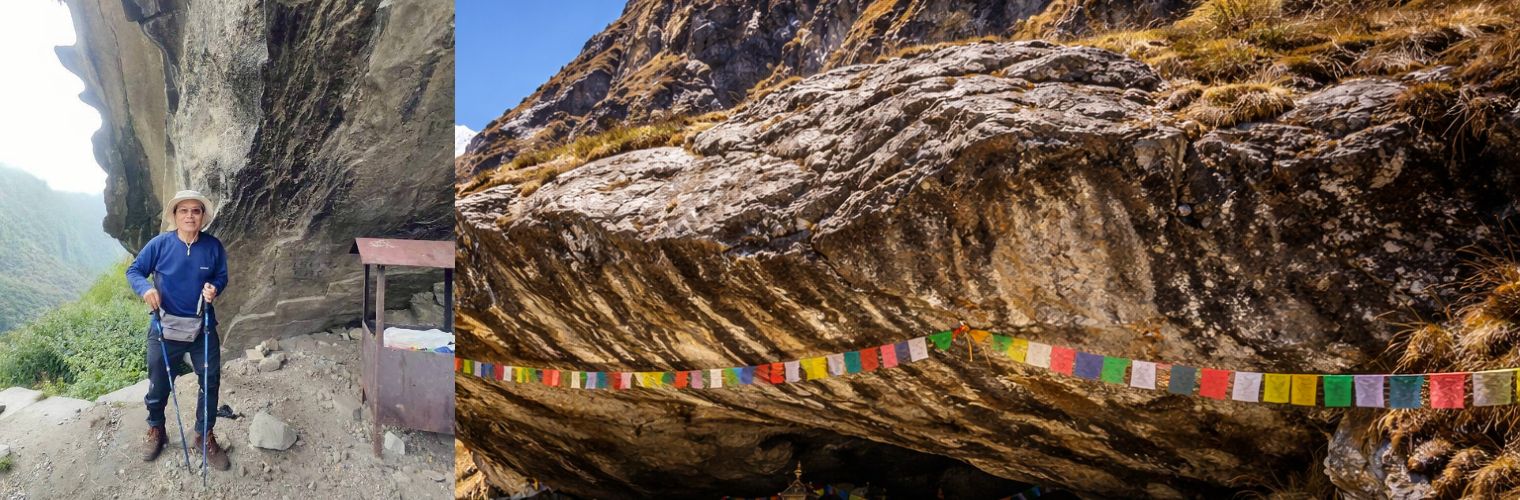
Hinku Cave
Hinku Cave is a natural rock overhang during the Annapurna Base Camp trekking route in Nepal. When Himalayan trekking was in its infancy, there were no lodges or teahouses for trekkers to use as a basic overnight shelter. Nestled among the wooded sections of the trail, it offered safety from rain and cold.
Hinku Cave was later no longer used for shelter, but it still remains an important historical site along the ABC Trek. It was a moment in time when trekking in the Annapurna region required greater self-sufficiency and less infrastructure.
Where Is Hinku Cave Located?
Hinku Cave is along the Annapurna Base Camp trekking trek within Nepal’s Annapurna Conservation Area. It’s located before reaching Deurali, on the trekking route toward Machhapuchhre Base Camp, in the upper portion of the Modi Khola.
The cave is at an elevation of around 3,200–3,300 meters above sea level. Here, the landscape begins to change, with dense forest giving way to more open alpine terrain as trekkers head deeper into Annapurna Base Camp.
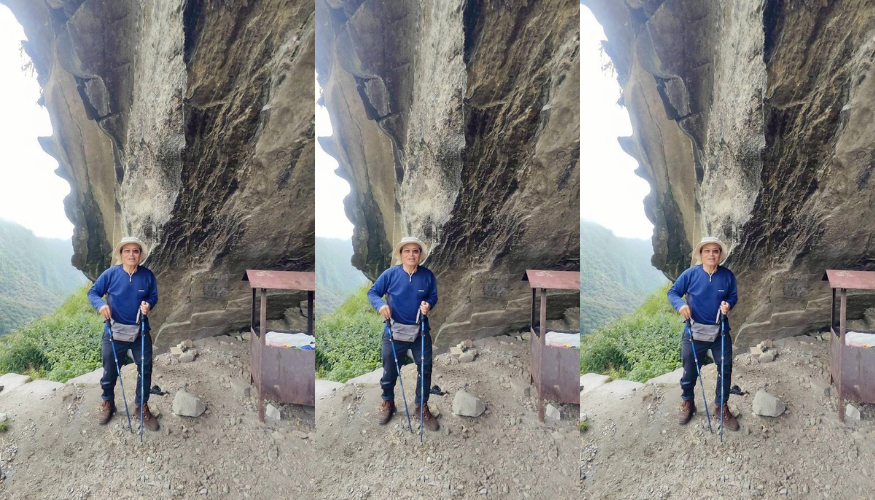
Located in a narrow valley corridor formed over the millennia by glacial and river action, Hinku Cave is situated at approximately 28.49° N, 83.93° E.
Today, it is the best stop on the Annapurna Base Camp route, a significant stopping point before infrastructure improvements in the area.
Why Is Hinku Cave Historically Important?
Yes, it is historically significant. Hinku Cave was a natural shelter before the development of teahouses along the route to Annapurna Base Camp. In trekking’s early days, a lack of infrastructure made the rock overhang to shield for wind, snow and cold in the Modi Khola Valley between Deurali and camps at high altitude.
The cave is also linked to the early exploration of the Annapurna region, which gained world fame after the first ascent of Annapurna I in 1950. Hinku Cave is a remnant of another era, when travel in the Himalayas was more self-sufficient and when people were transitioning from pioneering routes to organized trekking corridors as we see now.
Hinku Cave on the Annapurna Base Camp Trek Route
Hinku Cave is located on the route to Annapurna Base Camp, just before you find Deurali while ascending from Bamboo. It is situated along a narrow segment of the Modi Khola Valley and is fairly close to Deurali, making it a quick rest stop before heading into higher alpine terrain.
Approaching Deurali from Bamboo, one first reaches Hinku Cave, signalling the transition from part-forested sections to an open mountainscape. Let’s check the route below on table.
| Route | Duration | Elevation | Difficulty |
| Chhomrong to Bambo | 5-6 hrs | 2310m | Moderate |
| Bambo to Hinku Cave and Deurali | 5-6 hrs | 3,230 m | Moderate |
| Deurali to Machhapuchhe Base Camp | 4-5 hrs | 3,700m | Moderate |
| Machhapuchhe Base Camp to Annapurna Base Camp | 2 hrs | 4,130m | Moderate |
What Was It Like Staying in Hinku Cave?
Hinku Cave was used as a basic overnight shelter before the teahouses and lodges opened on the way to Annapurna Base Camp. It was a rudimentary, strenuous place to stay. There were no bunks, no orderly rooms, no insulation, only a natural rock overhang sheltering trekkers from wind and snowfall.
The floor was hard stone, sometimes uneven and wet. Trekkers and early expedition teams slept huddled in close quarters, in their own sleeping bags for warmth. Privacy was negligible, and comfort was often a function of one’s gear and the weather.
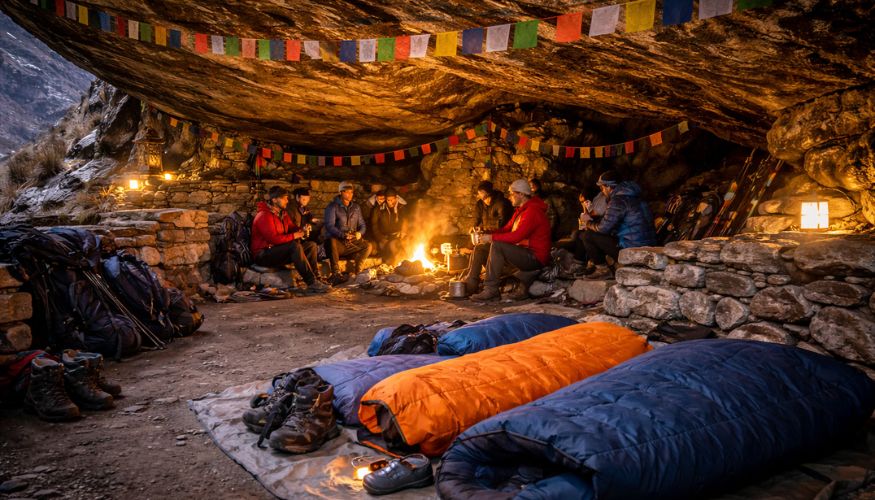
By contrast to today’s modern teahouses complete with beds, meals, dining halls and rudimentary plumbing, Hinku Cave hails from an era of Himalayan travel long before the comforts served along the trail, a time when shelter meant sheltering you from rain or wind but not your tendency to snore.
Why AnnapurnaBase Camp Trekkers Still Visit Hinku Cave Today?
Though it is not used as primary lodging anymore, Hinku Cave is still a well-known landmark on the Annapurna Base Camp trail. Trekkers typically spend a short time there, out of historical curiosity, to take pictures or listen to stories from guides about the early days of trekking.
For many, it begins as a symbolic reminder of how the route has changed from a feel-the-lessons kind of expedition travel to a well-structured trekking corridor with supported lodges. It is still a natural point of reference between Bamboo and Deurali.
Altitude & Terrain Around Hinku Cave
Hinku Cave is located about 3,200 meters before reaching Deurali, at the narrow part of the Modi Khola Valley. It’s up around this elevation that the landscape begins to shift dramatically. Dense forest becomes sparse as trekkers ascend toward Deurali and the higher camps.
Eventually, the valley narrows and steepens, with some sections potentially affected by avalanche danger in heavy snowfall, especially late winter/early spring. Below is the Modi River, carving this deep gorge into the Annapurna Sanctuary.
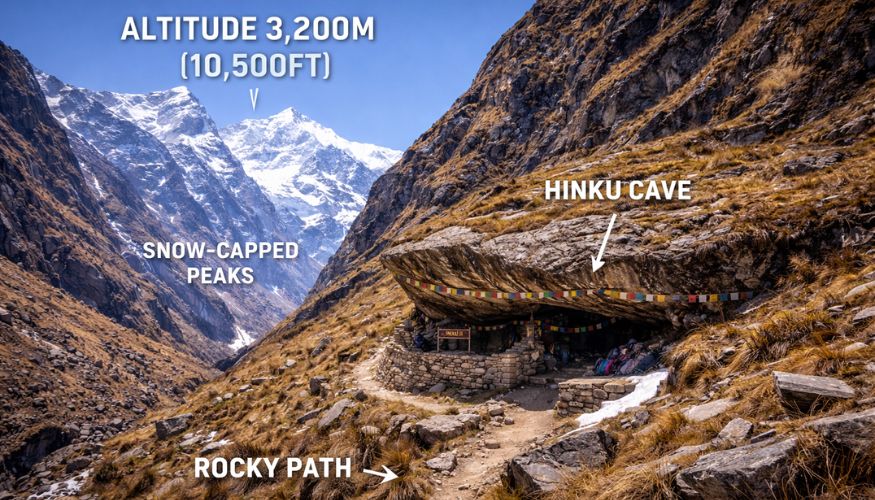
At this elevation, trekkers may start to experience the early effects of thinner air. As the body adapts to higher elevations, pacing and hydration are crucial. Hinku Cave does represent a geographical transition; you go from forest to alpine here, but also an acclimatization point, as trekkers build up for higher camps above 3,500 meters.
What Does Hinku Cave Look Like?
Hinku Cave is a natural rock overhang formed by the erosion of the steep walls of the Modi Khola Valley. Rather than a cave, it is just the jagged base of a wide rocky face that arches over and offers a sheltered area beneath. The inner area is roughly small and jagged, with a stony floor which limits how deep it can go for large groups.
It has a mountain setting with steep cliffs and rugged terrain surrounding the cave. The narrowness of the valley and rock walls towering overhead create a walling off perspective, notably as trekkers gain proximity to Deurali and the more marketable members of the Annapurna Sanctuary.
Is Hinku Cave Still Used for Overnight Stay?
No, Now Hinku Cave is not used for overnight stays. Because a teahouse settlement has been established in Deurali, a 15 to 20-minute walk from Hinku Cave.
However, it might be used as a makeshift emergency shelter in the event of someone becoming stuck due to weather or sudden change. It was never meant to be used as a planned overnight stop, because of the safety threats, cold exposure and lack of protection compared to modern-day lodges. In high-altitude environments, the choice of structured accommodation greatly reduces the risk.
The Evolution of Trekking Infrastructure in Annapurna
The Annapurna trekking route has changed a lot over the decades. Historically, natural shelters like Hinku Cave offered little more than a hastily erected roof for trekkers or expedition crews. As trekking tourism slowly began to take root, basic lodges started popping up along the trail.
Modern teahouses provide organized accommodation, access to food and communication channels and better safety measures. This new trend is a sign of the increasing popularity of trekking tourism in Nepal and a move toward safer, more accessible mountain travel.
Hinku Cave serves as a relic of that evolution, from dependence on natural places to sleep to a commercially established trekking infrastructure now focused on comfort, logistics and risk management in the Annapurna region.
FAQS
Where is Hinku Cave located?
Hinku Cave is located between Bamboo and Deurali in the Modi Khola Valley of the Annapurna Region, Nepal.
What is the altitude of Hinku Cave?
Hinku Cave sits at approximately 3,200 meters (10,500 feet) above sea level.
Can you sleep at Hinku Cave?
Overnight stays are rare today. Although the cave was allegedly used as housing before teahouses were built, most trekkers generally pass by, going on to nearby lodges in Deurali. It can give emergency cover in sudden changes in weather, but is not proposed as a planned overnight stay.
Is Hinku Cave on the ABC trek route?
Yes, Hinku Cave is on the main Annapurna Base Camp trail. Trekkers pass by it when they travel from Bamboo up toward Deurali and higher camps.
Why is Hinku Cave famous?
The known Hinku Cave Historical shelters for trekkers and expedition teams were used before the teahouses built up on their way to the Annapurna trail.
Is Hinku Cave safe?
Hinku Cave is a relatively safe short stop. But, because it is high in altitude and has slopes that are prone to avalanches at certain times of the year nearby, it is not suitable for overnight stays on planned arrivals. Modern lodges provide much better safety and comfort to trekkers.