
Lukla Airport In Nepal: Location, Altitude, And Why It Matters
Every Everest journey begins with a decision long before the trail starts. That decision is how you enter the mountains.
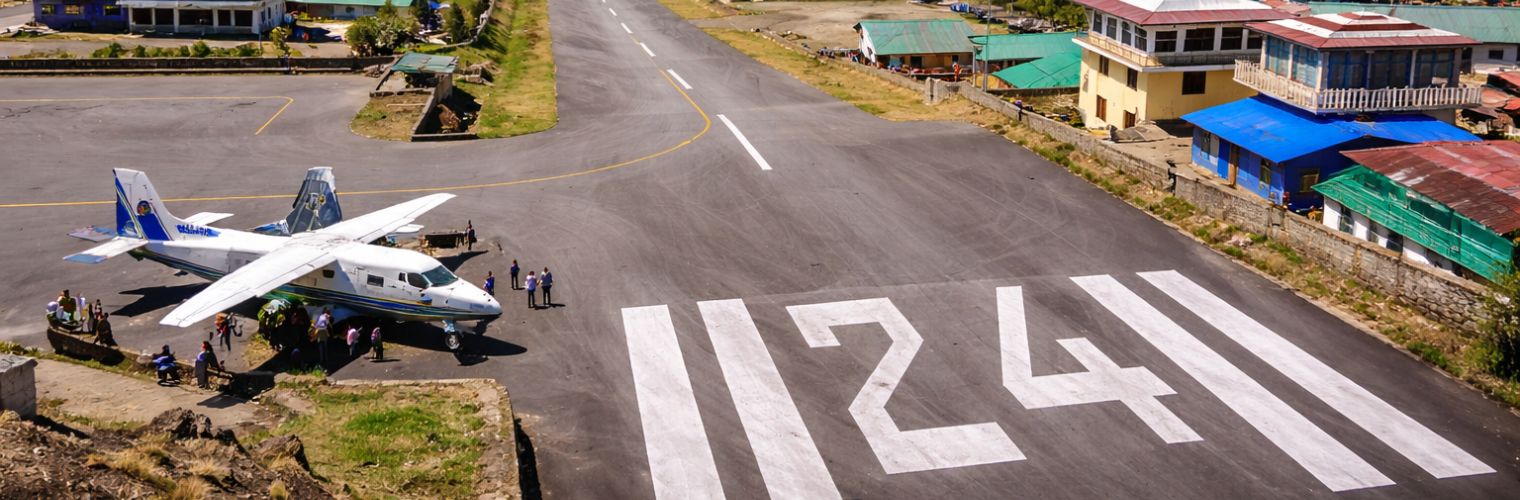
For most trekkers, that entry point is Lukla Airport, officially known as Tenzing-Hillary Airport. It sits in Lukla, Nepal’s Everest region, at an elevation of 2,846 meters (9,337 feet) above sea level, and connects the lower Khumbu Valley with the rest of the country.
This airport is often talked about in extremes. In reality, it is neither mystical nor reckless. It is simply a mountain airport, built where roads end, and walking begins.
Understanding how Lukla Airport works does not make your trip scarier. Rather, it makes it calmer.
Quick Summary
- Lukla Airport is the main air gateway to the Everest region.
- It sits at 2,846 meters inside Lukla town in Nepal.
- The airport is small but officially regulated and heavily used.
- Flights operate based on visibility and weather conditions, not fear-based risk.
- Weather delays are normal and manageable when buffer days are built into itineraries.
- Lukla Airport supports trekking logistics, local communities, and emergency access.
- Understanding how the airport works helps make Everest travel calmer and more predictable.
Where Is Lukla Airport?
Lukla Airport is located inside Lukla Bazaar, in an area locally known as Chaurikharka, within Solukhumbu District of eastern Nepal. Administratively, it falls under Khumbu Pasang Lhamu Rural Municipality-2, and it lies inside the buffer zone of Sagarmatha National Park.
That last detail matters more than people realize.
Because the airport is inside a protected mountain region, it was never designed to become a large, expandable hub. It was designed to do one job well: move people and supplies efficiently into a remote Himalayan valley.
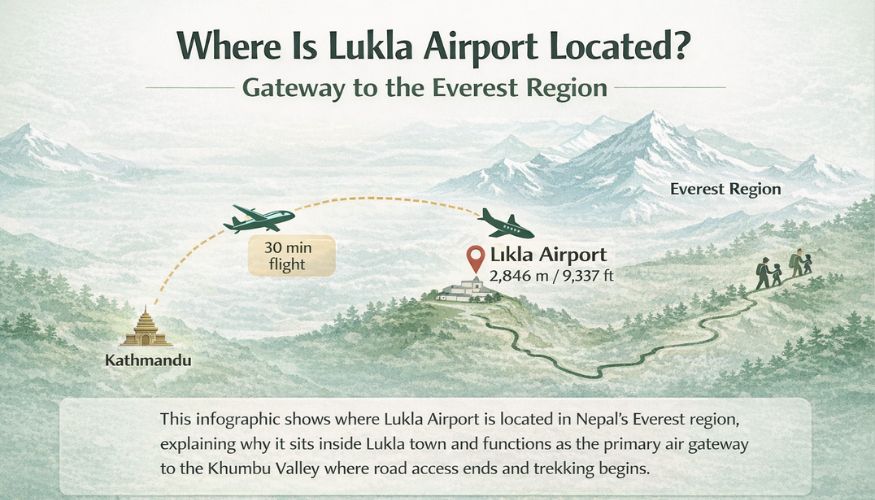
Unlike many airports around the world that sit far outside cities, Lukla Airport sits inside the town itself. When you land, you do not transfer to another vehicle. You walk out, and you are already in Lukla.
For trekkers, this is ideal. There is no long approach drive, no additional altitude jump, and no wasted energy before the trek begins.
A comparable situation exists in places like Telluride in the USA or Barra in Scotland, where the airport exists because geography leaves few alternatives. Lukla belongs to that same category of practical mountain access points.
Lukla Airport in Nepal: Names, Identity, and Why They Matter
Officially, Nepal’s Civil Aviation Authority lists the airport as TENZING HILLARY (LUKLA). In everyday use, people simply call it Lukla Airport.
You may also see:
- Tenzing-Hillary Airport
- Aeroporto Lukla or Aeroporto di Lukla in European search results
These are not different airports. They reflect different naming habits across languages.
What matters operationally is that Lukla Airport carries:
- IATA code LUA
- ICAO code VNLK
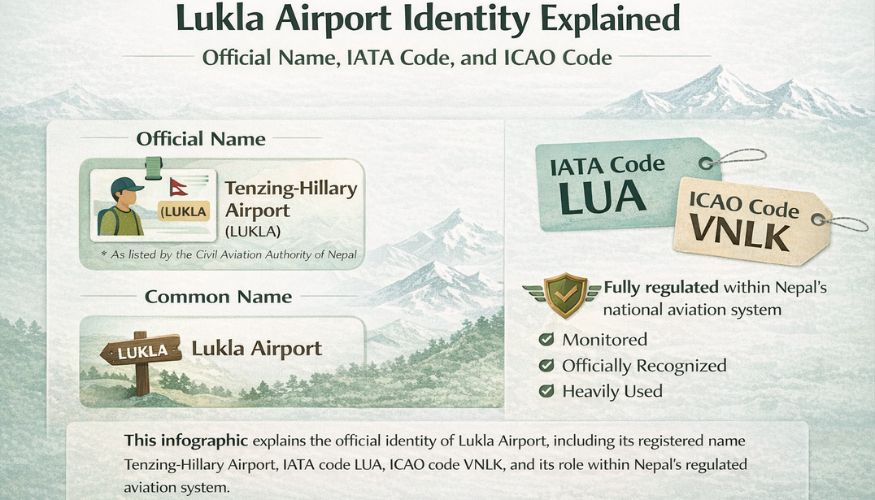
These codes are how airlines, pilots, and air traffic systems identify airports globally. They are also why Lukla flights integrate cleanly into Nepal’s national aviation network rather than operating as some informal landing strip.
This distinction is important for trekkers because it offers a quietly reassuring assurance: Lukla is regulated, monitored, and part of a national system.
How High Is Lukla Airport?
The official published elevation of Lukla Airport is 2,846 meters above mean sea level.
That number is often quoted dramatically, but altitude alone does not create danger. What altitude does is change how your body and aircraft behave, slowly and predictably.
At this height:
- Breathing may feel slightly faster when walking uphill
- Sleep can be lighter for some people the first night
- Hydration becomes more important
This is not an illness. It is an adjustment.
If you have visited places like Aspen (USA), La Paz (Bolivia), or even high mountain towns in Japan’s Nagano region, you may have felt something similar. Lukla is higher than many alpine resorts, but it is not an extreme altitude zone.
The real altitude challenges on the Everest Base Camp trek begin days later, and are very minimal at the airport itself.
Lukla Elevation vs Lukla Altitude: How High Is Lukla Airport Actually?
Many travellers notice that different websites list different elevation numbers for Lukla. This is one of the most common sources of confusion.
Here is the simple explanation.
The airport elevation, used for aviation purposes, is 2,846 meters, and a nearby meteorological station lists an elevation of 2,786 meters.
Both are correct.
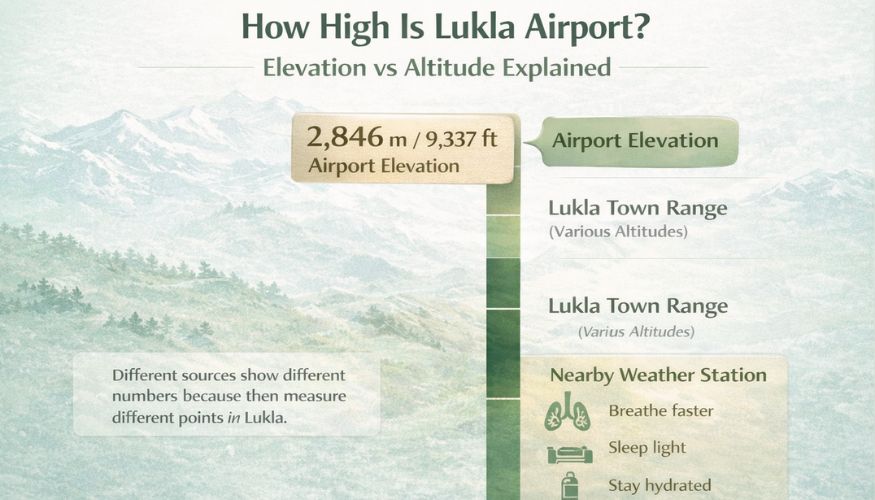
They measure different reference points.
The airport elevation refers to the aerodrome’s official reference above sea level. The weather station’s elevation refers to the location where the sensors are physically installed. Lukla town itself also varies slightly in height depending on where you stand.
When people search for “Lukla Nepal altitude,” they are often mixing these references together.
For trekking and flight planning, the airport elevation is the correct anchor.
Lukla Airstrip In Nepal Is Designed for Mountains, Not for Drama
The Lukla runway is short, but it is intentionally designed that way.
It measures 527 meters long and 20 meters wide, with an asphalt concrete surface. That may sound small compared to international airports, but size alone does not define capability.
Mountain airports across the world use similar designs:
- Short runways
- Specialized aircraft
- Terrain-guided layouts
The planes that operate here are not generic jets. They are STOL aircraft, built specifically for short takeoff and landing environments. You see the same aircraft families operating in Alaska, northern Europe, parts of Japan, and remote Asian regions.
The Lukla runway is not a compromise. It is a solution built for the landscape.
Lukla Town and Why the Airport Sits Where It Does
Lukla exists because of the airport, and the airport exists because of Lukla.
Before air access, reaching this part of the Khumbu Valley required weeks of walking from lower elevations. The airport reduced that approach time dramatically and allowed trekking, medical access, education, and supplies to reach the region more reliably.
Today, Lukla functions as:
- a trekker staging point
- a supply hub
- an emergency access node
- a working mountain town
For trekking companies like us, Lukla is where planning meets reality. Gear is reorganized, loads are redistributed, and pace becomes important for the first time.
This is also why Lukla is busy during the trekking season. It is not chaos. It is coordination.
Lukla Weather Without the Fear Narrative
Most stories about Lukla focus on the weather as something unpredictable or threatening. That framing is misleading.
The key operational fact is this: Lukla Airport operates under Visual Flight Rules. This means pilots must have sufficient visibility to fly safely.
That single rule explains most delays.
Flights tend to operate best:
- in the early morning
- during clear visibility windows
- outside heavy cloud or fog layers
In fact, here is the month-by-month overview of Lukla weather with how difficult it is to fly during that month:
| Month | Average Temperature (°C) | Typical Flying Conditions |
| January | -10 to 6 | Cold, clear mornings; flights depend on visibility and frost |
| February | -8 to 8 | Cold but improving; morning flights often possible |
| March | -4 to 10 | Stable spring weather; good visibility in early hours |
| April | -2 to 13 | One of the best months; clear mornings, busy air traffic |
| May | 2 to 15 | Warmest pre-monsoon month; clouds build later in the day |
| June | 5 to 17 | Monsoon onset; frequent cloud and visibility delays |
| July | 6 to 18 | Peak monsoon; limited flying windows, weather dependent |
| August | 6 to 18 | Monsoon continues; short, clear gaps possible in mornings |
| September | 4 to 16 | Monsoon retreat; improving conditions, some delays early |
| October | -1 to 14 | Best overall month; clear skies and reliable flights |
| November | -5 to 10 | Cold nights; generally stable, shorter daylight window |
| December | -8 to 7 | Very cold mornings; flights possible with clear visibility |
Furthermore, the Civil Aviation Authority of Nepal also publishes seasonal operating hours, which change slightly during the winter months. These are operational windows, not guarantees.
This is not unique to Lukla.
Mountain airports in South Korea, Japan, and parts of Europe operate under similar visibility-dependent constraints. Lukla simply receives more attention because of Everest.
The correct response to this reality is not fear. It is planning flexibility.
Can You Drive From Kathmandu to Lukla?
This question comes up frequently, and the answer deserves honesty.
There is no consistent, reliable road that reaches Lukla Airport directly.
However, road construction has extended access toward areas like Surkhe and Chaurikharka, and in the future, road access may improve further. But the harsh truth is, conditions remain seasonal and terrain-dependent.
For most trekkers today:
- Driving replaces only part of the journey
- Walking remains necessary
- Flying remains the most practical option
This situation is common in mountainous regions globally. Roads arrive gradually, not suddenly.
Tenzing and Hillary Airport: Why the Name Matters
While this airport is famously known as Lukla Airport, but it’s official name is Tenzing and Hillary Airport. The airport is named after Tenzing Norgay Sherpa and Sir Edmund Hillary, whose 1953 Everest ascent reshaped how the world understood Himalayan travel.
The airport began operations in September 1971, long after that ascent, but the name reflects partnership rather than conquest. It recognizes local knowledge and international collaboration.
For trekkers, this name is not a symbolic decoration. It reflects the shared responsibility between visitors and the communities of guides and local people that host them.
Is Lukla Airport Dangerous?
Before diving into that part, this question deserves context, not exaggeration.
Lukla Airport is:
- high altitude
- terrain constrained
- weather dependent
And reasons like these do make Lukla Airport a little dangerous. But these are also the reasons why the Everest Base Camp trek is dangerous.
However, it is also:
- regulated by Nepal’s aviation authority
- operated daily during seasons
- supported by decades of experience
- used for medical evacuations, cargo, and local transport
The reason Lukla attracts attention is not that it is reckless, but because it is visible. But al
How Busy Lukla Airport Actually Is
One of the least known facts about Lukla is how heavily it is used.
In a recent full operational year, official figures show nearly 200,000 passenger movements and over 50,000 aircraft movements.
This level of traffic does not happen at unstructured airfields. It happens at airports that work.
High usage brings procedures, oversight, and institutional knowledge. That is a stabilizing factor, not a risk multiplier.
Why Lukla Airport Matters to Your Everest Trek
For trekkers, Lukla Airport matters because it:
- shortens approach time
- allows controlled altitude entry
- enables medical access
- supports local livelihoods
- keeps the Everest region connected year-round
This is why professional trekking companies treat Lukla not as a gamble, but as part of a system.
When you understand how the airport fits into the bigger picture, it stops being something to fear and starts being something to respect.
So, What Is Lukla Airport?
Lukla Airport is not an adventure challenge. It is a working mountain gateway.
It exists because the Everest region needs access, not spectacle. It functions because people understand its limits and plan within them.
At Eco Nepal Trekkers, we treat Lukla the same way we treat the trail itself: with preparation, patience, and realism.
That mindset is what turns an intimidating name into a calm beginning.
FAQs
Do flights to Lukla allow checked luggage like international flights?
Yes, but luggage limits are much lower than on international flights. Weight restrictions depend on the airline and aircraft type, and excess luggage may be delayed to later flights.
What happens if my luggage does not arrive on the same flight as me?
This is common during busy seasons. Luggage is usually flown on the next available flight once weather and capacity allow, often within one or two days.
Can helicopters land at Lukla Airport if planes cannot?
Sometimes yes, sometimes no. Helicopters still require visibility and safe wind conditions, and they do not operate automatically when flights are cancelled.
Is Lukla Airport used for medical evacuations?
Yes. Lukla is a major coordination point for helicopter evacuations from the Everest region, especially for altitude illness or injuries.
Are Lukla flights more expensive than other domestic flights in Nepal?
Yes. Short-runway aircraft, limited seating, and high demand make Lukla flights more expensive than lowland domestic routes.
Do Lukla flights operate year-round?
The airport operates year-round, but flight frequency drops significantly in winter and during peak monsoon months due to weather conditions.
Can children or elderly trekkers fly into Lukla?
Yes. There are no age restrictions for flying into Lukla, but medical fitness and comfort with altitude should be considered.
Is there a control tower at Lukla Airport?
Lukla Airport operates with AFIS (Aerodrome Flight Information Service), not a full control tower like major international airports.
Can you spend a night in Lukla if flights are delayed?
Yes. Lukla has many lodges and hotels, and staying overnight due to delays is very common and manageable.
Is Lukla Airport only used by trekkers?
No. It is also used by local residents, cargo supply flights, emergency services, and government operations, making it a lifeline airport, not just a tourist one.