
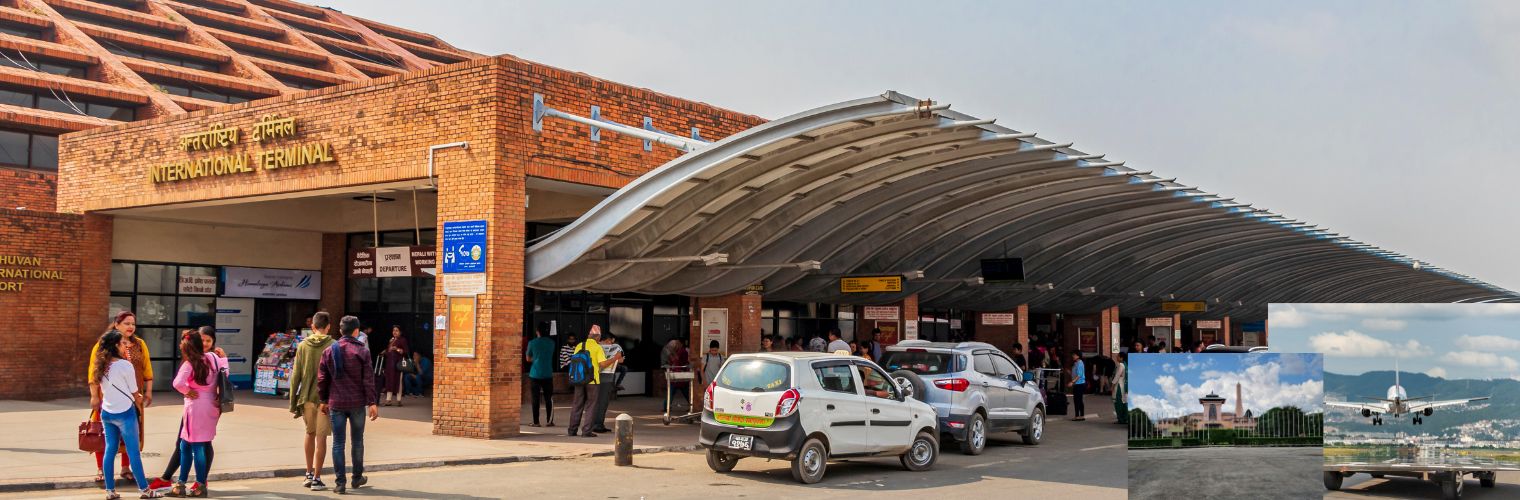
Tribhuvan International Airport I Nepal’s Main Gateway to the World
Every journey to Nepal begins and ends at Tribhuvan International Airport in Kathmandu.
Located in the middle of Kathmandu Valley, this airport is not just a fly-through. It is Nepal’s key air traffic hub, linking the roof of the world with Asia, the Middle East, and beyond. Whether you are going to the Everest Region, the Annapurna Region, business places, or pilgrimage sites, or heading for any kind of Nepalese adventure activities, Tribhuvan International Airport (TIA) is the starting point for every visitor to Nepal.
Quick Summary
- Tribhuvan International Airport, serves as the country’s main international and domestic airport, managing most outbound global traffic and inward mountain bound traffic.
- Only 5-6 km from downtown Kathmandu, you can reach Thamel, hotels and business areas in no time.
- Tribhuvan International airport operates two terminals: International and Domestic flight.
- Single 3,050 meter runway capable of use by regional aircraft such as A320 and B737 with terrain guided instrument approaches limited by nearby hills.
- Winter fog and monsoon rain seasonally impact operations, with autumn providing the most reliable flying conditions.
- Every trek to Everest and Annapurna starts here, making it the backbone of Nepal’s tourism and trekking business.
Where Is Tribhuvan International Airport Located?
Tribhuvan International Airport is in eastern Kathmandu; it’s approximately 5-6 kilometers from the city center. It is located in the heart of a dense city, sheltered by housing communities, temples, and old structures.
Unlike many global airports constructed far from their cities, TIA is stitched directly into the fabric of daily life in Kathmandu. You would be 20 minutes from these:
- Thamel (tourist hub)
- Durbar Square
- Major hotels and business districts
This central location simplifies point-to-point connections, but it also limits runway expansion because the runways are surrounded by development.
Why Is It Called Tribhuvan International Airport?
The airport is named for King Tribhuvan of Nepal, who helped oversee the transformation of Nepal’s political system in the mid-20th century.
Its official operating entity is the Nepal Civil Aviation Authority that owns:
- IATA Code: KTM
- ICAO Code: VNKT
If you notice Kathmandu on your ticket, it is actually shorthand for Kathmandu’s Tribhuvan International Airport.
These codes matter operationally. They integrate Nepal into the global aviation network as structured as any other international airport.
International and Domestic Terminals Explained
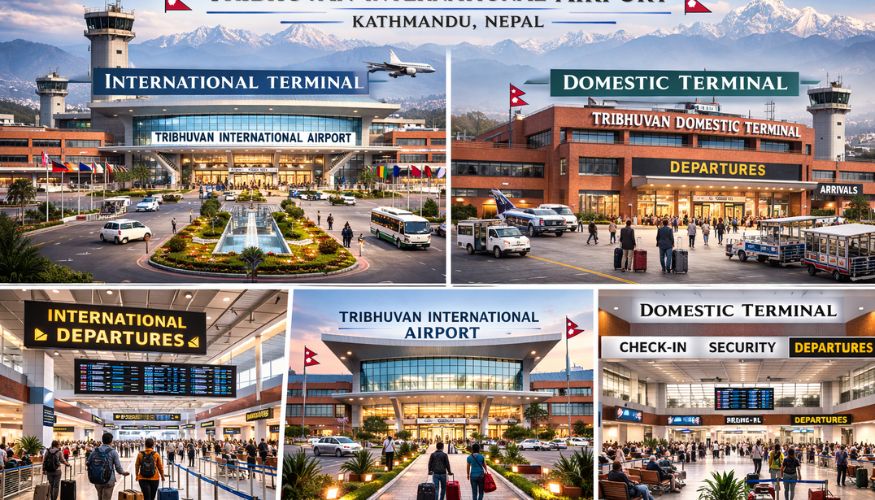
Tribhuvan International Airport is Nepal’s main aviation hub, and it operates with the International Terminal and Domestic Terminal. The difference is necessary to know, especially when there are trekkers affiliated with mountain races.
International Terminal
The international terminal is used for all arrival and depature overseas flights. That includes long-haul and regional routes flying to and from Kathmandu to major transit cities like Doha, Dubai, Kuala Lumpur, Delhi, and Bangkok. This section has all immigration clearance, visa on arrival procedures, baggage claim, and customs.
Domestic Terminal
The domestic terminal handles flights to and from inside of Nepal. It’s the jump off point for major trekking hubs like Lukla (for the Everest region Trekking) and Pokhara (for Annapurna Region Trekking). It also has flights to Bharatpur, Biratnagar, Bhadrapur, Nepalgunj and several remote mountain airstrips. Helicopter transfers and rescues in the mountains are coordinated from the domestic side.
How Busy Is Tribhuvan International Airport?
Tribhuvan International Airport is Nepal’s main international and domestic airport, processing millions of passengers a year. In practical terms, it is the country’s main aviation artery.
Nepal’s mountainous terrain constrains large-scale road and rail development. As a consequence, air travel is of much greater national significance than in many flat countries. This one airport is the portal for international visitors, domestic travelers, cargo and medical evacuations as well as trekking traffic.
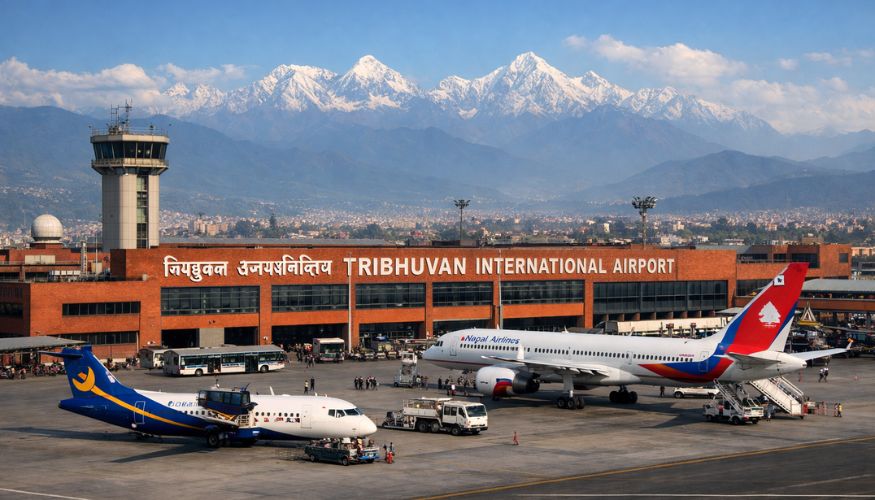
This concentration creates predictable patterns:
- Surge in Traveller Seasons like Spring and Autumn
- Crowds in domestic departure halls early in the morning, when flights to the mountains take off
- Evening hours were likely to see higher international arrival volumes
This high traffic reflects centralization, not chaos. Nepal relies on this gateway, and operations are organized around that fact.
Tribhuvan International Airport Infrastructure
Tribhuvan International Airport has one main runway which is approximately 3050 meters in length. The new runway will accommodate mid-sized aircraft typical on regional and international routes, including Airbus A320 and Boeing 737 class planes.
Its valley approaches are equipped with special radar and navigational systems. The Kathmandu Valley is surrounded by hills, which means that aircraft follow terrain-guided flight paths instead of flat, open approaches typical with coastal airports.
Specialised helicopter operations are embedded within the airport, supporting mountain flight and emergency evacuation and regional transport.
Pilots landing in Kathmandu receive special training for these valley conditions. The airport’s disposition isn’t about size or architectural scale.
It reflects geography and it works in geography.
Weather and Operations in Tribhuvan International Airport
Tribhuvan International Airport has more stable flying conditions than places like the high-altitude mountain airstrips at Lukla. Its lower elevation and full instrument landing system capabilities make it useful in broader weather conditions.
All that said, seasonality still affects Kathmandu’s operations.
Valley fog can sometimes settle in on winter mornings, delaying anyone arriving or departing before it clears. During the monsoon (June to August), cloud cover and reduced visibility are increasingly common and air traffic flow is occasionally slowed. During the pre-monsoon season, short-lived thunderstorms in the afternoon can briefly interrupt flights, especially on departures.
Unlike smaller mountain airports that can operate only during visual flight conditions, Tribhuvan International Airport is equipped with instrument landing procedures. That allows flights to land when visibility is low, so long as conditions are within regulated safety parameters.
Overall delays are mostly seasonal and weather-related, as opposed to structural. Once visibility improves, operations tend to normalize.
Kathmandu Tribhuvan International Airport Seasonal Weather
| Seasons | Months | Conditions | Operational Impact |
| Spring | March to May | Warm afternoons, occasional thunderstorms | Minor afternoon delays |
| Autumn | September to November | Clear skies, stable weather | reliable flying season |
| Winter | December to February | Cool temperatures, morning fog in valley | morning delays possible |
| Monsoon | June to August | Heavy rain, cloud cover, reduced visibility | Periodic delays during heavy rainfall |
In most of the cases, weather interruptions are temporary. Once visibility stabilizes, flight schedules resume in an organized sequence.
Kathmandu’s aviation rhythm is shaped by seasons, but it remains consistent and manageable with realistic planning.
Why Tribhuvan International Airport Matters for Trekkers and Nepal Visitors
Tribhuvan International Airport is more than an entry point for trekking operations. It is the logistical bedrock of every itinerary.
Every Everest Base Camp, Annapurna Base Camp or other Nepal remote region trek starts here. International arrivals are welcomed, domestic connections are unified, equipment is shuffled around and schedules are changed when weather buffers become necessary. All airport pickups, briefings and introductions of teams pass through this one hub.
Because so much of Nepal’s air access is funneled into Kathmandu, the airport has a vital national role. It aids tourism flow, cargo transport into mountain regions, helicopter evacuations, government operations and regional connectivity across a landscape where roads remain limited.
Without this airport running as it does, Nepal’s trekking industry wouldn’t be able to operate at its current scale.
It’s not just an arrival terminal. It is the lifeline that links the Himalayas to the outside world.
Is Tribhuvan International Airport Difficult to Navigate?
Compared to big international gateways like London Heathrow Airport (LHR) and Manchester Airport (MAN), Tribhuvan International Airport is small.
That smallness serves the traveler well. Distances within terminals are short and flow is direct. The arrival process usually has a defined order:
- Arrival
- Visa on arrival
- Baggage collection
- Exit hall
- Transfer pickup
So while the airport may seem busy at peak hours, things still move in a very orderly fashion. It might not have the scale or architectural polish of bigger international airports, but its design is simple and utilitarian.
With calm and reasonable expectations in mind, getting around the airport is easy and doable.
Practical Tips for International Arrivals
When you approach Tribhuvan International Airport prepared rather than hurried, it’s an uncomplicated arrival.
Visa on arrival fees are generally required to be paid in USD or another major currency, so bringing small denominations with you beforehand can save you if the same-day exchange is an issue. While passport-sized photos may be obsolete with digital systems now being the norm, it is still good to bring a few if you have them for a backup.
If you’re working in a domestic flight connection especially to Lukla or other mountain airstrips it’s wise to plan for buffer time. If the schedule shifts slightly, tight same-day transfers during peak trekking seasons can add extra pressure that’s not needed.
Domestic departures typically run on the early side, particularly mountain flights, when weather conditions are more predictable. Knowing ahead of time will also save you last-minute repacking at the domestic terminal due to luggage weight limit restrictions.
Following calm plans helps minimize airport stress better than speed.
So, What Is Tribhuvan International Airport?
Nepal’s aviation backbone is at Tribhuvan International Airport.
Checking in with that feeling isn’t a matter of size or design. It is defined by function.
It links trekkers to the Everest region.
It links pilgrims to the Kathmandu Valley Sightseeing.
It facilitates business travel, cargo transport, medical evacuations and daily domestic mobility in a mountainous country.
If you look at it realistically, when it is not overwhelming. It’s organized, efficient and integral to how Nepal works.
For most visitors, it’s just the first step into the country as an entry point before the mountains come into view.
FAQs
Does Nepal only have an international airport in Tribhuvan International Airport?
It is currently the main and busiest international airport in Kathmandu; however, some regional international airports have begun to expand their operations.
How far is Tribhuvan International Airport from Thamel?
Around 6 km 20-30 mins depending on traffic.
Is there a visa on arrival facility at Kathmandu airport?
Yes, several nationalities can acquire a visa on arrival subject to the rules of the Nepal government.
Does the airport have currency exchange services?
Yes. Foreign exchange counters and ATMs are present in both arrivals and departures.
How early do I have to get there for international departure?
Recommended Minimum before 3 hours of your departure time
Does Tribhuvan International Airport have Wifi?
Yes, although speed and stability vary.
After flying internationally, can I be directly transferred to a Lukla flight?
Sometimes you can do that, but it’s dependent on arrival time, season and flight schedules. Buffer planning is strongly advised.