
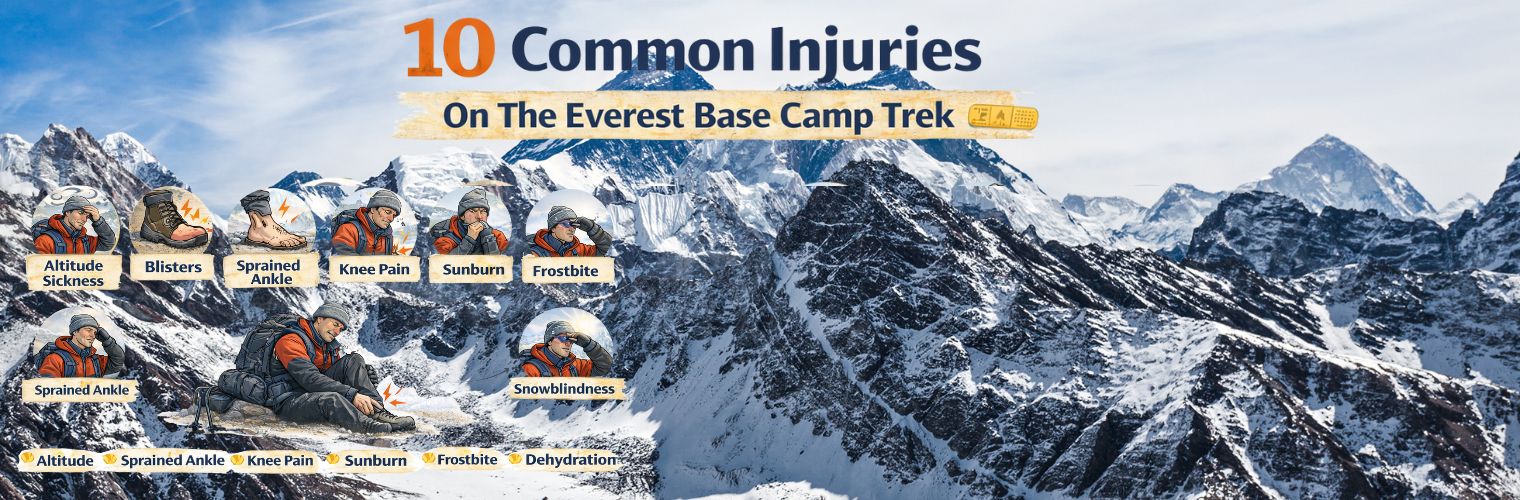
10 Common Injuries on the Everest Base Camp Trek
Injuries on Everest Base Camp are rarely dramatic. In fact, it’s not a technical climb, which means you won’t see unfortunate accidents that involve falls or frostbite due to extreme weather.
However, every year we find almost 60% of trekkers fail to complete this trek. While one of the main reasons behind this substantial rate is altitude sickness, there are other injuries that also plays its role
After years of guiding in the Everest region and reviewing trek outcomes, we see the same pattern every season. As a matter of fact, these wounds are usually small at first, slow to develop, and easy to ignore. Knee pain that appears only on downhill. A blister that feels manageable. A stiff Achilles in the morning. These issues build quietly until walking becomes painful, unstable, or unsafe.
But the reassuring truth is that most injuries on the Everest Base Camp trek are preventable when trekkers understand why they occur, where they most often occur, and how to respond early.
Quick Summary
- Most Everest Base Camp injuries develop gradually and are preventable, rather than sudden or dramatic.
- Knee pain, ankle sprains, and blisters are the most common physical problems on the trail.
- Injury risk increases with fatigue, altitude exposure, cold conditions, and repeated downhill walking.
- Early pain that is ignored often leads to a forced descent later in the trek.
- Proper pacing, appropriate gear, and good preparation significantly reduce injury risk.
Why injuries happen on the Everest Base Camp trek
The Everest Base Camp trek is not technical, but it is physically repetitive and demanding. On a standard Everest Base Camp trek (about 12 to 15 days), trekkers usually cover roughly 130 km round trip (Lukla to EBC), averaging 10 to 15 km per day and around 5 to 7 hours of walking daily on uneven trails.
And the “roughest underfoot” terrain often includes rocky stone-step climbs (common around the Namche approach) and glacial moraine higher up (for example, Lobuche to Gorak Shep is about 4.5 km and typically 2 to 3 hours, over the rocky moraine of the Khumbu Glacier).
This means downhill sections are long and constant. Foot placement matters more than speed.
Furthermore, above 3,500 meters, oxygen availability drops, and muscle recovery slows. Above 4,000 meters, inflammation lasts longer, and fatigue accumulates faster. Cold temperatures tighten muscles and tendons. Heavy backpacks increase joint load. Fatigue reduces coordination.
None of these factors alone causes injury. But together, they create the conditions where small problems grow.
This is also why general fitness alone does not prevent injuries. Strong legs still absorb impact. Strong lungs do not protect joints. Preparation must match the Everest Region trekking environment, not just a normal hiking experience.
1. Knee injuries on the Everest Base Camp Trek
Knee pain is the most common injury on the Everest Base Camp trek.
It usually appears on long downhill days, especially between Namche and Phakding and again between Pheriche and Namche during descent. These sections involve sustained downhill walking on hard stone steps that repeatedly load the knee joint.
Downhill walking places high stress on the quadriceps as they control descent. Leaning backwards, locking the knee, weak quadriceps, and heavy backpacks increase joint impact. Trekkers often report that uphill feels manageable while downhill becomes increasingly painful.
In fact, during the monsoon season, these kinds of injuries become very common and becomes contributing factor for the 60% failure rate.
If ignored, inflammation increases, swelling reduces stability, and walking confidence drops. Many trekkers then alter their gait, which creates secondary pain in the hips or ankles.
How to avoid knee injuries
- Use trekking poles correctly on all downhill sections
- Take shorter downhill steps and avoid locking the knee
- Slow down on descents, even if uphill feels easy
- Strengthen quadriceps before the trek with squats and step downs
- Respond early to knee pain instead of treating it as normal
2. Ankle sprains on the Everest Base Camp Trek
Ankle sprains are very common on the Everest Base Camp route.
They occur most often on rocky sections between Lukla and Namche and between Lobuche and Gorak Shep of the Everest Region. These areas combine uneven stone steps, loose rocks, and fatigue late in the day.
Most sprains happen when trekkers feel confident rather than cautious. Fatigue reduces balance and reaction time, and lightweight shoes without ankle support increase the risk.
Once an ankle is sprained, swelling and instability develop quickly. At altitude, healing is slow, and uneven terrain becomes unsafe.
How to avoid ankle sprains
- Wear mid or high ankle boots with proper support
- Lace boots tightly on rocky and uneven sections
- Slow down when tired, especially near the end of the day
- Watch foot placement carefully on moraine trails
- Avoid rushing descents
3. Blisters on Everest Base Camp Trek
Almost every trekker develops at least one blister, usually during the early days from Lukla to Namche.
Blisters form due to friction from new boots, moisture, foot swelling at altitude, and long walking hours. While blisters themselves are minor, infected blisters often force trekkers to stop. This is why packing becomes essential in the Everest Base Camp.
At altitude, healing is slower, and infections worsen faster.
How to avoid blisters
- Break in boots at least three to four weeks before the trek
- Use a two-layer sock system with a liner and trekking socks
- Wash and dry your feet every evening
- Treat hot spots immediately with tape or blister patches
- Avoid cotton socks
4. Lower back strain
Lower back strain develops gradually and often becomes constant by Tengboche or Dingboche.
It is caused by poor backpack fit, excessive pack weight, weak core muscles, and leaning forward while walking uphill. As pain increases, trekkers compensate with their hips and shoulders, reducing efficiency and endurance.
In fact, during the trek, our guides noticed that this problem is especially common among content creators, since their packing lists often include added weight from cameras and batteries.
How to avoid lower back strain
- Keep backpack weight under 10 kilograms
- Ensure weight rests on hips, not shoulders
- Use trekking poles to reduce forward lean
- Strengthen core muscles before the trek
- Adjust the backpack fit properly before starting
- Hire an extra porter if necessary
5. Shin splints
Shin splints are common among first-time trekkers, especially during early ascents and long descents on hard stone staircases.
Sudden increases in walking volume, stiff downhill walking, and inadequate footwear cushioning overload the lower leg muscles.
How to avoid shin splints
- Train gradually before the trek
- Use cushioned footwear
- Take shorter downhill strides
- Stretch calves daily in the morning and evening
- Address early shin pain immediately
6. Shoulder and neck strain
Shoulder and neck strain occur throughout the trek.
Improper backpack adjustment, weight carried too high, cold-induced muscle tension, and constant downward head posture all contribute. Persistent tension reduces circulation and causes stiffness that worsens in cold weather.
This issue is especially common among beginners. If you are looking forward to hiking to Everest Base Camp, you need to be prepared at least 2 weeks in advance.
How to avoid shoulder and neck strain
- Adjust the backpack so the weight sits on the hips first
- Loosen straps during rest breaks
- Perform gentle neck mobility exercises
- Maintain an upright posture while walking
- Dress warmly to reduce muscle tension
7. Achilles tendon strain
Achilles strain appears most often on long uphill days above Namche.
Tight calves, cold muscles, steep ascents, and old injuries contribute. Morning stiffness that does not ease with walking is an early warning sign.
How to avoid Achilles strain
- Stretch calves daily
- Warm up slowly every morning
- Avoid sudden pace changes
- Perform heel drop exercises before the trek
- Stop ascending if pain worsens while walking
8. Toe injuries and black toenails
Toe injuries are common on long downhill sections.
Boots that are too small, feet sliding forward, thick socks reducing toe space, and repeated toe impact bruise toenails and cause pain.
How to avoid toe injuries
- Choose boots half a size larger
- Trim toenails before the trek
- Use heel lock lacing on downhill days
- Adjust sock thickness to boot volume
- Pay attention to downhill toe pressure early
9. Muscle strains in quads, calves, and hamstrings
Muscle strains occur throughout the trek, especially above 3,500 meters.
Reduced oxygen slows muscle repair. Cold increases stiffness. Inadequate hydration and calories worsen fatigue.
How to avoid muscle strains
- Eat sufficient calories daily
- Hydrate consistently, even in cold weather
- Stretch each evening gently
- Wear warm layers before starting each day
- Avoid aggressive stretching when muscles are cold
10. Cold-related injuries On Everest Base Camp
Cold-related injuries occur mainly in winter and early spring around Lobuche, Gorak Shep, and Kala Patthar.
Poor circulation at altitude, tight boots or gloves, standing still in the wind, and inadequate insulation contribute.
How to avoid cold-related injuries
- Layer clothing early, not after feeling cold
- Keep gloves and boots loose
- Keep moving in the cold wind
- Change wet socks immediately
- Protect exposed skin from wind
What Do We Advise For Trekkers?
Most injuries on the Everest Base Camp trek are not caused by danger. They are caused by impatience.
Slowing down, using trekking poles, carrying less weight, listening to early pain, and preparing properly prevent most problems. This is why injury awareness links directly to understanding whether Everest Base Camp is dangerous and why many trekkers turn back early.
FAQs
Are injuries on Everest Base Camp usually emergencies?
No. Most injuries develop slowly and become serious only when ignored.
Do injuries happen more often at higher altitudes?
Yes. Reduced oxygen slows recovery and increases inflammation above 3,500 meters.
Can porters reduce injury risk?
Yes. Carrying less weight significantly reduces knee, back, and ankle strain.
Do trekking poles really help prevent injuries?
Yes. Poles reduce joint load, improve balance, and lower fall risk.
Should minor pain always be reported to guides?
Yes. Early pain is easier to manage than advanced injury.
Does cold increase injury risk?
Yes. Cold tightens muscles and tendons, increasing strain risk.
Can injuries force a helicopter evacuation?
Yes. Severe injuries or instability sometimes require evacuation.