
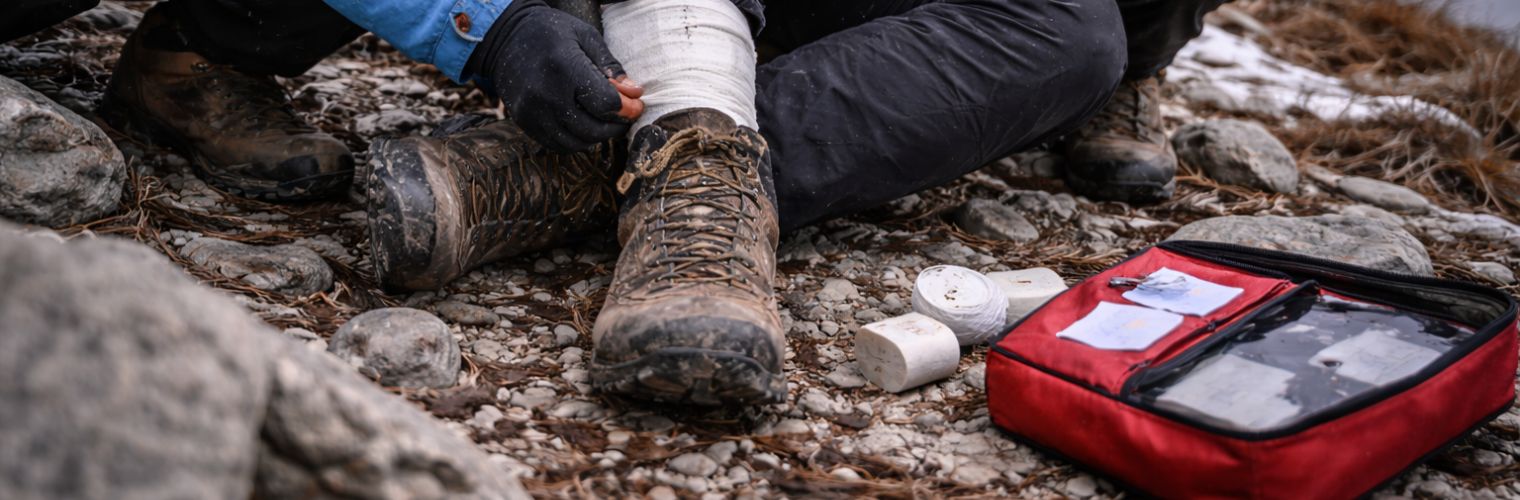
What Happens When A Trekker Gets Injured On Everest Base Camp Trek?
You are on a journey to Everest Base Camp, and unfortunately, you slipped on the stone steps or, during the downhill, your knees suddenly gave out.
So what happens then? We are sure many trekkers have similar questions in mind before committing to this once-in-a-lifetime journey. And, you are right, injuries during the Everest Base Camp trek are more common than you think.
When someone gets injured on the Everest Base Camp route, the outcome depends on how calmly and systematically the situation is handled, not on toughness or speed.
This article explains what actually happens on the trail when an injury occurs, and step by step process on how we handle them, so that you can calmly begin your next trek.
Quick Summary
- Most injuries on the Everest Base Camp trek are managed calmly rather than as medical emergencies.
- Many situations improve with early descent, rest, and proper stabilization.
- Evacuation decisions depend on the trekker’s location, weather conditions, and ability to walk.
- Helicopter evacuation is a last resort and not the default response to injuries on the trail.
- Good early handling helps prevent minor injuries from developing into serious problems.
Why are injuries on Everest Base Camp handled differently?
The Everest Base Camp trek is not technical climbing, which makes it less dangerous, but it is nevertheless high-consequence trekking. In fact, trekkers walk for almost 10 to 15 days on uneven stone steps, glacial moraine, and exposed trails.
This means that above 3,500 meters, balance and coordination drop, and beyond 4,000 meters, recovery slows. Cold stiffens joints and tendons. Fatigue builds quietly.
In addition, medical facilities are limited and spread far apart. This is why the same injury that might be manageable on a normal hiking trail often requires a more conservative response here.
And during the time of this unfortunate situation, your only help becomes your trekking guides. Which is why anyone hoping to trek to Everest Base Camp needs to understand what steps guides follow when injuries occur on the trail.
Step 1: Stopping the movement
When a trekker gets injured on the Everest Base Camp route, the first decision is always the same.
Everything stops.
Because continuing to walk “just a little further” is one of the most common causes of secondary accidents. On busy sections of the trail, trekkers fall while trying to help. Yaks or mules approach unexpectedly. Loose rocks shift underfoot.
Which is why the injured one is immediately moved off the main trail to a stable area. If the location is near an edge, a river crossing, an icy section, or a loose slope, repositioning happens right then and there. One person is placed uphill to watch for animals and traffic.
At the same time, the guide scans the environment. Wind, temperature, cloud movement, and precipitation matter because they affect how long the group can safely remain in one place.
At this stage, nothing medical happens yet. The goal is to prevent the situation from getting worse.
Step 2: Slowing Everything Down
Once movement stops, the next priority is psychological control.
Pain and panic amplify each other. This is why our guides first try to calm the situation. After being in a rested environment, the injured trekker makes better decisions and gives more accurate feedback.
Then the injured trekker is reassured clearly and kept still. Breathing is slowed. The group is asked to stay quiet and focused. Only one guiding voice directs the situation.
This step often determines whether the injury remains manageable or escalates.
Step 3: Guides Assess the Injury
While guides do carry basic first aid kits, they do not have diagnostic tools. Decisions rely on observation, simple questioning, and experience.
This is why they perform the rapid assessment to get the ideas on:
- How the injury occurred
- Exact pain location
- Ability to move toes or fingers
- Any head impact, dizziness, or nausea
- Amount of bleeding
During this step, visible warning signs are checked carefully. Rapid swelling, obvious deformity, inability to bear weight, numbness, or heavy bleeding immediately change the response level.
If there is suspicion of head injury, spinal injury, or major fracture, unnecessary movement stops, and the situation shifts toward emergency coordination.
Step 4: Guides Perform The Basic Treatment
One of the most misunderstood parts of injury response on Everest Base Camp is timing.
Treating before stabilizing often worsens the injury because joints must be immobilized before movement. Bleeding must be controlled before relocation. Cold exposure must be addressed immediately, as it can worsen pain and stiffness.
At this stage, our guide focuses on:
- Immobilizing the affected area
- Controlling bleeding if present
- Reducing exposure to cold and wind
Only after stabilization does movement or further treatment become an option. But here is an honest fact: guides carry only a limited supply in their first-aid kit. God forbid, but if multiple trekkers were injured at the same time, the initial first aid might take time. This is why it is a good idea to include first aid kit in your packing list.
Step 5: Perform the critical walking test
After stabilization, walking ability is assessed carefully.
The test is simple. Can the trekker stand with support? Can they take a few controlled steps? Does pain increase sharply with weight?
This is not about bravery. It is about mechanics. At this altitude, injuries do not improve quickly with continued movement. If walking is unsafe now, it will usually be worse later in the day.
This moment often determines whether the trek continues, descends, or ends.
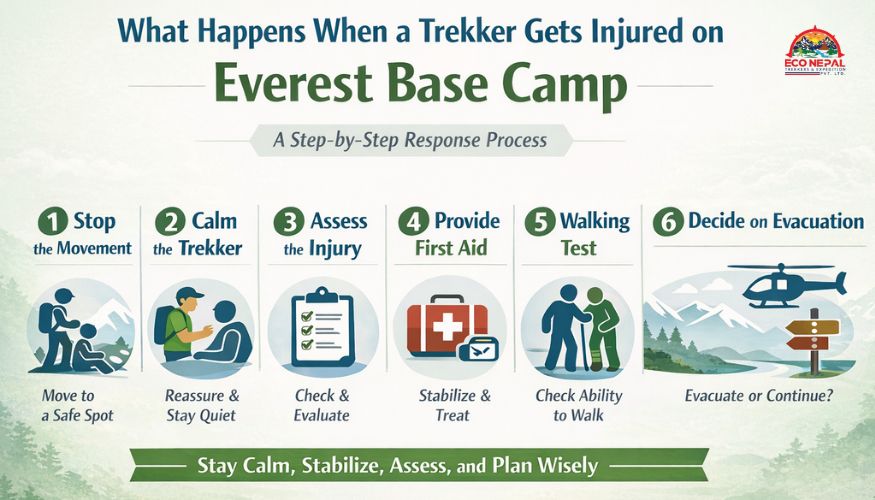
Step 6: Guides take the critical decision on Evacuation or Continue
Decisions on the Everest Base Camp route are never based on a single factor. They are based on a combination of realities.
Severity matters first. Mild strains are different from unstable joints or suspected fractures.
Location matters next. Distance and trail difficulty to the nearest lodge or village change options significantly.
Then they look at time and weather signals. Late afternoon, rising wind, snowfall, or dropping visibility can quickly reduce safe movement windows.
Group resources are checked next. Availability of assistant guides, porter support, and group strength affects transport possibilities.
From these factors, guides takes one of these decisions:
- slow movement to the nearest lodge
- descent to a safer village
- assisted transport using local resources
- evacuation coordination when necessary
Why Evacuation Is Not Automatic Or Immediate
Many trekkers assume that helicopter evacuation solves everything, since helicopters can reach the Everest Base Camp. But the honest fact is that it is not always true.
Helicopter availability depends on weather, visibility, wind, and location. Narrow valleys, cloud cover, and afternoon winds often delay or cancel flights. In some cases, ground transport to a lodge or village is the only option.
This reality is why conservative decisions are made early rather than waiting for conditions to worsen.
Step 7: Reaching a lodge and reassessing the situation
Once shelter is reached, the situation changes.
Warmth and rest often reveal the true severity of an injury. Swelling may increase after stopping. Pain may change once muscles relax. New symptoms sometimes appear.
This is why reassessment at a lodge is critical. What looked manageable on the trail may not be stable overnight.
Details are documented carefully. Time, location, injury progression, and actions taken all matter for next-day decisions and communication with support teams or family contacts.
What happens to the rest of the group
When one trekker is injured, the entire group is affected.
Groups may need to slow down, change itineraries, or stop early. Sometimes one assistant stays with the injured trekker while others manage logistics and move on. And sometimes the group stays together to reduce confusion and risk.
Clear communication matters here. A simple, realistic plan reduces panic and prevents people from taking unnecessary risks to “catch up.”
The next-day reality most trekkers do not expect
Many Everest Base Camp treks end the morning after an injury, not on the day it happens.
If the injury improves and remains stable, a rest day and short walking test may be attempted. Continuation only happens if walking is safe and controlled.
If pain persists or stability worsens, descent to a lower altitude and better facilities is chosen. This is one of the most common points where treks end responsibly.
Ending a trek here is not failure. It is risk control.
Why experienced support changes outcomes
When a trekker gets injured during trekking in the Everest region, the outcome is rarely determined by the injury alone.
It is decided by:
- early stabilization
- calm decision making
- realistic planning
- conservative judgment
This is why experienced operators matter in the Everest region. Experienced guides matter. Not because injuries are dramatic, but because they are predictable and compound quickly when handled poorly.
Final Thing To Remember
On the Everest Base Camp trek, injuries do not demand heroism. They demand patience, structure, and restraint.
The safest outcomes come from stopping early, stabilizing properly, and choosing descent when margins disappear. Most serious situations are avoided not by strength, but by calm systems and realistic decisions.
This is what actually happens when a trekker gets injured on Everest Base Camp.
FAQs
Should trekkers carry personal medical records on EBC?
Yes. Allergy, medication, and condition details help guides and doctors decide faster.
Can painkillers hide serious injury symptoms at altitude?
Yes. Masking pain can delay correct decisions and worsen outcomes.
Is it safer to descend immediately at night after an injury?
Usually no. Darkness and cold increase risk unless delay is dangerous.
Do injured trekkers need to inform their families immediately?
Not always. Guides usually wait until a clear plan is confirmed.
Can minor injuries become serious due to altitude alone?
Yes. Reduced recovery and cold can turn small issues into major limitations.
Is solo trekking riskier after an injury?
Yes. Solo trekkers lack immediate support for stabilization and decision-making.
Are evacuation decisions influenced by the trek schedule or flights home?
They should not be, but fixed return dates sometimes pressure poor decisions.
Can injured trekkers rejoin the trek after evacuation?
Sometimes, if recovery is fast and altitude loss is beneficial.
Is insurance approval easier with doctor involvement?
Yes. Medical notes strongly support evacuation authorization.
What is the most common mistake trekkers make after getting injured?
Trying to push forward instead of descending early.