
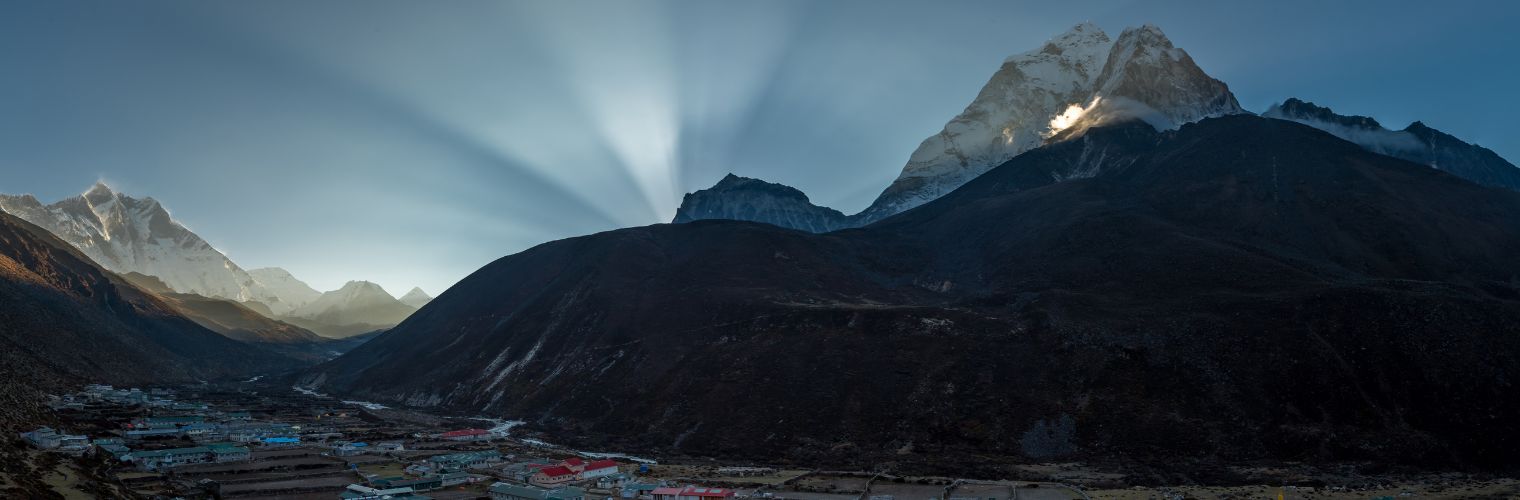
Dingboche Village
Did you know that Dingboche is another acclimatization stop on the Everest Base Camp Trek route after Namche Bazaar?
It is a high-altitude Sherpa village along the Everest Base Camp trekking route, approximately 4,410 meters above sea level in Nepal’s Everest region.
The village is situated in the Imja Valley and surrounded by the high Himalayas, open valleys, stone-walled fields, and alpine regions.
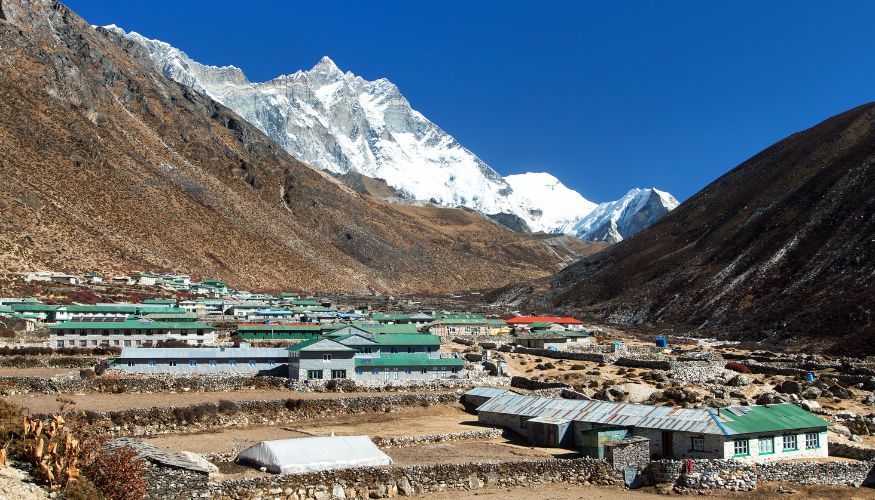
Most popular itineraries for the Everest Base Camp Trek include an acclimatization day in Dingboche before heading to Lobuche, Gorak Shep, EBC, and Kala Patthar, making Dingboche a vital stopover.
Trekkers should ascend slowly at this altitude and thus allow their bodies to acclimatize before walking above 5,000 meters.
Where Is Dingboche Village?
Dingboche is located in the Khumbu region of Solukhumbu District, Nepal, along the classic trekking route to Everest Base Camp. The village sits in the Imja Valley at approximately 4,410m above sea level and is reached after Tengboche and Pangboche.
The landscape around is wide open alpine valleys, fields bordered with stone, and little observation of vegetation besides what grows at hand along the way, Hindu Peaks that rise further overhead than May make water bottle.
| Location Detail | Information |
| Region | Khumbu Region / Everest Region |
| District | Solukhumbu |
| Valley | Imja Valley |
| Elevation | 4,410 m (14,469 ft) |
| Trek Route | Everest Base Camp Trek |
| From Namche Bazaar | Approx. 18–20 km |
| Walking Time from Namche | Approx. 5–7 hours |
| From Everest Base Camp | Approx. 30–35 km |
| Everest Base Camp Elevation | 5,364 m (17,598 ft) |
The distance from Namche Bazaar to Dingboche is about 18–20 km (11–12.5 miles). You will cross through Tengboche, Deboche, Pangboche, and Somare as you approach the village.
You are at a similar distance from Everest Base Camp, about 30–35 km via the trekking path from Dingboche. Trekkers will pass through Lobuche and Gorak Shep to complete the final part of their journey by reaching Everest Base Camp, which sits at 5,364 meters (17,598 feet).
Dingboche Altitude
Dingboche is one of the highest permanent settlements along the standard Everest Base Camp Trek and sits at about 4,410 meters (14,470 feet) above sea level. Located at a high altitude, it serves as an important acclimatization stopover for trekkers continuing on toward Lobuche, Gorak Shep, and Everest Base Camp.
The altitude in Dingboche is much higher than what it was in Namche Bazaar and Tengboche, and from here the trail continues to climb towards Lobuche and along the way also pushes up to Gorak Shep, before finally reaching Everest Base Camp. Standard EBC itineraries have a rest day in Dingboche so people can acclimatize before heading above 5000 meters.
| Location | Elevation |
| Lukla | 2,860 m |
| Namche Bazaar | 3,440 m |
| Tengboche | 3,860 m |
| Dingboche | 4,410 m |
| Lobuche | 4,900 m |
| Gorak Shep | 5,164 m |
| Everest Base Camp | 5,364 m |
The normal trekking route is from Lukla to Namche Bazaar to Tengboche to Dingboche, so they gradually gain elevation.
This slow rise is necessary as oxygen levels start to drop with increased altitude. The Trek leads to the Base of Everest via Lobuche and Gorak Shep from Dingboche, and the acclimatization detour is included in your plan.
Why Is Dingboche Important on the Everest Base Camp Trek?
Dingboche is an important stop on the Everest Base Camp Trek, as it sits at 4,410 meters (14,470 feet) and also signifies the start of your ascent into a higher altitude area within Khumbu. Most common EBC itineraries visit this site for another night here, then trek on to Lobuche, Gorak Shep, and Everest Base Camp. This second rest helps trekkers recover, acclimatize to the altitude, and prepare for the upper areas of the trek.
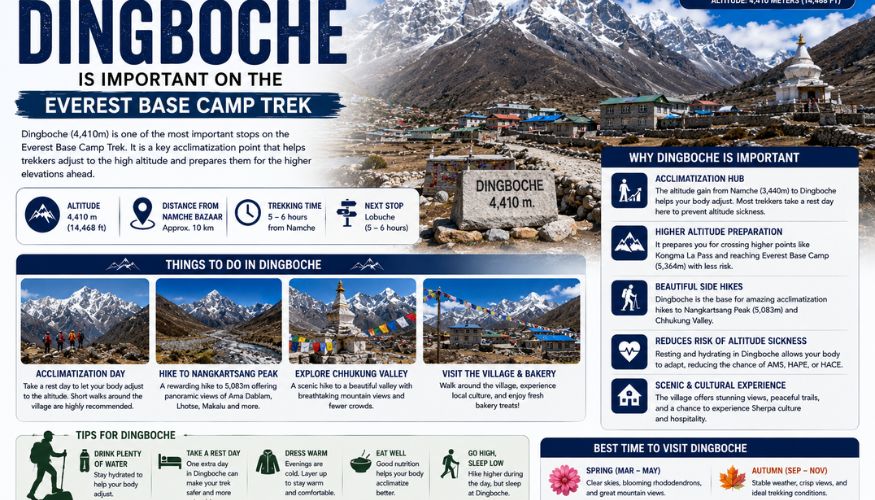
Dingboche is a principal acclimatization halt on the route. The additional night at 4410 meters gives trekkers time to acclimatize before they continue with their ascent. The path then leads to Lobuche (4,900 m) on the way to the trailheads Gorak Shep (5,164 m) and Everest Base Camp (5,364 m), where the scenery gets increasingly remote as you enter mistaken alpine territory.
Dingboche acclimatization also allows you to take a break and drink some water, eat food properly, check your trekking gear, and prepare for the next step. At this altitude, a slow and steady approach to accumulating height is especially important since oxygen levels decrease with elevation. Trekking the hundreds of heights, which, in their various incarnations, are above 5,000 m, there is a planned stop in Dingboche to help reduce the high altitude around this difficult section.
Dingboche Acclimatization Day
Most normal Everest Base Camp itineraries have one acclimatization day in Dingboche. The additional day enables trekkers to acclimatize to the elevation before continuing onto Lobuche, Gorak Shep, and Everest Base Camp. Mainly used for light activity, rest, hydration, regular meals, and acclimatization to 6000 meters.
Trekkers will often spend an additional night in Dingboche to better acclimate and to break up the inevitable uphill grind of the journey. The climb high, sleep low approach essentially advocates hiking higher in elevation during the day, then descending back down lower in order to sleep there. Acclimatization day includes a short hike but still returns to Dingboche for the night.
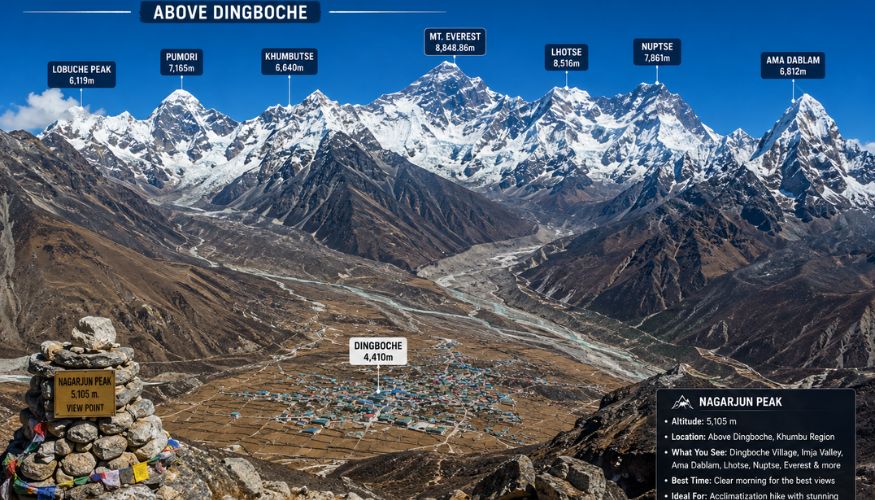
The day is meant to be light hiking, not too strenuous. In the late afternoon, after a gradual hike to the high viewpoint, trekkers will return to Dingboche, rest, drink adequate water, have regular meals & prepare gear before the next trekking day.
Those who are more sensitive may experience altitude symptoms such as headaches, dizziness, nausea, fatigue, and shortness of breath. In the event of escalating symptoms or no improvement with rest, trekkers should tell their guide and refrain from climbing until symptoms improve. In cases of serious symptoms, descent and proper care are essential.
Best Acclimatization Hikes from Dingboche
There are a number of hikes to take in Dingboche, the main higher-altitude one being Nangkartshang Peak, which is used for acclimatization purposes. The height is about 5,083 meters (16,677 ft), and it offers views of Ama Dablam, Island Peak (Imja Tse), Makalu, among other peaks of the Himalayas. The walk usually takes several hours, depending on the route and walking pace. For the more active trekker, shorter walks around Dingboche Ridge and the Imja Valley are optional; the temperature reflects this.
| Hike Elevation | Elevation | Purpose |
| Nangkartshang Peak | 5,083 m | Higher acclimatization hike and mountain views |
| Dingboche Ridge | Varies | Shorter elevation-gain walk |
| Imja Valley walks | Varies | Light activity and acclimatization |
Visible Mountains from Dingboche
Dingboche offers clear views of several major Himalayan peaks, including Ama Dablam, Lhotse, Island Peak, and Makalu. Depending on the viewpoint and weather conditions, trekkers can also see Pumori, Cholatse, Taboche, and other surrounding peaks.
| Mountain | Elevation |
| Ama Dablam | 6,812 m |
| Lhotse | 8,516 m |
| Island Peak (Imja Tse) | 6,189 m |
| Makalu | 8,485 m |
| Pumori | 7,161 m |
| Cholatse | 6,440 m |
| Taboche | 6,367 m |
Dingboche Village and Sherpa Culture
Dingboche is a Sherpa village where the day-to-day existence of local life revolves around high-altitude farming, livestock keeping, Buddhist culture, and trekking tourism. The village and the area are characterized by stone-walled fields, prayer flags, mani walls, and chortens, which are seen as common features of this region.
Sherpa families have traditionally relied on farming, livestock, trading, and mountain activities as important elements of their livelihood. Crops grown here are high-altitude potatoes and barley. Dingboche stone walls are used for separating and protecting agricultural lands.
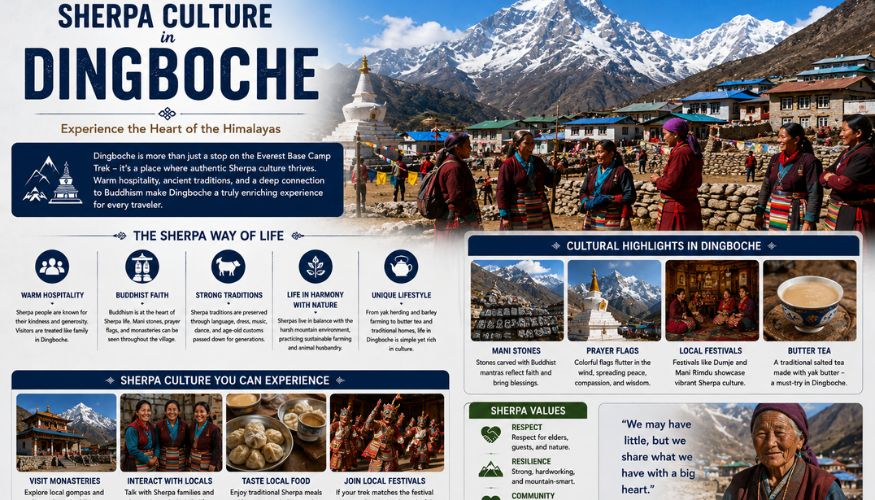
Buddhists operate daily life there, so prayer flags, mani walls and chortens mesh with casual Buddhist prayers around the village. This, in turn, has led to the growth of teahouses, lodges, restaurants, shops and now wi-fi services. Training for Everest trekking is predominantly by trekkers, with tourism becoming an important source of local income.
History of Dingboche Village
Dingboche evolved as a typical high-altitude Sherpa village but gained prominence as a key stopover destination on the Everest Base Camp Trek. The village was originally a seasonal settlement where local families farmed, grazed livestock and used high mountain pastures. Dingboche had more teahouses, lodges and shops, with trekking services arising around the official rise of trekking in the Everest region.
Situated between Tengboche and Lobuche, as well as serving the purpose of an acclimatization stop, it has become a key overnight village on the EBC trail. Modern-day trekkers and climbing groups stop at Dingboche to rest and acclimatise before heading up towards the remote, high Khumbu region and Everest Base Camp.
Weather in Dingboche
Dingboche has a cold mountain climate that also differs more significantly from season to season. Daytime is very comfortable on a clear night & after sunset temperatures drop dramatically.
| Season | Conditions |
| Spring (March to May) | Improving weather, clearer skies, gradually warmer days |
| Monsoon (June to August) | Cloud cover, rain, and reduced mountain visibility |
| Autumn (September to November) | Clear skies, dry trails, good mountain visibility |
| Winter (December to February) | Very cold temperatures, freezing nights, possible snowfall |
In early season, snow can still linger around roads on higher slopes in spring. October is also one of the busiest months for trekking as Autumn usually brings in some of the clearest conditions. Above around 4000 feet, it snows or ice forms in winter.
Places that are exposed can see gusty winds, and freeze warnings indicating temperatures lower than 32 degrees Fahrenheit in the evening are prevalent during the winter and in elevated areas.
Accommodation in Dingboche
All over Dingboche along the trekking route to Everest Base Camp, you will find a number of teahouses and likewise trekkers’ lodges. Accommodation is mostly basic, with simple rooms and dining areas, primarily sharing meals, electricity, and other trekking facilities. Rooms are often furnished with twin beds, mattresses, blankets, and very basic furniture; private rooms may be offered as available, depending on the lodge and season.
Shared rooms are very common in peak trekking seasons, and accommodation quickly fills. Lodges can offer a varied Wi-Fi connection, and the electricity is variable; the hot shower is dependent on the lodge keeping updated on factors such as water supply, fuel for heating, and weather conditions.
Food in Dingboche
Teahouses and lodges in Dingboche serve a variety of familiar Nepali and common trekking meals such as dal bhat, rice, veggies, noodles (instant noodles), soups (soup or noodle soup), pasta, eggs, potatoes, and bread. Breakfast often consists of eggs, bread, pancakes, porridge, Tibetan bread, potatoes, tea, and coffee. Instead of that, these also include hot beverages such as black tea, milk tea, lemon tea, coffee, and hot chocolate.
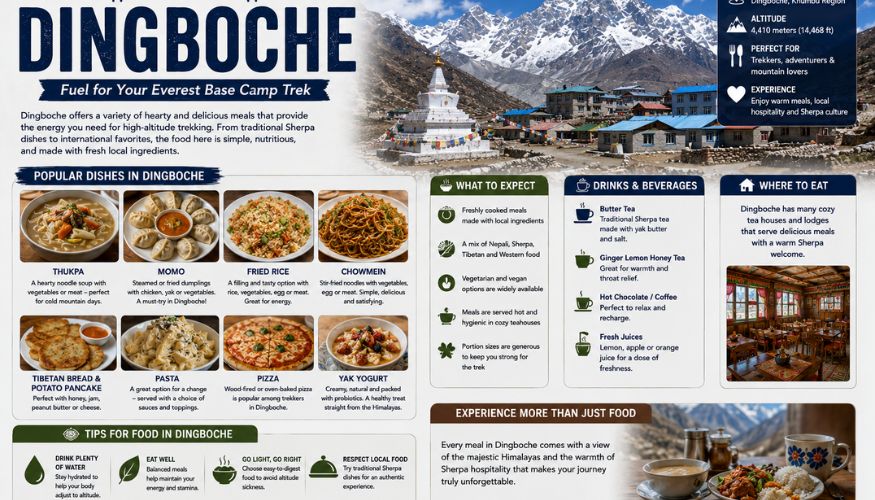
Dal bhat is super common, consisting of rice, lentil soup, and usually some veggies with an overall curry flavour. Vegetarian is relatively easy to source; vegan options do differ from lodge to lodge. Because Dingboche is remote and at high altitude, food prices are relatively high because supplies need to be transported in from lower down.
What Does the Trek from Tengboche to Dingboche Look Like?
It is about 10 to 11 km from Tengboche to Dingboche and normally takes between 5 and 6 hours. Afterwards, the trail passes through Deboche, Pangboche, and Somare to Dingboche at 4,410 meters. As the trail gently departs from the tree line and into the alpine lands of the Imja Valley, you will be able to take in areas removed from all but special access, cutting across meadows and exploring sacred valleys.
While walking, trekkers spot Ama Dablam, Lhotse, and Island Peak as well as many other Himalayan peaks. This segment of the EBC route is unlike that lower down, with stone paths, suspension bridges, and an increasingly barren landscape where the vegetation begins to disappear.
What Is the Trek from Dingboche to Lobuche Like?
It is a 10 km trek from Dingboche to Lobuche and takes about 4–5 hours in good conditions. It traverses up to 4910 meters over a landscape that leaves the realm of trees and descends into increasingly rocky, alpine terrain. Trekkers head through Dugla and Thukla to eventually reach Lobuche.
This area, the memorial area at Thukla Pass, is home to memorials for climbers who were killed on Everest and elsewhere in the Himalaya. It is a realization of what to expect above the lowlands at Gorak Shep and Everest Base Camp, where the climbing will grow more difficult as the air grows thinner.
Things to Do in Dingboche
The acclimatization stay in Dingboche offers a number of activities. Visit Nangkartshang Peak, walk through the village, and shoot a picture of Ama Dablam and the surrounding traditional stone-walled fields from agricultural land. You can also experience Sherpa culture and village life.
On acclimatization day, modest hiking, plenty of hydration, good rest, and preparing your gear are all essential if trekkers are to continue successfully on the trail through ever-higher elevations toward Lobuche, Gorak Shep, and Everest Base Camp.
Is Dingboche Difficult to Reach?
Reaching Dingboche is a challenge as you will be walking higher, for longer periods each day, on rocky trails and in unpredictable mountain weather. Generally, hikers arrive at Dingboche after Namche Bazaar and Tengboche, where you will be a bit higher up in altitude at 4,410 meters (14,470 feet).
Altitude sickness is the main obstacle; therefore, the vital things are correct acclimatization and moderate, even-paced walking. You should be fit enough to walk several hours a day.
Dingboche vs Namche Bazaar
Namche Bazaar is also more developed with a larger variety of shops, restaurants, and lodges, etc. Dingboche is higher, slightly quieter, and has a much more open alpine landscape. Both are significant acclimatization stops, but Dingboche gets trekkers ready for much higher up to Lobuche, Gorak Shep, and Everest Base Camp.
| Feature | Namche Bazaar | Dingboche |
| Altitude | 3,440 m | 4,410 m |
| Main Role | Trading and acclimatization hub | High-altitude acclimatization stop |
| Facilities | More developed | More basic |
| Landscape | Green Mountain Valley | Alpine and dry |
| EBC Route | Early section | Upper section |
Best Time to Visit Dingboche
You can be in Dingboche any time of the year, but conditions are starkly different by season.
Spring (March to May) usually happens with improving weather and clearer mountain views, while autumn (Sep to Nov) has dry conditions, clear skies, and great visibility.
Winter (December to February) is considerably colder, with frost at night and regular snow. Cloud cover and rain can compromise visibility during the monsoon (June to August). October and November typically offer the best visibility of the mountains.
Dingboche for Everest Base Camp Trek
Dingboche is usually an acclimatization stop along the Everest Base Camp Trek. Most itineraries include two nights in the village prior to heading on toward Lobuche. When trekking to the EBC in a normal 15-day itinerary, Dingboche would be reached from Tengboche and then trekked the following day to Lobuche after acclimatizing.
Skipping an acclimatization day results in faster altitude gain; not ideal. The trek contains a few nights in Dingboche to give trekkers an opportunity to acclimatize before proceeding above 4900m towards Lobuche, Gorak Shep, and last but not least Everest Base Camp.
Tips for Staying in Dingboche
Dingboche is also a high-altitude village and relatively sparsely populated, so trekkers should prepare for these relative limitations of Dingboche and plan ahead. Bring sufficient cash for accommodation, charging, Wi-Fi, showers, and anything else you may wish to do.
When there are few charging points available or if you have to pay a small fee for using them, a power bank comes in handy instead.
Dress in layers that can be adjusted between sunny daytime weather and chilly evening chills. Drink water on acclimatization day, walk slowly, and do not do much physical work. Be ready for chilly nights & do as your guide tells you about acclimatization before heading to greater heights.
FAQs About Dingboche
Where is Dingboche Village located?
Dingboche is located in the Khumbu region of Solukhumbu District, Nepal.
What is the altitude of Dingboche?
Dingboche is situated at 4,410 meters (14,470 feet) above sea level.
Why is Dingboche important on the Everest Base Camp Trek?
Dingboche is an important high-altitude acclimatization stop before trekkers continue toward Lobuche, Gorak Shep, and Everest Base Camp.
How many days should I stay in Dingboche?
Most standard EBC itineraries include two nights in Dingboche, with one full day used for acclimatization.
What can you do in Dingboche?
You can hike Nangkartshang Peak, explore the village, walk around stone-walled fields, photograph Ama Dablam, and experience Sherpa culture.
Is Dingboche colder than Namche Bazaar?
Yes. Dingboche is 970 meters higher than Namche Bazaar, so temperatures are generally colder, particularly at night.
Can you get Wi-Fi in Dingboche?
Yes. Some teahouses and lodges provide Wi-Fi, but connection speed and reliability can vary.
Are there ATMs in Dingboche?
There are no ATMs in Dingboche. It is better to withdraw enough Nepali cash in Kathmandu or Namche Bazaar before continuing Trek.
What food is available in Dingboche?
Teahouses serve dal bhat, rice, noodles, soups, pasta, eggs, potatoes, bread, porridge, pancakes, tea, coffee, and other hot drinks. Vegetarian options are commonly available.
Is Dingboche safe for trekkers?
Dingboche is a regular trekking stop, but its 4,410-meter elevation makes altitude an important consideration. Trekkers should acclimatize properly, walk slowly, stay hydrated, and follow their guide’s advice.
Conclusion
Dingboche is not just a stopover for one night on the way to the Everest Base Camp Trek. Situated at an altitude of 4,410 meters, it is one of the key acclimatization points before the route reaches the higher Khumbu. The village is a great place to adjust to the altitude and witness Ama Dablam, Lhotse, Island Peak, and Makalu among many other Himalayan peaks.
As you head further up the trail, Dingboche offers more exposure to Sherpa culture, traditional stone-walled fields, and high-altitude mountain living and Buddhist life. A little acclimatization hike and time spent in the village can make visiting Everest Base Camp a better experience!