
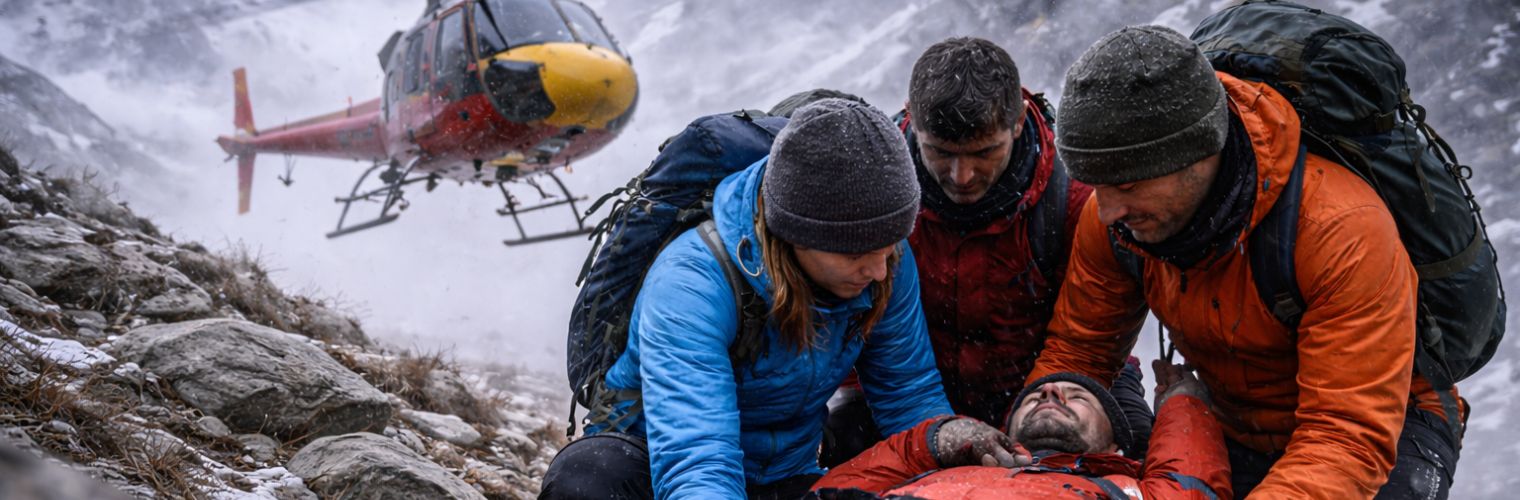
Evacuation Process on the Everest Base Camp Trek
Evacuation on Everest Base Camp trek sounds scary until you understand how it really works.
Most of the time, it is not panic. It is logistics.
A trekker gets hurt or becomes unwell. We stop, stabilize, and then choose the safest way to get them lower or get them to medical care. In many cases, the “evacuation” is simply a controlled descent to the next village, followed by rest and reassessment in warmth.
At Eco Nepal Trekkers, we treat evacuation as a safety tool. Once trekkers understand the process, they usually feel calmer, because the situation becomes predictable and they won’t view the Everest Base Camp as Dangerous.
Quick Summary
- Evacuation on the Everest Base Camp trek is usually calm and planned rather than chaotic.
- Most cases are resolved through controlled descent instead of helicopter evacuation.
- Ground evacuation and assisted walking are common, effective responses to many situations.
- Helicopter use depends on weather conditions, location, and insurance approval.
- Whenever possible, doctors are consulted before evacuation decisions are made.
- Evacuation is a form of risk control, not a sign of trek failure.
What does evacuation mean on EBC
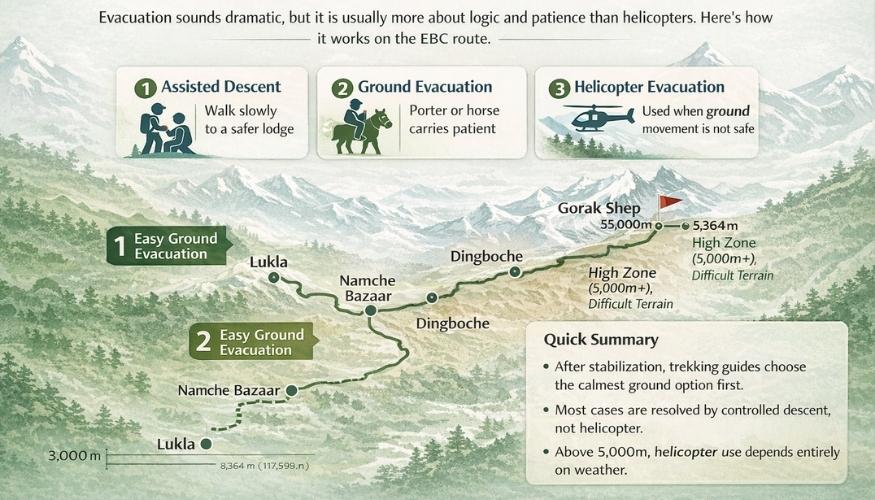
On the EBC route, evacuation can mean three different things. Most confusion happens because trekkers only imagine helicopters.
| Type of evacuation | What it means on the trail |
| Assisted descent | Walking down slowly with support to a lodge or lower village |
| Ground evacuation | Horse or porter carry when walking is unsafe or impossible |
| Helicopter evacuation | Flying to the hospital for care when ground movement is not safe |
A helicopter is not step one. It is usually step three when no other option seems feasible at the given moment.
Why descent solves more than people expect
Many problems improve fast once you drop 500 to 1,000 meters.
This is why, in real trail situations, we often aim for a safe lodge first. Warmth, rest, and lower altitude make the body behave better. Swelling reduces. Breathing improves. Decision-making becomes clearer. Ignoring these might lead to trekkers failing to complete the EBC.
To explain this logic better, let us give you an example:
A trekker twists an ankle between Tengboche and Pangboche in the Everest region. The ankle is painful, but stable. Instead of calling for helicopters, we slow down, remove their backpack load, and help them reach Pangboche or Dingboche, depending on the situation. Once they rest overnight, we reassess. Sometimes the trek continues with a revised plan. Sometimes the trek ends with a descent. But it stays controlled.
As a matter of fact, this is the same logic used in the US and UK wilderness. A hiker on the John Muir Trail or a walker in the Scottish Highlands is usually moved to safer ground first. Air evacuation is used only when ground movement is not safe or not possible.
Where is evacuation easier, and where does it become difficult in EBC?
Location changes everything because it changes the severity of the injury during the trek. For example, if one gets injured in Namche Bazar, then the evacuation becomes easier as altitude stress is comparatively lower and finding a horse or mule support is comparatively easier.
However, the same can’t be said for the trekkers injured in Gorak Shep, as the altitude makes the recovery process slower and the terrain is difficult even for horses or mules.
Here is the table to give you a brief idea of where the process is easier and where it’s harder.
| Location zone | What usually changes |
| Lukla to Namche | More lodges, easier coordination, lower altitude stress |
| Namche to Dingboche | Moderate difficulty, options still exist |
| Above Dingboche | Higher risk zone, colder, recovery slower |
| Lobuche to Gorak Shep | Most difficult zone for weather windows and movement |
This is why guides act earlier. Waiting until the highest points reduces options.
Ground evacuation: where horses are actually arranged from
People often ask, “Where do you get a horse from?”
The honest answer is: we arrange horses from the nearest practical village where horses and handlers are available, and where the trail conditions allow it.
On the classic EBC route, horses are most commonly arranged from villages that have regular animal availability and local networks.
| Common horse arrangement points | Why these places work |
| Phakding | Early trail access, easier terrain |
| Monjo or Jorsalle | Near the park entry corridor, animal movement is common |
| Namche Bazaar | Strong logistics hub, more coordination ability |
| Khumjung or Kunde area | Access to handlers, depending on the season |
| Pangboche | Practical point for mid-route assistance |
| Dingboche | Used when someone cannot walk and weather blocks are flying |
Above Dingboche, horse availability becomes more limited, and the trail becomes more exposed. That is why ground evacuation is not guaranteed in the highest sections.
Here is a realistic example of how the ground evacuation really works:
If someone cannot walk near Deboche during the Everest region trekking, we can often arrange a horse from Namche or the nearest village network. It does not arrive instantly. It takes time. That is why stabilizing the person and getting them warm is not optional.
Medical support and doctor consultation before evacuation
Good guides do not evacuate blindly.
If the trekker can safely reach a medical point like Namche or Pheriche, a doctor evaluation often comes before helicopter escalation. If reaching a clinic is not possible, remote consultation through our company network is common. Initially, doctors look for symptoms of Altitude sickness as well, which is quite common in the Everest region.
And in the Everest region, it is usually handled by the Himalayan Rescue Association, also known as “HRA”.
| Medical point | Location |
| HRA Pheriche Aid Post | Pheriche |
| Everest ER seasonal clinic | Everest Base Camp area |
| Trekking clinics | Namche Bazaar |
A simple example that feels real.
If someone develops worrying breathing symptoms near Lobuche, we do not “wait and see” at the same altitude. We stabilize, begin descent if safe, and consult medical support. If symptoms suggest severe risk and descent is not fast enough, we shift toward evacuation planning.
Helicopter evacuation: what people misunderstand
Helicopter evacuation in the Khumbu is possible, but it is not automatic.
Three things decide helicopters more than anything else:
- weather window
- landing feasibility
- payment confirmation
Pilots make the final call. Not guides. Not trekkers. As they are the ones with a better idea of whether helicopters can fly under the current conditions.
This is the part that makes Everest feel unpredictable. But it is actually predictable once you accept the rule. The weather decides.
Insurance reality, plus extra costs, people do not expect
Even with good insurance, there may be costs that surprise people during the Everest Base Camp Trek.
Insurance often covers the core evacuation, but you can still face:
- deductibles or excess payments
- exclusions if your policy is not high-altitude specific
- upfront deposits requested by providers while verification happens
- costs for extra nights in lodges while waiting
- transport expenses after reaching Kathmandu
- medical tests that insurance may not fully reimburse
Here is a clean way to understand it.
| Cost area | Why can it still happen |
| Deductible or excess | Policy requires you to pay part of the cost |
| Deposit while verifying | Providers sometimes need a guarantee before dispatch |
| Lodges and food delays | The weather holds you in place longer |
| Hospital diagnostics | Imaging or tests may be partially covered |
| Admin and paperwork | Time and coordination cost money and time |
This is why trekking companies insist on proper insurance that clearly covers helicopter evacuation in Nepal at high altitude. It reduces stress when minutes matter.
Where evacuated trekkers usually go
Most evacuations fly to Kathmandu because Kathmandu has full hospitals, imaging, and specialist care.
Here is the real life scenario that will help you
If someone is evacuated from Dingboche, the goal is not just “a helicopter ride.” The goal is to get them to a facility where X-rays, scans, oxygen care, and specialist decisions can happen quickly.
| Destination | Why is it chosen |
| Kathmandu | Best hospital access, diagnostics, and specialist care |
What happens to the rest of the group
When one trekker evacuates, the trek does not automatically collapse.
Sometimes the group continues with a revised pace. Sometimes they descend together. Sometimes one staff member accompanies the injured trekker while the main guide stays with the group. The plan depends on group strength, timing, and safety.
Here is the real-life scenario of what happens during that period:
If one trekker evacuates from Namche, the rest of the group may continue after a rest day. If the evacuation happens above Dingboche, the schedule often changes because the high zone has fewer margins.
Managing this calmly is part of professional guiding.
Final Truth On Evacuation On Everest Base Camp
Evacuation on the Everest Base Camp trek is not meant to scare you. It is meant to protect you.
Most cases resolve through descent. Ground evacuation exists when walking is not possible. Helicopters help when conditions allow and the situation requires it.
When issues are reported early, the process stays calm. When people hide pain until it becomes severe, options shrink.
That is why the safest trekkers are not always the strongest. They are the most honest and the most patient.
Ready for your next Himalayan adventure?
Talk to our local experts and plan a safe adventure.
+977 9813322433
Call / WhatsApp
FAQs
Can trekkers refuse evacuation if guides recommend it?
Yes, but guides may end responsibility if safety is compromised.
Are evacuation decisions influenced by peak trekking seasons?
Yes. Busy seasons improve availability but also increase delays.
Can evacuation be delayed intentionally for better weather?
Yes. Waiting for safer flying or walking conditions is often smarter.
Do helicopters fly at night in the Everest region?
No. Evacuations only happen during daylight hours.
Can an evacuation happen without a guide present?
It is possible, but coordination is slower and riskier.
Are children or elderly trekkers evacuated differently?
Decision logic is the same, but tolerance margins are lower.
Does altitude affect helicopter performance during evacuation?
Yes. Thin air reduces lift and limits payload and hover time.
Can an evacuation be cancelled after being approved?
Yes. Weather changes can cancel flights even after approval.
Do trekkers need to carry cash during evacuation situations?
Sometimes. Deposits or uncovered costs may require immediate payment.
Is evacuation harder in winter compared to spring or autumn?
Yes. Cold, snow, and shorter daylight reduce options significantly.