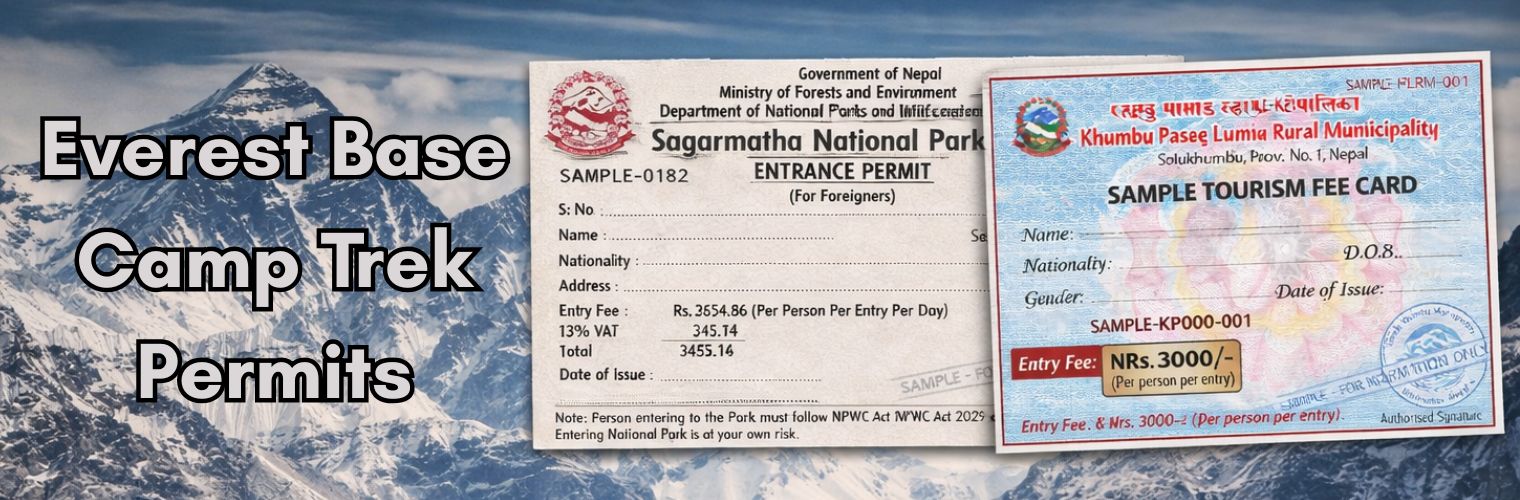
Everest Base Camp Trek Permit
Whether you are from the USA, the UK, Europe or any other country, one question matters before flights, packing, or training: do you need a permit for Everest Base Camp?
The answer is yes. Every trekker must carry official permits to enter the Everest region because the trail passes through Sagarmatha National Park and the Khumbu Pasang Lhamu Rural Municipality. These permits are mandatory, checked along the route, and required regardless of whether you are trekking independently or with an agency.
This guide explains which Everest Base Camp trek permits are required, how much they cost, where to get them, and why they exist, so you can plan your trek without confusion.
Quick Summary
- Everest Base Camp trekking requires multiple permits covering national park and local administrative regions.
- Permit costs vary by nationality and directly support conservation efforts and local community development.
- Sagarmatha National Park and Khumbu municipality permits are mandatory for all trekkers in the Everest region.
- Permits are checked at Lukla, Monjo, and additional internal checkpoints along the Everest trail.
- Carrying physical copies of permits is essential to continue trekking legally in the Everest region.
Do You Need a Permit for the Everest Base Camp Trek?
Yes. All trekkers need permits to trek to Everest Base Camp.
The requirement applies whether you are doing the classic Everest Base Camp Trek, combining routes such as Everest Base Camp via Gokyo Lake , returning by air on the Everest Base Camp Trek with Helicopter Return , or attempting longer and more demanding itineraries like the Everest Three High Passes Trek.
Permits are region-based, not itinerary-based. As long as you are trekking in the Everest region, the same permit framework applies.
Why Are Permits Required for the Everest Base Camp Trek?
1. Legal requirement under Nepal law
Under Nepal’s National Parks and Wildlife Conservation Act, entry into any national park requires an official permit. Since the Everest Base Camp trail enters Sagarmatha National Park, carrying a valid permit is a legal obligation, not a discretionary rule.
2. Conservation of Sagarmatha National Park
Sagarmatha National Park is a UNESCO World Heritage Site and one of the world’s highest protected areas. Permits allow authorities to regulate access, monitor visitor movement, and manage tourism impact in a fragile alpine environment where trail erosion, waste management, and ecosystem protection are constant concerns.
Why are permits of Everest Base Camp trek checked multiple times
Trekkers encounter several checkpoints because the trail crosses:
- Protected-area jurisdiction (Sagarmatha National Park)
- Local administrative jurisdiction (Khumbu Pasang Lhamu Rural Municipality)
Each authority manages a different responsibility, which is why multiple permits are required and verified throughout the trek.
Where Does the Everest Base Camp Permit Fee Go?
Permit fees support both conservation and local communities.
According to Sagarmatha National Park’s management framework, a significant portion of park revenue is allocated to buffer-zone programs, including:
- Conservation and biodiversity protection
- Community development projects in Khumbu villages
- Income generation and skill development
- Conservation education
- Park staffing and administration
While year-by-year spending is not published as a single itemized statement, permits are a primary mechanism that keeps trails maintained, checkpoints staffed, and conservation programs functioning in one of the world’s most demanding trekking environments.
Ready for your next Himalayan adventure?
Talk to our local experts and plan a safe adventure.
+977 9813322433
Call / WhatsApp
Why Does Everest Base Camp Permit Cost Differ by Nationality?
Permit costs differ for foreigners, SAARC nationals, and Nepali citizens under Nepal’s protected-area fee policy.
In simple terms:
- Nepali citizens contribute to conservation through national systems and local participation, so fees are minimal.
- International trekkers pay higher fees under a user-pays conservation model, a structure also used in national parks in the USA, UK, Europe, and other regions.
- SAARC nationals fall under a reduced regional fee category.
This approach allows international tourism to directly fund conservation and local development without shifting the financial burden onto local communities.
Required Permits for Everest Base Camp Trek
In practical terms, permits are issued by two separate authorities and, depending on your approach route, sometimes a third. Each permit applies to a specific region, is issued at a specific location, and is checked at specific points along the trail.
Understanding this structure helps you avoid last-minute surprises. Here is the details on both of these permits:
1. Sagarmatha National Park Entry Permit
The Sagarmatha National Park Entry Permit is the primary and unavoidable permit for the Everest Base Camp trek. It is required because the standard EBC route enters Sagarmatha National Park, a legally protected area and UNESCO World Heritage Site.
Who issues this permit?
This permit is issued by Nepal’s protected-area authority under the Department of National Parks and Wildlife Conservation, with processing handled through official government counters.
Where do you get it?
You can obtain this permit:
- At the Kathmandu Tourist Service Center (Bhrikutimandap) before the trek, or
- At the park entry checkpoint in Monjo, if you are already en route
Most trekkers flying in from overseas choose to get it in Kathmandu to avoid queues and delays on the trail.
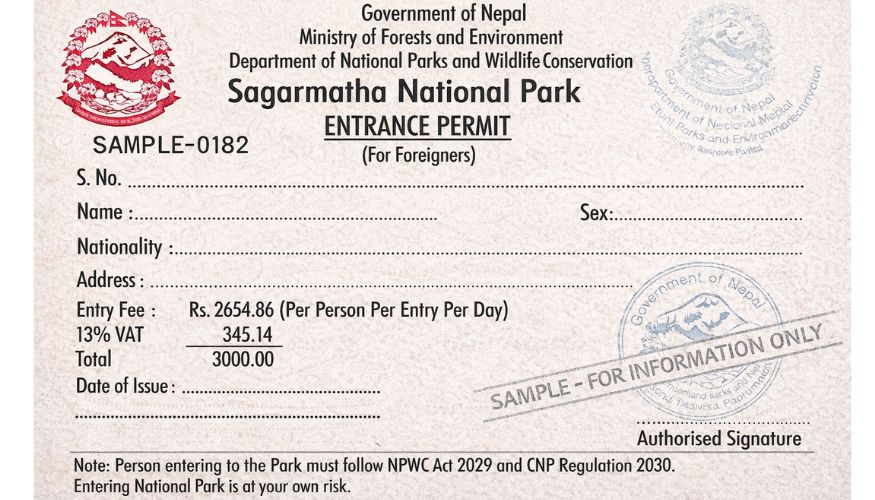
Which region does it cover?
This permit covers entry into Sagarmatha National Park, starting from Monjo and extending throughout the upper Khumbu region, including Namche Bazaar, Tengboche, Dingboche, Lobuche, Gorak Shep, and Everest Base Camp itself.
Where is it checked?
- At Monjo, the official Sagarmatha National Park entrance
- Occasionally at internal checkpoints inside the park
You must carry the physical permit at all times once inside the park.
Sagarmatha National Park Entry Permit Cost (per person, per entry)
| Nationals | Cost (per person, per entry) |
|---|---|
| Foreign nationals | NPR 3,000 |
| SAARC nationals | NPR 1,500 |
| Nepali citizens | NPR 100 |
| Children under 10 years | Free |
This same permit applies not only to the Everest Base Camp route, but also to treks such as the Everest View Trek and the Gokyo Lake Trek, since they fall within the same national park boundary.
2. Khumbu Pasang Lhamu Rural Municipality Permit (Trek-Card)
The Khumbu Pasang Lhamu Rural Municipality Permit, commonly referred to as the Trek-Card, is a local entry and registration permit introduced by the Khumbu local government.
This permit is separate from the national park permit and is mandatory for all trekkers entering the Khumbu region.
Who issues this permit?
It is issued directly by the Khumbu Pasang Lhamu Rural Municipality, the local administrative authority governing the Everest region villages.
Where do you get it?
This permit is not issued in Kathmandu. It is obtained only at the Tourist Information Centres in Lukla, shortly after you land.
This is why trekkers flying into Lukla cannot complete all permit formalities in Kathmandu alone.
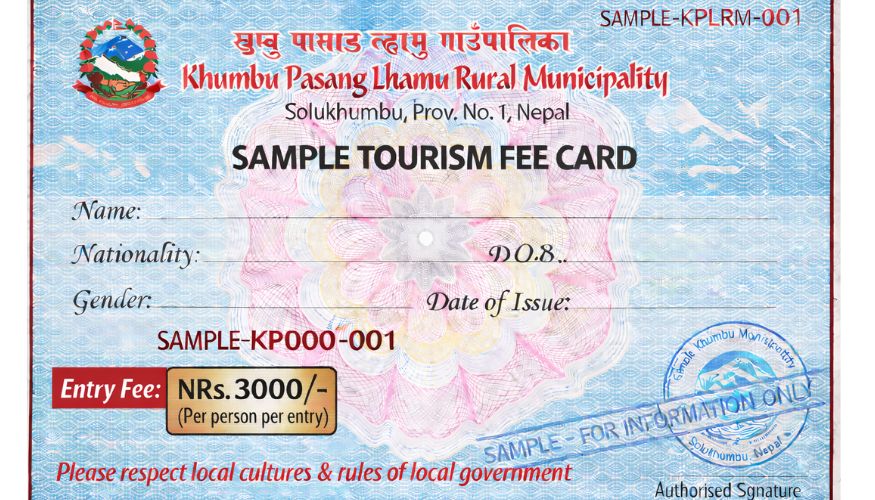
Which region does it cover?
The Trek-Card applies to the entire Khumbu administrative area, including Lukla airport, Phakding, Namche Bazaar, and all settlements beyond.
Where is it checked?
- At Lukla, shortly after arrival
- At multiple checkpoints along the Khumbu trail, often before Namche Bazaar
Trekkers are expected to carry this permit throughout the trek.
Khumbu Pasang Lhamu Rural Municipality Permit Cost (per person)
| Nationals | Cost (per person, per entry) |
|---|---|
| Foreign nationals (non-SAARC) | NPR 3,000 |
| SAARC nationals and Chinese citizens | NPR 2,000 |
The municipality does not publicly list a separate Trek-Card fee for Nepali citizens.
3. Additional Permit for Trekking via the Jiri Route (Gaurishankar Conservation Area)
Trekkers who approach Everest Base Camp via the traditional Jiri route must obtain an additional permit because this approach passes through a different protected area before entering the Everest region.
Who issues this permit
The Gaurishankar Conservation Area Permit is issued under Nepal’s protected-area system, similar to national park permits.
Where you get it
This permit can be obtained:
- At the Kathmandu Tourist Service Center, or
- At designated entry points to the conservation area
Which region does it covers
This permit applies only to the Gaurishankar Conservation Area, which lies between Jiri and the Everest region. Once you exit this area and enter Sagarmatha National Park, the Sagarmatha permit becomes mandatory.
Where it is checked
At the Gaurishankar Conservation Area entry checkpoints
Gaurishankar Conservation Area Cost (per person, per entry)
| Category | Cost (per person, per entry) |
|---|---|
| Foreign nationals | NPR 3,000 |
| SAARC nationals | NPR 1,000 |
| Nepali citizens | NPR 100 |
| Children under 10 years | Free |
This permit is required only if your trekking route passes through Gaurishankar, including certain approaches linked with routes such as Pikey Peak trek.
Everest Base Camp Trek Permit Cost Table
| Permit | Foreigners | SAARC | Nepali | Issued At | Coverage |
|---|---|---|---|---|---|
| Sagarmatha National Park Entry Permit | NPR 3,000 ($30) | NPR 1,500 | NPR 100 | Kathmandu or Monjo | Sagarmatha National Park (Monjo to EBC) |
| Khumbu Pasang Lhamu RM Trek-Card | NPR 3,000 ($30) | NPR 2,000 | NPR 100 | Lukla | Khumbu administrative region |
| Gaurishankar Conservation Area Permit (Jiri route) | NPR 3,000 ($30) | NPR 1,000 | NPR 100 | Kathmandu or the entry point | Gaurishankar Conservation Area |
Permit fees are only one component of the total trekking budget. Flights, accommodation, guides, porters, food, and seasonal logistics all play a role in the overall Everest Base Camp trek cost.
Where and When Are Permits Checked on the Trail?
Permit checks are an active part of trekking in the Everest region, not a one-time formality.
You should expect checks:
- Immediately after landing in Lukla (local municipality registration)
- At Monjo, the official Sagarmatha National Park entrance
- At internal checkpoints within the park and the Khumbu region
Trekkers must carry physical copies of all permits. Failure to present valid permits can result in being stopped from continuing the trek until documentation is verified.
Because most international trekkers enter the region by flying from Kathmandu or via Ramechhap during peak seasons, permit checks are closely linked with flight routes and seasonal logistics.
Is a TIMS Card Required for Everest Base Camp Trek?
Nepal Tourism Board’s revised TIMS guidance (effective March 31, 2023) lists the Everest region under routes intended to be trekked with a licensed guide and an agency-issued TIMS card.
In practice:
- Sagarmatha National Park permit and Khumbu Trek-Card are mandatory
- Trekkers using an agency typically have TIMS arranged as part of the service
- Independent trekkers should verify the latest requirements before arrival, as enforcement can vary
This distinction is especially important for first-time trekkers planning their journey through the Everest Base Camp Trek.
Guide Requirement For Everest Base Camp Trek
According to Nepal Tourism Board policy, trekking routes such as Everest Base Camp are intended to be done with a licensed guide.
Many trekkers choose to hire a guide and Porter for the Everest Base Camp Trek not only for compliance but also for navigation, safety, and altitude management.
Furthermore, with the help of a trekking agency like ours, you can get detailed instructions on how to prepare for Everest Base Camp, which increases your chances of completing EBC drastically.
Practical Planning Notes for International Trekkers
Most trekkers reach the Everest region by flying into Lukla, either directly from Kathmandu or via Ramechhap during peak seasons. Ground transfers between Kathmandu and Ramechhap are common when flights are redirected due to weather or congestion.
Permits, flights, packing, and seasonal timing are closely connected. Understanding the Best Time for the Everest Base Camp Trek helps align permit planning with weather windows and flight reliability.
Packing also plays a role, as permits and documents are checked alongside basic readiness at checkpoints. Many trekkers prepare using detailed gear guidance, such as What to Pack for Everest Base Camp Trek.
In fact, if you are a content creator, then the packing list for you folks will be different in comparison to normal trekkers.
So, What You Need To Remember About Everest Base Camp Trek Permit?
Everest Base Camp trek permits are not optional paperwork. They are a legal requirement, a conservation tool, and a local support mechanism that keeps trekking in the Everest region sustainable.
Whether you are travelling from North America, Europe, Japan, or South Asia, understanding permit requirements early allows you to plan costs accurately, avoid delays, and trek responsibly in one of the world’s most extraordinary mountain environments.
FAQs
Can I apply for Everest Base Camp trek permits online before arriving in Nepal?
No. Everest Base Camp trek permits are not issued online. All permits must be obtained in person in Nepal, either in Kathmandu or at official checkpoints such as Lukla or Monjo.
Do I need separate permits if I exit and re-enter the Everest region during the trek?
Yes. Most permits are issued per entry, not for unlimited access. If you exit the region and re-enter, you may be required to obtain permits again, depending on where you exit and re-enter.
Are Everest Base Camp trek permits refundable if my trek is canceled?
No. Permit fees are non-refundable, even if your trek is canceled due to weather, illness, or flight delays. Once issued, permits cannot be refunded or transferred.
Do Everest Base Camp trek permits have an expiration date?
Permits are generally valid for the specific trekking period and entry they are issued for. They are not open-ended and cannot be reused for future treks.
Is a permit required if I only trek part of the Everest Base Camp route?
Yes. As soon as you enter the Everest region or Sagarmatha National Park, permits are required, even if you do not plan to reach Everest Base Camp itself.
Do helicopter flights to or from Everest Base Camp require trekking permits?
Yes. Even if you fly by helicopter for part of the journey, trekking permits are still required if you land or trek within the Everest region.
Are permits required for children trekking to Everest Base Camp?
Yes. Children also require permits. However, children under 10 years old are exempt from some permit fees, depending on the permit type.
Can someone else collect Everest Base Camp permits on my behalf?
Yes. Trekking agencies or authorized representatives can collect permits for you, provided they have your passport details and required documents.
Do I need additional permits if I include side trips during the Everest Base Camp trek?
It depends on the side trip. Most side routes within the Everest region are covered by the same permits, but entering a different conservation area may require an additional permit.
What happens if permit rules change after I arrive in Nepal?
If permit rules change, trekkers are expected to follow the latest regulations. Trekking agencies and local authorities usually help travellers comply with updated requirements.
Are Everest Base Camp trek permits refundable?
No, once issued, the permits for the Everest Base Camp trek are non-refundable.