Namche Bazar Of Nepal | Location, Population & History
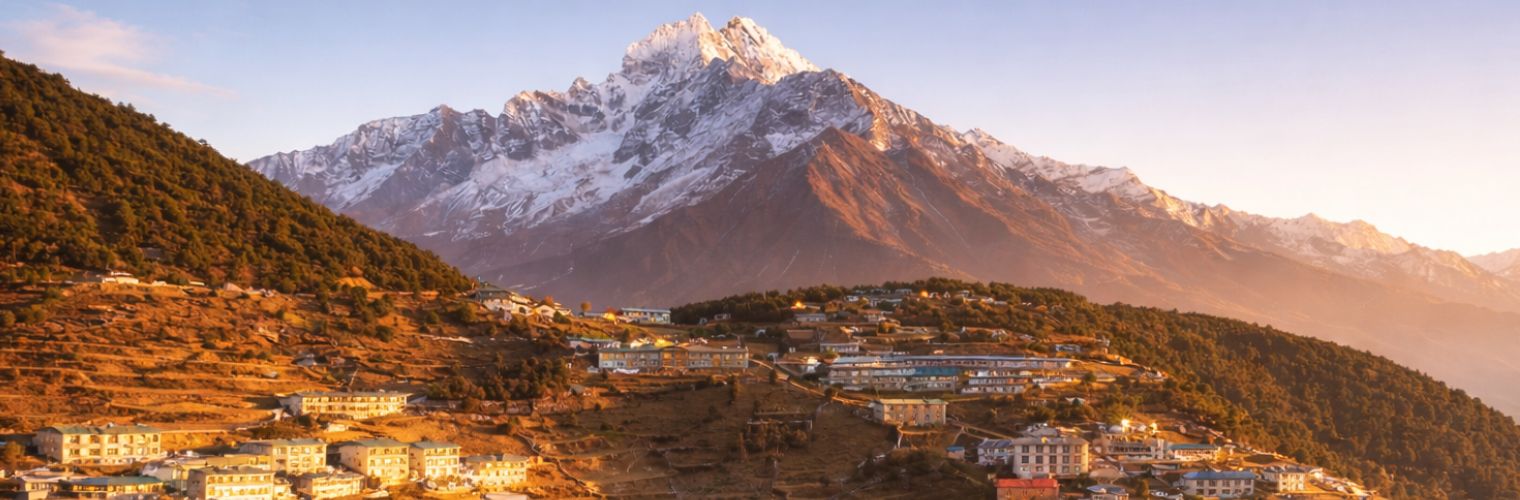
Namche Bazaar, also written as Namche, Namche Bazar, or Namche Bazaar, Nepal, is a Sherpa town in the Everest region of Nepal at about 3,440 meters. On the trail, Nepal Namche is not treated as a sightseeing stop, because this is where altitude, pacing, and logistics begin to shape daily decisions.
In Namche, trekkers acclimatize, reorganize gear, and adjust plans, and because there is no road access, everyone arrives the same way and leaves the same way. The town exists because of trade, yet today it functions because of trekking, and that mix explains its market, its layout, and its pace.
Today, the town functions because of trekking, and this role places Namche at the center of the Everest region trekking routes.
But wait! What does Namche Bazaar actually mean?
Namche Bazaar literally means big dark forest market. This derivation comes from Nauche, the village’s older name, which means “big dark forest.” Although the forest itself is no longer large or dark, a small wooded patch still exists near the monastery area, including the Nauche Gumba on the western edge. The word bazaar means market, which fits the town’s original role.
Quick Summary
- Namche Bazaar sits at an altitude of 3,440 meters in Nepal.
- It is typically reached after a two-day hike from Lukla.
- Most trekkers arrive in Namche Bazaar by mid-afternoon.
- Namche Bazaar serves as the main acclimatization stop on the Everest Base Camp trek.
- Mount Everest is visible from viewpoints located northeast of the town.
Where is Namche Bazaar Located?
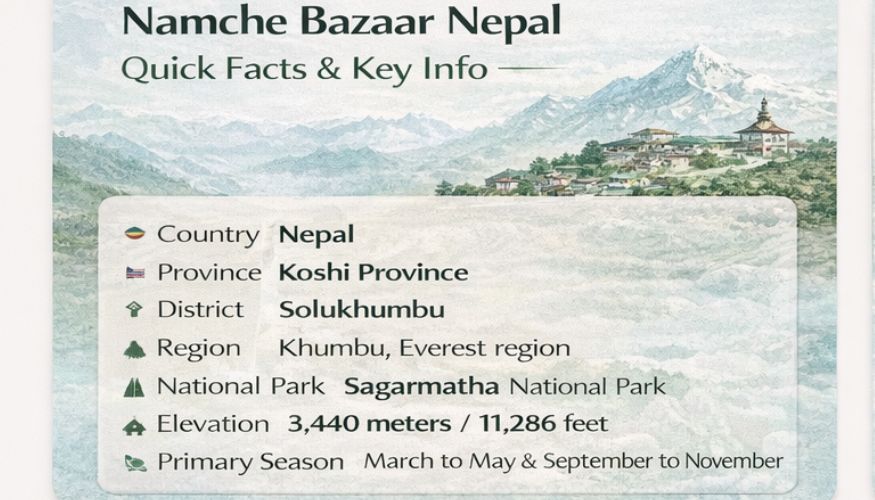
Namche Bazaar is located in northeastern Nepal, inside the Solukhumbu Namche Bazaar area of Solukhumbu District, Koshi Province. It sits at the junction of the Dudh Koshi and Bhote Koshi river valleys, and it lies within the buffer zone of Sagarmatha National Park.
| Location detail | Information |
| Country | Nepal |
| Province | Koshi Province |
| District | Solukhumbu |
| Region | Khumbu, Everest region |
| National Park | Sagarmatha National Park |
| Elevation | 3,440 meters |
| Terrain | Amphitheater-shaped hillside |
There is no road access to namche nepal, so all supplies reach the town by air to Lukla and then by porter or mule. Because Namche lies inside Sagarmatha National Park, all trekkers passing through must already hold a valid Everest Base Camp trek permit.
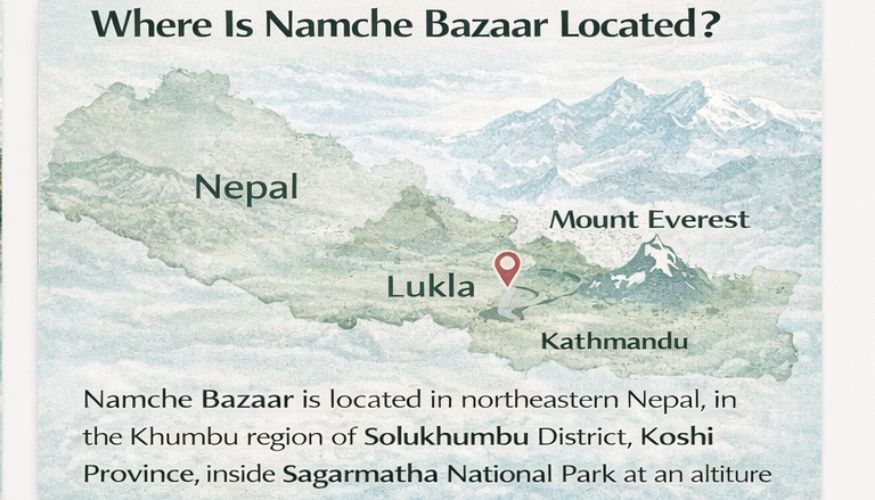
Namche Bazaar in the Map of Nepal
On a map of Nepal, Namche Bazaar appears northeast of Kathmandu and southwest of the Everest massif, close to the Tibet border. Its exact geographic position is 27.8053° N latitude and 86.7106° E longitude.
On any Namche Bazaar Nepal map, the settlement is clearly visible at the point where a narrow river valley suddenly opens into a natural bowl, which is why Namche developed as the main trading and acclimatization hub of the Khumbu region.
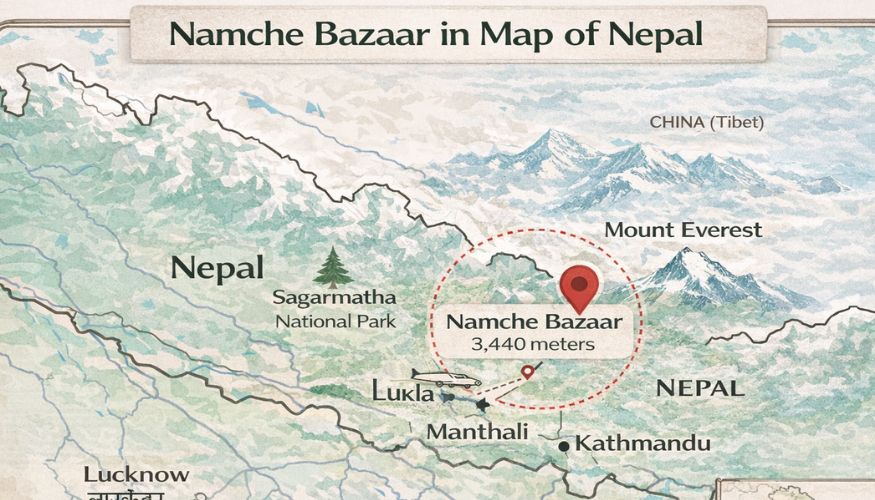
The standard route that places Namche on the map stays consistent:
- Travel from Kathmandu, or by road to Manthali during flight diversion season, then take the Kathmandu to Lukla or Ramechhap to Lukla flight.
- From Lukla, the trail begins immediately after landing at Lukla Airport, with no road access beyond this point.
- From Phakding or Monjo, climb to Namche Bazaar on day two.
During peak seasons, going to Lukla often means taking a bus, jeep, or Hiace from Kathmandu to Manthali via Ramechhap before flying onward.
Although this approach is often described as a two-day hike, the second day is significantly harder. The final ascent from the Dudh Koshi river junction gains around 800 meters of elevation in a short distance, making it one of the most physically demanding climbs of the early Everest Base Camp trek.
Namche Bazaar Population
Namche bazaar population is smaller than many people expect, yet it feels large during trekking season.
Back in 2001, the population of Namche Bazaar was just around 1600. In fact, in 2015, the population decreased down to 1,271. But in recent years, we can see the increase in settlements, and thus the current population of Namche Bazaar is around 1,500.
| Population type | Approximate number |
| Permanent residents in Namche | 1500 |
| Khumbu Pasang Lhamu Rural Municipality | 8700 |
| Peak season daily population | Hundreds to nearly 1,000 |
Because lodges fill quickly, and because guides and porters stay overnight, the town feels crowded even though the permanent population is modest. This directly affects room availability, dining space, and service speed during peak months.
For people new to high-altitude trekking, especially those reading an Everest Base Camp trek for beginners guide, this crowding often feels more intense than expected.
In addition, seasonal crowding influences accommodation prices, which directly ties into the overall Everest Base Camp trek cost.
Namche Bazaar History and Earthquake
Namche bazaar history began as a trade center long before trekking existed. Sherpa traders moved salt, wool, and yak products south, while rice, tea, and sugar moved north. Because trade happened weekly, a market tradition formed and stayed.
After the 1953 Everest ascent, tourism slowly replaced trade. Lodges expanded, bakeries appeared, and Namche became the administrative and commercial center of the Khumbu.
2015 earthquake’s impact on Namche Bazaar remains part of the town’s story. The 2015 earthquake damaged many stone buildings and trails, and rebuilding took years. Most reconstruction is now complete, and newer structures are earthquake-resistant, which changes how the town looks today.
Why Namche Bazaar Is Called the Gateway to Everest
The phrase “Namche Bazaar: Being Everest Gateway“ is practical.
At 3,440 meters, Namche is where many people first feel breathlessness, lighter sleep, and appetite changes, and because of that, an acclimatization day becomes necessary. It is also the last major settlement with full amenities before higher villages.
That is why almost every itinerary includes two nights here, and why late arrivals worry about room shortages during peak season.
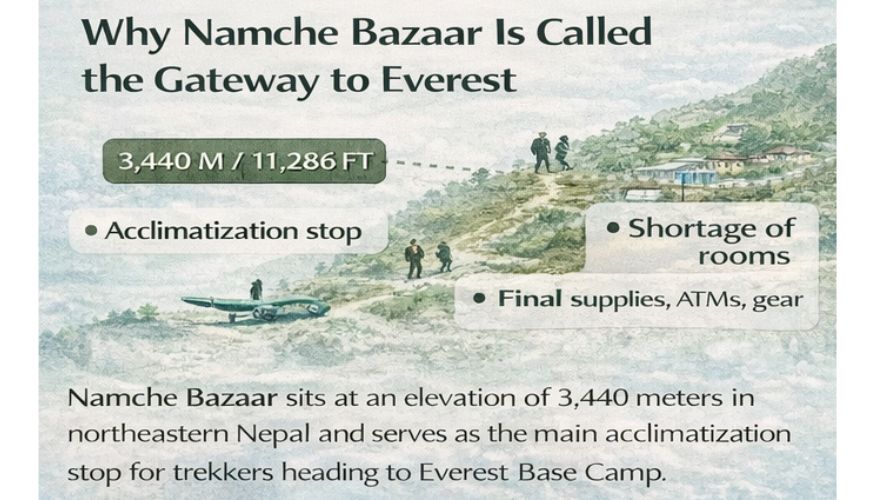
Be it Everest Base Camp, Gokyo Lake, or the Three High Passes, one needs to spend some time here. In fact, even in short itineraries like the short Everest base camp or Pikey Peak, a day of acclimatization is kept in this unique place.
Besides that, Namche is also where trekkers begin applying what they learned while planning and preparing for Everest Base Camp, rather than pushing too hard.
The Market, Shops, and Shopping Experience
The Namche Bazaar market takes place every Saturday morning and starts early. Traders arrive from villages like Khumjung, Kunde, and Thame, and by mid-afternoon, the stalls thin out.
Fresh vegetables, yak cheese, butter, dried meat, wool products, and household goods dominate. Locals shop with purpose, while trekkers mostly observe.
Namche bazaar shops exist because gear fails and plans change.
| Shop type | What usually happens |
| Gear shops | Emergency replacements |
| Pharmacies | Altitude medication and basics |
| Groceries | Snacks and energy food |
| Bakeries | Calories and rest |
| ATMs | Often unreliable |
Namche bazaar shopping often comes with regret, because many people realize they did not buy enough socks or rent a down jacket earlier, and prices here are higher. This often means that their Everest Base Camp packing list was incomplete.
Then, at the time of returning, this becomes a sort of souvenir that travellers can take back home.
One such gift is Namche Bazaar incense, particularly juniper incense, which is common across the Everest region for religious use, yet it should not be treated as a unique market specialty without local confirmation.
Besides that, upon returning, travellers often spend some time at the Namche Bazaar Irish Pub, officially known as the Irish Pub Namche Bazaar Nepal. It was opened back in 2011 and is known for its altitude. We recommend that you visit this pub only during the descent, as during the ascent, alcohol worsens headaches and slows acclimatization, which directly increases the risk of altitude sickness during the Everest Base Camp trek.
Namche Bazaar Stupa and Cultural Landmarks
During the acclimatization walks, there are many stupas and religious landmarks that embodies the local culture of Namche Bazaar.
Inside Namche Bazaar, you can find places like:
- Namche Monastery, founded in 1905, is the only monastery within the settlement.
- The main entrance stupa and water-powered prayer wheels mark arrival into town.
- The Pemba Doma memorial pagoda sits near the lotus pond and shrine area.
Note: While going through some sources, you might find them mentioning Namche Bazaar Stupa or Namche VDC. You don’t need to be confused about that, as Namche VDC is just an outdated administrative term.
Within acclimatization reach, you can visit:
- The Hillary Memorial Chortens lie on the loop toward Khumjung
- Everest View Hotel is often missed, although it offers a strong Everest backdrop.
Can You See Everest from Namche Bazaar?
Seeing Everest from Namche Bazaar depends on timing and position.
From the center of town, Everest is distant and often blocked. Everest from Namche Bazaar is best seen from viewpoints above the village.
From Namche, Everest lies to the northeast. Ama Dablam dominates the southeastern view, so confusion is common.
What many trekkers expect vs. what actually happens
From inside Namche Bazaar, Mount Everest is not consistently visible. The town sits in a bowl-shaped valley, and surrounding ridges block direct lines of sight. This is why people often say they “missed Everest” despite staying in Namche.
Where the view really works
The best Everest views are from viewpoints above town, not from the main market streets. Short climbs toward Syangboche, the Everest View Hotel ridge, or established lookout points open the skyline. From these higher angles, the peaks line up clearly.
When to look
- Direction: Look northeast
- Time window: 6:00 AM to 9:00 AM
Early morning offers the most reliable visibility before valley clouds and afternoon haze build up.
What do you see if you are lucky?
On a clear morning, Everest appears between Lhotse and Nuptse, often subtle but unmistakable. Without guidance on timing + viewpoint, many trekkers overlook it entirely.
Things To Do in Namche Bazaar (Acclimatization Day Guide)
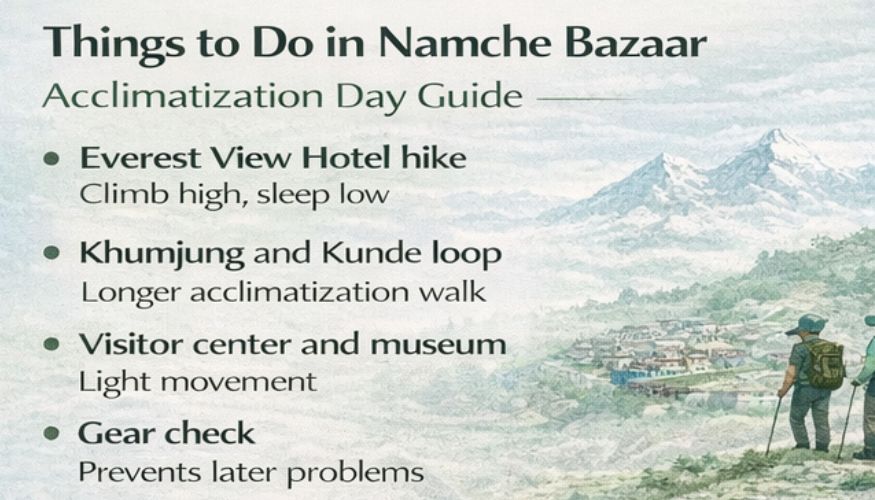
Things to do in Namche Bazaar should support acclimatization, although many people overdo it.
A realistic day follows a simple pattern: climb a little, return, then rest.
| Activity | Why it helps |
| Everest View Hotel hike | Climb high, sleep low |
| Khumjung and Kunde loop | Longer acclimatization walk |
| Visitor center and museum | Light movement |
| Gear check | Prevents later problems |
| Bakery stops | Eating and hydration |
These are things to do in Namche Bazaar, and also the practical answer to what to do in Namche Bazaar. But while roaming around the area, trekkers should never overexert, as this is often one of the main reasons many fail to complete the Everest Base Camp trek, despite feeling strong early on.
Furthermore, a careful gear check should be included in your to-do list in Namche, as the risk of common injuries is reported later on the Everest Base Camp trek.
Namche Bazaar at Night
Namche Bazaar at night becomes quiet by 8 or 9 PM. People gather in lodge dining rooms and then retreat early, because rooms are cold and sleep is already disrupted by altitude.
These small stresses help explain why people later ask whether Everest Base Camp is dangerous, even though the trail itself is non-technical.
Namche Bazaar night view shows lodge lights across the hillside bowl. Room temperatures often drop below freezing, so layers, hydration, and skin care matter.
Best Time to Visit Namche Bazaar
The best time to visit Namche Bazaar depends on visibility and crowd tolerance.
| Season | Months | Conditions |
| Spring | March to May | Clear mornings, busy |
| Autumn | September to November | Best visibility, crowded |
| Monsoon | June to August | Cloudy, flights delayed |
| Winter | December to February | Cold, quiet |
October and April offer the most stable balance, although room rush is common.
FAQ
Where is Namche Bazaar located in Nepal?
In Solukhumbu District, Koshi Province, inside Sagarmatha National Park.
Why is Namche Bazaar famous?
It is the Gateway to Everest and the main acclimatization stop.
Can you see Everest from Namche Bazaar?
Yes, from viewpoints northeast of the village.
What can you do during acclimatization in Namche?
Short hikes, rest, hydration, and gear checks.
Was Namche Bazaar affected by the earthquake?
Yes, the 2015 earthquake caused damage, but rebuilding is complete.